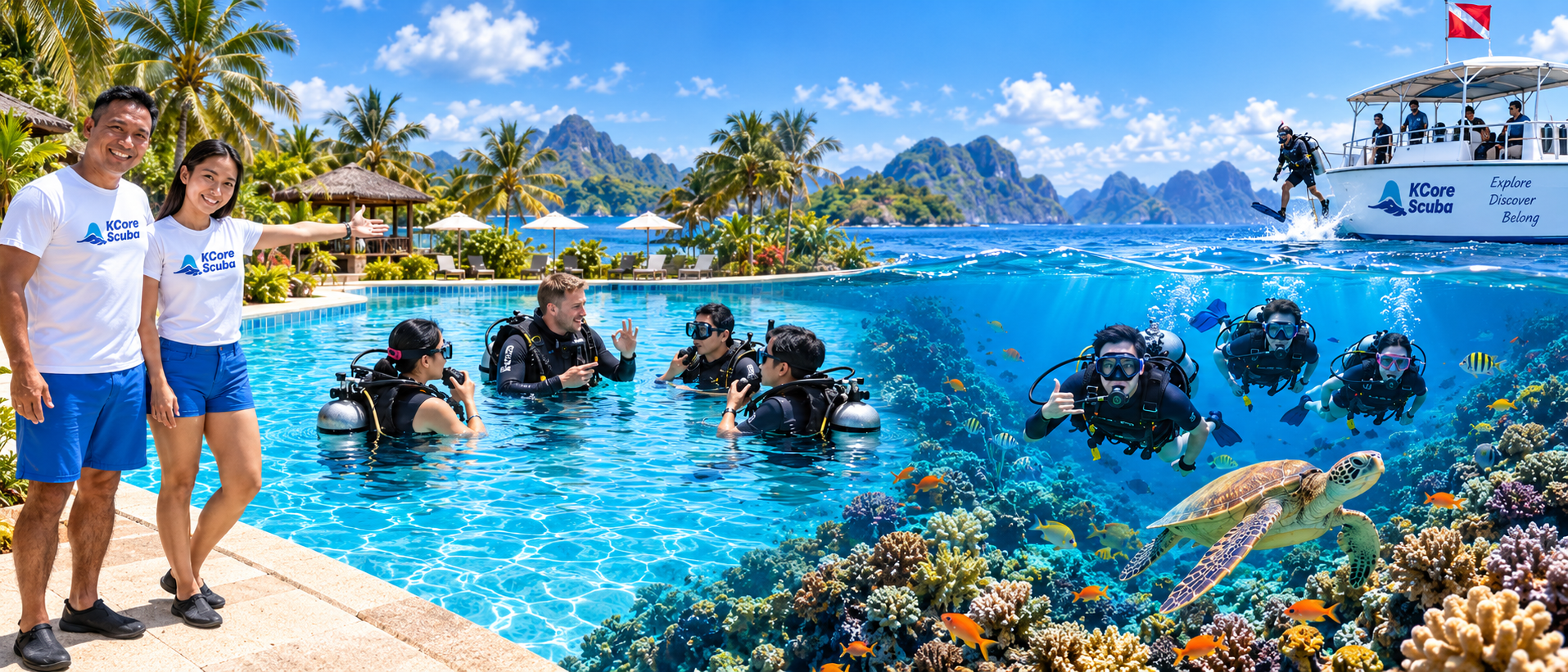
Scuba diving can look complicated from the outside.
Cylinders. Regulators. Gauges. Computers. Buoyancy. Pressure. Hand signals. Strange equipment. New rules.
But the truth is much simpler:
Diving is not nearly as difficult as it may look at first glance.
People of many ages and backgrounds learn to dive successfully. You do not need to be an elite athlete, a competitive swimmer or an underwater superhero.
With basic health, reasonable fitness, appropriate medical suitability and the willingness to learn, scuba diving can become one of the most enjoyable ways to experience our planet.
And you do not need to learn everything at once.
That is where the DiverInterCom KCore approach begins.
We believe that learning works best when you understand what you are doing, experience it yourself and are given enough time to become comfortable.
There is no race. There is no prize for receiving your certification card one day earlier.
The goal is not simply to finish a course. The goal is to become a diver.
Use DiverInterCom KCore Scuba Along Your Diving Journey
Explore before your course. Learn alongside it. Keep discovering afterwards.
DiverInterCom is a free companion to whichever recognised school or agency you choose. Wander through the website, follow what catches your curiosity, and use the videos, articles, games and quizzes to make the knowledge more familiar and enjoyable.
Explore. Watch. Play. Quiz. Discover. Dive. Keep learning.
Have fun — and become a safer, more knowledgeable and more comfortable diver along the way.
Start with the Water
Before scuba equipment comes water.
If you already swim and snorkel confidently, excellent. If you do not, that is also fine. Start there.
You do not need to become an exceptional swimmer. You simply want to become comfortable enough in the water that, when scuba equipment is added later, the environment itself is no longer completely unfamiliar.
And they can be fun from the very beginning. A mask and snorkel can already open a completely new world: fish below you, sunlight moving across the bottom, and a reef you could only see from the beach before.
Check Your Health
Before scuba training, make sure that you are medically suitable to dive.
Scuba exposes the body to increased pressure and affects the ears, sinuses, lungs, circulation and other body systems.
Most reputable training organisations use a medical questionnaire before training begins. Depending on your answers, age, health history, medication or local requirements, you may need a medical examination or clearance from a physician.
This should never be seen as an annoying formality. It is part of safe diving.
Snorkeling - Your First Underwater Door
For many people, snorkeling is the ideal first step.
With these simple tools you can already begin learning how your body behaves in the water. You discover how fins change movement, learn to breathe calmly while your face is submerged, learn to look down instead of forward, and begin to relax.
Most importantly, you begin enjoying the environment before scuba training ever starts. Snorkeling can remain part of your life even after you become a scuba diver.
Optional Step - Apnea / Freediving
Breath-hold diving can be another interesting step. It is optional. You may explore it before scuba, after scuba, years later, or never.
Freediving has its own procedures and risks and should also be learned safely. Never practice prolonged breath holding alone.
Try Scuba
Now comes one of the magical moments: your first breath underwater.
Different organisations may call introductory programs Try Scuba, Discover Scuba Diving, introductory scuba, resort dive or a basic scuba experience. The idea is the same: experience breathing underwater under professional supervision.
Scuba divers normally breathe compressed air - not pure oxygen.
Ordinary breathing air contains roughly 21% oxygen and mostly nitrogen. Later, divers may learn to use other breathing gases such as Nitrox or Trimix. But your normal first scuba cylinder is not an oxygen tank.
Choose a Dive School and Instructor
When you decide that you want to become a certified diver, choose a reputable training centre and instructor.
Later, if you progress into more specialised or technical diving, you may encounter organisations and programs such as TDI, IANTD, GUE, SSI XR, technical CMAS programs and others.
For your first certification, the major recognised systems all aim to teach the fundamental knowledge and skills necessary for safe entry-level scuba diving. The exact course structure and terminology may differ. The fundamentals do not differ dramatically.
The instructor matters too.
Your Open Water Diver Course
The Open Water Diver course, or its equivalent, is the standard first full scuba certification. This is where you learn the foundations.
A typical entry-level program combines theory, confined-water practice, open-water training dives, and demonstration of the required knowledge and skills.
The exact details vary by agency, but the learning journey is very similar.
Learn the Equipment
First you need to understand the tools that allow a human to function underwater.
Each part solves a particular problem. The mask lets you see. The fins help you move efficiently. The exposure suit keeps you warm and changes your buoyancy. The cylinder carries your breathing gas. The regulator reduces high-pressure gas so you can breathe it. The BCD helps you control buoyancy. The computer helps monitor depth, time and decompression status.
You do not need to buy all of this immediately. Most beginners learn using school or rental equipment first.
DiverInterCom KCore Optional Step - Diving History
You do not need diving history to pass an Open Water course. But understanding where scuba came from can make the whole subject much more interesting. Modern scuba equipment did not appear overnight. Divers, inventors, scientists, military organisations, explorers and occasionally some rather crazy pioneers spent generations developing what we now take for granted. History gives context, and context makes learning more memorable.
Learn the Basic Physics
Water changes the rules. Pressure increases with depth. Gas volume changes. Buoyancy changes. Gas becomes denser. Your breathing gas supply behaves differently underwater than it does on land.
Do not worry. You do not need to become a mathematician. The purpose is simply to understand what happens underwater and why.
Learn What Pressure Does to the Human Body
Once you understand some physics, diving medicine begins to make sense.
This may sound serious. It is serious. But understanding these subjects does not make diving frightening. It makes diving easier to manage.
When Physics Meets Medicine
This is where things begin connecting. Pressure is no longer only something from a textbook. You feel it when you equalise your ears. Gas expansion is no longer only Boyle's Law. You understand why you breathe normally during an ascent. Buoyancy is no longer just a definition. You feel yourself rise and fall slightly as you breathe.
Learn it. Experience it. Understand it.
That is one of the central DiverInterCom KCore principles.
Learn to Plan a Dive
Scuba diving is not simply jumping into the water and seeing what happens. Before a dive, you consider:
NDL - No-Decompression Limit
The no-decompression limit describes how long you can remain at depth without requiring mandatory decompression stops according to the decompression model being used. Recreational Open Water diving is normally planned within no-decompression limits.
Planning also means doing a little calculation
During beginner training you will learn the simple calculations and planning methods behind a safe recreational dive: how depth and time affect your no-decompression limit, how surface intervals and repetitive dives change the next dive, and how to estimate whether your available breathing gas is sensible for the plan. Depending on the training system, this may be taught with tables, planning tools, formulas, a dive computer — or a combination of them.
You do not need advanced mathematics. The important part is understanding the relationship between depth, time, gas and limits instead of treating the dive computer as a mysterious black box.
Modern dive computers make much of this easier. But understanding what the computer is calculating remains valuable.
Learn the Skills in the Water
Now comes the practical part. In a pool or suitable confined-water environment you begin putting everything together.
Some skills may feel completely natural. Others may feel strange. That is normal.
Open Water - Now It Becomes Diving
Eventually you leave the pool or confined environment and enter real open water. This is where everything begins to come alive.
And suddenly there may be a moment where you stop thinking about every piece of equipment. You simply float. Your buddy is beside you. A fish swims past. Sunlight comes down through the water.
I am actually diving.
That feeling is difficult to explain until you experience it yourself.
Certification - And the Real Beginning
After completing the required knowledge development, confined-water training and open-water dives, you receive your first scuba certification. Congratulations.
But this is not the end. It is the beginning.
You have demonstrated the required entry-level knowledge and skills to start diving within the limits of your training and experience.
Now: go diving.
Dive - And Have Fun
This part sometimes gets forgotten in training discussions. Scuba diving is supposed to be enjoyable.
Go somewhere beautiful. Dive with friends. Join a cheerful group on a dive boat. Drink coffee while cylinders are being loaded. Talk nonsense with your buddies between dives. Travel. Discover a reef. Watch turtles. Hover beside a wall. See your first octopus. Watch a cuttlefish change colour. Have a curious fish follow you. Float effortlessly above the bottom. Take photographs. Explore. Laugh about the terrible giant stride somebody made. Tell dive stories over dinner.
The certification exists to open the door to all of this.
Gain Experience
After Open Water, do not immediately worry about collecting every certification available. Dive. Repeat. Improve.
Some of the most important learning happens after the instructor has stopped giving you exercises.
Become a More Advanced Recreational Diver
Once you have built some experience, the next logical step for many people is advanced recreational training.
Depending on the program, you may experience deeper recreational diving, navigation, night diving, buoyancy training, drift diving, boat diving, search techniques, underwater photography, wreck orientation and other specialty dives.
The goal should not simply be: I am allowed to go deeper now.
Become a more capable diver.
Discover Wreck Diving
For many recreational divers, wrecks become one of the great highlights of scuba diving.
There is something fascinating about descending through blue water and suddenly seeing the outline of a ship appear below.
Even without entering a wreck, there is often an enormous amount to see: deck structures, propellers, anchors, cargo, machinery, schools of fish, and corals and other organisms gradually turning human engineering into habitat.
Many famous wrecks around the world can be enjoyed by recreational divers without technical diving.
Stress & Rescue
After becoming reasonably comfortable taking care of yourself underwater, another extremely valuable step is learning how to recognise problems involving others.
You learn subjects such as recognising stress, assisting tired divers, responding to panic, missing-diver procedures, surface assistance, towing, helping an unresponsive diver, emergency oxygen and emergency planning.
Rescue training often changes the way a diver sees the whole group. You begin thinking not only: Am I okay? but: Is everybody okay?
Add Nitrox
For many recreational divers, Nitrox is one of the most useful additional qualifications.
Normal air contains approximately 21% oxygen and mostly nitrogen. Nitrox contains a higher percentage of oxygen. Common recreational mixtures include EAN32 and EAN36.
Using Nitrox can reduce nitrogen exposure compared with breathing air at the same depth and can provide longer no-decompression limits on many common recreational profiles. But the increased oxygen percentage also introduces new limits.
A Strong Recreational Diving Foundation
By this point you can have a wonderfully capable recreational diving foundation — one that can take you to reefs, walls, boats, night dives, wrecks and dive holidays around the world.
For many people this is a rich, flexible place to spend years enjoying recreational diving. There is no pressure to turn every holiday into another course — you can simply dive, travel, explore and enjoy.
And if one day you want more, the door stays wide open.
And There Is Always More to Discover
And if you discover that diving has become more than an occasional holiday activity? The road continues almost indefinitely.
The DiverInterCom KCore Scuba Path
Think of the journey as a series of comfortable stages rather than a ladder you have to climb as quickly as possible.
- Health & basic fitness
- Water comfort
- Snorkeling
- Optional apnea
- Try Scuba
- Good school & instructor
- Equipment
- Physics & medicine
- Dive planning & basic calculations
- In-water skills
- Open Water certification
- Gain experience
- Buoyancy & awareness
- Reefs & animals
- Buddies, boats & travel
- Have fun
- Advanced recreational
- Wrecks & other interests
- Stress & Rescue
- Nitrox
- Photography & science
- DPV & sidemount
- Technical & Trimix
- Rebreathers
- Caves, advanced wrecks & more
Your pace. Your interests. Your diving journey.
One Goal
Different divers take different paths. Some people feel completely at home during their first scuba experience. Others need more time. Some begin as excellent swimmers. Others discover the underwater world slowly. Some dream about tropical reefs. Some want to photograph tiny animals. Some become fascinated by wrecks. Some eventually look into caves, Trimix or rebreathers. None of those paths is automatically better.
DiverInterCom KCore Scuba is here to accompany that journey. Before your course. During your course. After your certification.
Whether the card in your wallet eventually says PADI, SSI, SDI, CMAS, NAUI or another recognised organisation, our knowledge is here for you.
Take what helps. Learn at your pace. Ask questions. Experience things yourself. Stay curious. Stay respectful.
Diving is not about how quickly you reach the next level. It is about how much of the underwater world you are able to experience along the way.
Learn. Experience. Understand.
Float. Breathe. Observe.
Enjoy the dive.