KCore Scuba Diving Training Curriculum
Basic Scuba DiverEvolution Forum
Here you will be guided step by step through our KCore Scuba Diver curriculum.
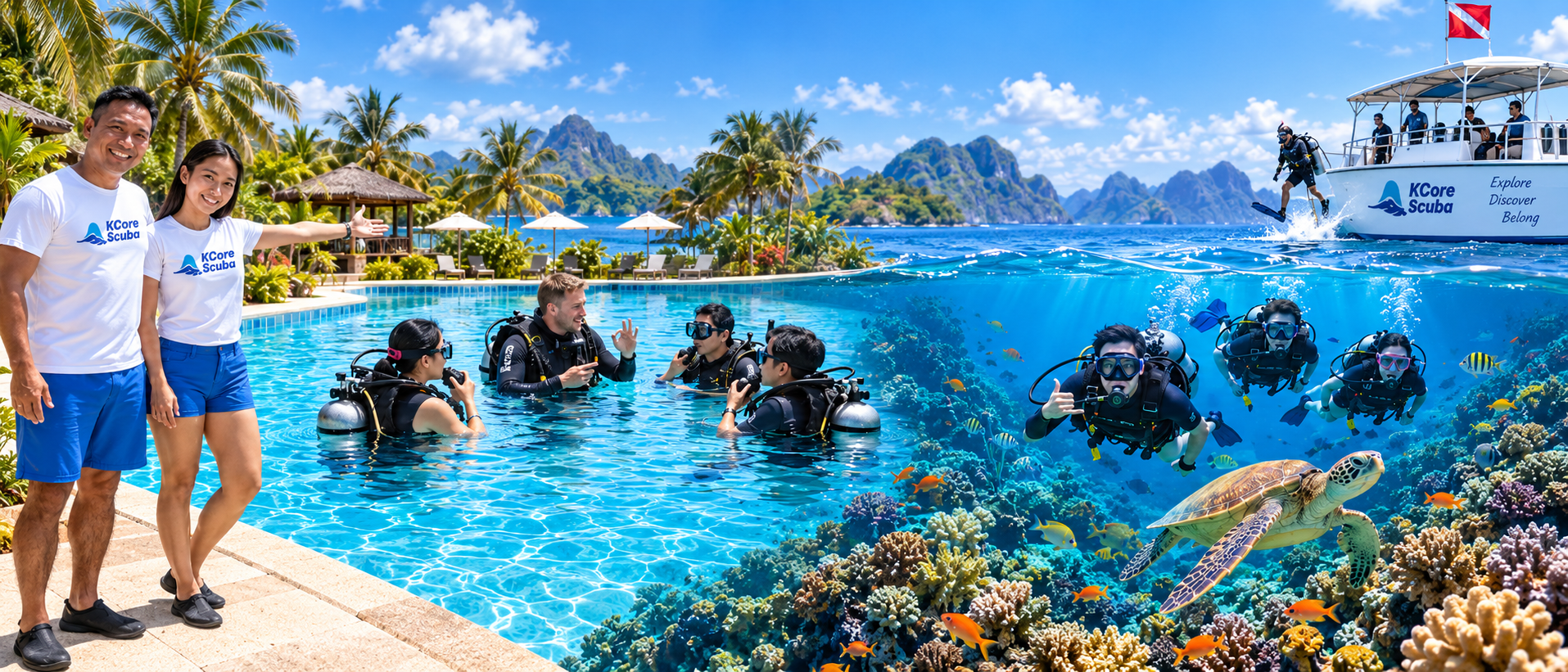
Start simple. Learn at your pace. Discover how much fun the underwater world can be.
Introduction
Welcome to the DiverInterCom KCore Scuba Curriculum
Welcome to the DiverInterCom KCore Scuba curriculum for basic scuba diving training. Depending on your previous experience, dive in wherever you find something interesting, or start right at the beginning.
After checking your medical health status and confirming that you are fit to dive, follow our step-by-step training sections. They introduce the knowledge and skills you need on your journey toward becoming a Basic Open Water Scuba Diver.
Each section includes a short overview and description, together with a related training video. The lessons guide you through the complete learning process, one step at a time.
Get ready to explore the amazing underwater world!
Introduction video
Learn Scuba Diving for Beginners
An introduction to the path toward becoming a scuba diver. This video gives you an overview of the full learning journey and what matters along the way.
▶ Watch introduction videoStep 1 • Getting comfortable in the water
The First Steps — Try Snorkeling
Snorkeling is one of the easiest ways to discover what lies beneath the surface. You do not need much equipment, it is easy to get started, and it is fun! Explore colorful fish and coral reefs in the ocean, or discover the underwater world of lakes and rivers.
Staying safe is important, even when snorkeling. This lesson introduces the basics, practical considerations, and additional equipment that can make your snorkeling adventures more enjoyable and safer.
Snorkeling is also an excellent way to become comfortable in the water at your own pace. You can get used to wearing a mask, looking below the surface, and breathing through a snorkel. As your confidence grows, you can become familiar with gentle waves, currents, and even the movement of the tides. It is a great foundation for learning to scuba dive.

Snorkeling video lesson
The First Steps — Try Snorkeling
Get started with snorkeling: the basics, equipment, confidence in the water, and staying safe.
▶ Watch snorkeling lessonBasic Scuba Diver Course • Chapter 0
Welcome to Your Scuba Diving Course
Welcome to the course! In this introductory chapter, you will learn a little about DiverInterCom KCore Scuba, how the training is structured, and how to make the most of each lesson as you develop the knowledge and confidence to become an underwater explorer with scuba diving equipment.
Course introduction video
Free Scuba Diving Course – Chapter 0 | Introduction & Basic Diver Course Overview
Meet the course, understand the training journey, and discover how to get the most from your scuba diving lessons.
▶ Watch Chapter 0Step 2 • Learn the theory behind diving
The History of Diving
Why did humans first venture beneath the surface, and how did diving develop into what we know today? In this lesson, we explore the history of diving, from its ancient beginnings to the inventions that made longer stays underwater possible.
Follow our curiosity to explore the ocean, gather food and resources, hunt, recover lost objects, and carry out military and salvage operations. Discover how inventors and researchers advanced diving techniques and our understanding of the underwater environment.
From early diving methods to modern equipment and techniques used in recreational diving, scientific research, and underwater construction, this chapter introduces the discoveries, developments, and possibilities that shape diving today.

History and diving theory video
The History of Diving — From Ancient Beginnings to Modern Scuba
Learn how human exploration, invention, and research made diving possible.
▶ Watch Step 2Step 3 • Optional foundation for scuba diving
From Snorkeling to Apnea — Discover Breath-Hold Diving
What happens when you leave the surface and explore underwater on a single breath? It might be a brief duck dive from the surface to photograph a fish, observe a coral, or simply enjoy a closer look. Or you might become interested in breath-hold diving as an activity in its own right.
This section is optional for a basic scuba diving course using a tank and regulator, but it offers another way to connect with the underwater world. Practising simple snorkeling skills and learning about breath-hold diving can help build water confidence, awareness of your limits, and comfort beneath the surface.
Some divers discover a passion for apnea and continue developing their freediving skills. Others may prefer to stay at the surface with a snorkel or try only gentle, shallow duck dives. Either way, the experience can provide a useful foundation for scuba diving.
Safety: Never practise breath-hold diving alone or hyperventilate before a dive. Learn and practise with a trained, attentive buddy and suitable supervision.

Optional breath-hold diving video lesson
From Snorkeling to Apnea
Discover duck diving, breath-hold exploration and how water confidence supports your journey into scuba.
▶ Watch Step 3Step 4 • Essential scuba knowledge
The Scuba Diving Equipment — Know and Understand Your Gear
As scuba divers, we carry compressed breathing gas in a dive cylinder. Our regulator delivers that gas at the pressure we need to breathe comfortably underwater. A mask and fins are basic equipment for seeing clearly and moving through the water.
As we stay underwater longer and explore greater depths, additional equipment helps us remain comfortable and safe. A buoyancy compensator (BCD) provides flotation at the surface and lets us adjust our buoyancy underwater. A diving suit helps protect us and keep us warm.
We also need instruments to monitor depth, time and remaining breathing gas. A dive computer tracks our dive profile, calculates no-decompression limits (NDL) or decompression information, and provides important alerts. Dive lights and other safety equipment support us in different diving conditions.
In this lesson, we take a closer look at the equipment used by a SCUBA diver — someone diving with a self-contained underwater breathing apparatus. What do you need, why do you need it, how does it work, and what should you look for? Understanding your gear is one of the most important foundations of diver training.

Scuba equipment video lesson
The Scuba Diving Equipment
Learn what each piece of equipment does, why you need it, and how to choose and understand your scuba gear.
▶ Watch Step 4Step 5 • Essential scuba theory
Diving Physics — Understanding the Science Behind Safe Diving
Physics is one of the scientific foundations of safe scuba diving. To understand what happens to our bodies and equipment underwater, we first explore what air is made of, what ambient pressure means, and how water pressure increases as we descend.
We take a closer look at the gas laws: what they tell us about pressure, volume, and breathing gases, and why these relationships matter to every diver. We also discover how heat transfers faster in water, why sound travels differently underwater, and how light behaves beneath the surface.
Why do we float, sink, or hover? Archimedes’ principle introduces the science of buoyancy. We also examine how looking through a diving mask changes our perception of size and distance, and why colors gradually disappear as we dive deeper.
Understanding diving physics helps you make sense of your equipment, your environment, and the decisions that keep you safe underwater.

Diving physics video lesson
Diving Physics
Explore pressure, gas laws, buoyancy, temperature, sound, light, and the physics every scuba diver should understand.
▶ Watch Step 5Step 6 • Essential scuba theory
Diving Physiology — Understanding Our Own Body
To dive safely, we need to understand how our bodies work both at the surface and underwater. In this lesson, we explore the circulatory and respiratory systems: the heart, lungs, blood and blood vessels, as well as the muscles and bones that support us as we move through the water.
We take a closer look at the ears, sinuses, lungs and other air-filled spaces in our bodies, and how changing pressure affects them during descent and ascent. We also learn how breathing gases are exchanged and transported through the body, how our metabolism uses oxygen, and what happens to inert gases such as nitrogen during a dive.
What is barotrauma? What is decompression sickness, and why can it occur? Which physical signs and symptoms should divers recognize, and what medical considerations matter before, during and after a dive? These are essential questions for understanding the effects of diving on our bodies.
Basic diving physiology and medical knowledge are fundamental to becoming a safe, informed scuba diver.

Diving physiology video lesson
Understanding Our Own Body
Discover how pressure and breathing gases affect the body, and learn about equalization, gas exchange, barotrauma and decompression sickness.
▶ Watch Step 6Step 7 • Essential scuba theory
When Physics Meets Medicine — DCS, Pressure & Safe Ascent
Diving physics and human physiology come together every time we descend and ascend. As pressure changes, the gases we breathe behave differently, and our bodies respond. Understanding this connection helps us recognize why careful depth control, breathing, and ascent procedures matter.
We explore how nitrogen is absorbed into the body's tissues under pressure and released as pressure decreases. What is decompression sickness (DCS), how can gas bubbles form, and why do dive time, depth, ascent rate, and previous dives influence decompression stress? We also distinguish decompression sickness from pressure-related injuries such as lung overexpansion and other forms of barotrauma.
The lesson connects these principles with practical recreational diving: respecting your no-decompression limits, monitoring your dive computer, ascending slowly and in control, and understanding the purpose of a safety stop. We also introduce warning signs that call for stopping the dive and seeking prompt medical assessment.
Understanding how physics affects the human body is an essential foundation for planning and completing safer dives.

Diving physics and medicine video lesson
When Physics Meets Medicine | DCS, Pressure & Safe Ascent
Discover the relationship between pressure, dissolved gases, decompression sickness, and safe ascent practices.
▶ Watch Step 7Step 8 • Practical lesson • Instructor-supervised confined water
Pool Familiarization & Basic Scuba Skills
Now it's time to take your first steps underwater with scuba equipment. Under the direct supervision of your qualified dive instructor, begin in a swimming pool or suitable clear, calm, shallow confined water. Take your time: the goal is to become comfortable, not to rush through a checklist.
Prepare for Your First Dive
Get familiar with your diving suit. Thicker neoprene can provide noticeable buoyancy, which may feel unfamiliar at first. With your instructor, learn how to select and check the correct amount of weight—enough to descend under control, but not so much that you are overweighted. Assemble your cylinder, BCD and regulator, and practise the equipment and buddy checks before entering the water.
Your First Breaths Underwater
Here comes the exciting part: breathing underwater! Start in a comfortable position where you can easily stand up or be assisted by your instructor. Breathe normally through the regulator, relax and get used to the sensation. When you feel ready, move around a little and begin exploring how your breathing and BCD affect your buoyancy.
Essential Underwater Skills
With your instructor demonstrating and supervising each exercise, practise removing and replacing your regulator, clearing water from it by exhaling or using the purge button, and recovering the regulator when it is out of your mouth. Learn to clear water from your mask. As you grow comfortable, try breathing through your regulator without your mask, opening your eyes underwater if comfortable, then replacing and clearing your mask. Practise operating your BCD inflator and making small, controlled buoyancy adjustments.
Build Confidence, One Skill at a Time
Repeat each skill until it feels familiar before progressing. Then combine the basics: regulator removal and recovery, regulator clearing, breathing without a mask, mask replacement and clearing, and basic buoyancy control. Your instructor will guide the sequence and help you progress at a comfortable pace.
Take your time, breathe continuously, and enjoy discovering how comfortable you can become underwater. These practical skills must be learned in person with a qualified instructor; this page is an overview, not a substitute for supervised training.
Step 9 • Classroom lesson • Dive calculations and planning
Back to the Classroom — Calculations & Dive Planning
How much breathing gas is in your cylinder, and how long will it last? In this lesson, we learn to calculate available gas from cylinder volume and pressure, understand surface air consumption (SAC) and respiratory minute volume (RMV), estimate gas use at depth, and plan appropriate reserves—including provisions for sharing gas with a buddy in an emergency.
Build Your Dive Profile
Every dive has three main phases: descent, time at depth, and ascent. We learn how to plan maximum depth and bottom time, follow appropriate descent and ascent rates, allow for a safety stop, and respect the no-decompression limit (NDL). Dive tables and dive computers help us understand depth and time limits; we also learn how to check and configure the computer before the dive, including the correct breathing-gas setting.
Plan for the Team and Conditions
A good dive plan considers more than numbers. Check weather, visibility, currents, water temperature, entry and exit points, and team experience. Agree on buddy communication, gas checks, turn and ascent criteria, and emergency procedures before entering the water. Know what to do if conditions change or a diver needs assistance.
Think Beyond a Single Dive
Surface intervals and repetitive dives affect our remaining NDL and decompression exposure. We introduce dive-table concepts, no-decompression versus decompression planning, altitude-diving considerations, and flying after diving. Understanding these factors helps you make informed decisions for the full diving day—not just one dive.
Plan the dive, dive the plan—and be ready to adjust or end the dive when the real conditions require it.
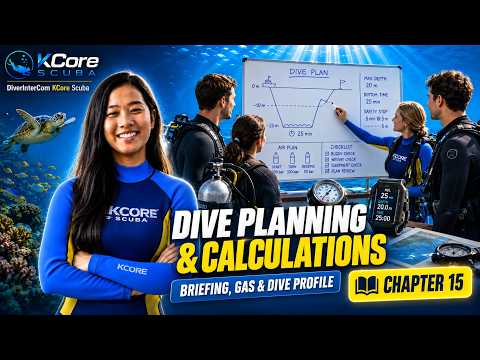
Calculations & Dive Planning — Video Lesson
From cylinder gas supply and SAC/RMV to NDL, ascent planning, reserves, dive computers and repetitive dives.
▶ Watch Step 9Step 10 • Practical lesson • Pre-dive preparation and underwater skills
Pre-Dive Preparation & Underwater Skills
Now it is time to bring together the knowledge and practical skills you have learned. A successful dive starts before entering the water, with careful preparation, a clear dive plan, and good teamwork.
Preparing for the Dive
We begin with the dive briefing: understand the dive site, planned depth and time, entry and exit points, underwater conditions, hand signals, and emergency procedures. Choose your buddy, agree on your responsibilities, and prepare your scuba equipment.
Check that everything fits and functions correctly. Inspect your cylinder pressure, regulator, BCD, weights, instruments and dive computer. Perform your self-check and buddy check before entering the water.
Practising Essential Underwater Skills
Under your instructor's supervision, review the fundamental techniques that every scuba diver should develop:
- Controlled descent and ascent, including equalization and safety stops.
- Calm, continuous breathing and comfortable movement underwater.
- Regulator recovery and clearing, mask clearing, and breathing without a mask.
- Monitoring breathing gas, depth, dive time, and computer information.
- Maintaining neutral buoyancy and communicating with your buddy.
- Practising alternate-air-source sharing and appropriate emergency procedures.
Building Confidence Through Practice
These skills become easier and more natural with repetition. Your instructor will demonstrate and explain each exercise, then guide you through practising and combining the techniques.
Good preparation and familiar skills help you become a calmer, more confident, and competent underwater explorer.
Pre-Dive Preparation & Underwater Skills — Video Lesson
From the dive briefing, equipment and buddy checks to controlled descents, breathing, regulator and mask skills, buoyancy, communication, and emergency practice.
▶ Watch Step 10Step 11 • Practical lesson • Open water dives
Your First Open Water Dives
Together with your dive buddy and under the direct supervision of your instructor, you are now ready to begin your first open water scuba dives. Start shallow, take your time, and progress to greater depths gradually as your skills and confidence develop. Feeling comfortable means being able to demonstrate the basic skills calmly and competently at your current depth—not simply reaching a deeper number.
Find Your Balance Underwater
Practise good trim and buoyancy control as you become familiar with the three-dimensional freedom of movement underwater. Enjoy the feeling of floating and hovering while continuing to refine your breathing and finning techniques.
Dive With Awareness
Follow your agreed dive plan and practise the skills your instructor assigns. Regularly check your depth, dive time, remaining gas and no-decompression information. Stay aware of your surroundings and your buddy throughout the dive. As you gain confidence, begin observing the fish, plants, corals and other underwater life around you without disturbing them.
Complete the Dive Safely
Manage your ascent rate carefully, stay with your buddy and complete a safety stop when appropriate and conditions allow. Surface together, then finish with a dive debriefing: discuss what went well, what you learned and what to practise next.
After the Dive
Care for your equipment after the dive. Following the manufacturer's procedures, rinse your regulator and other dive equipment with fresh water, clean and dry the gear, and check it before storing it. Finally, record your depth, time, conditions, equipment and experiences in your dive logbook.
Take your time, build confidence at each depth, and enjoy becoming an underwater explorer.
Step 12 • A closer look at NDL time and decompression theory
Understanding NDL Time & Decompression
How long can we stay underwater at a given depth, and why does that time change as we dive deeper? In this lesson, we take a closer look at the no-decompression limit (NDL), the principles behind decompression and how they influence recreational dive planning.
What Happens to Breathing Gases Under Pressure?
As we descend, increasing pressure causes more inert gas, mainly nitrogen when breathing air, to dissolve into our tissues. During ascent, the pressure decreases and dissolved gas can be released. Depth, time and our previous dives all influence this process. Every dive involves decompression, even when no mandatory decompression stops are required.
Understanding the No-Decompression Limit
The NDL helps recreational divers plan an ascent without mandatory decompression stops according to the selected dive table or computer model. We explore why the available NDL becomes shorter at greater depths, how multilevel diving changes the picture, and why surface intervals and repetitive dives matter.
From NDL to Decompression Theory
What is the difference between a recommended safety stop and a required decompression stop? How do dive computers estimate tissue loading and remaining NDL? We introduce decompression models and the reason controlled ascents and conservative dive planning are important. For basic scuba training, the goal is to understand and respect the NDL—not to plan mandatory decompression dives.
Understand your NDL, monitor your computer and gas supply, and plan a controlled ascent with your buddy.
A Closer Look at NDL Time and Decompression Theory — Video Lesson
Discover the principles behind no-decompression limits, gas absorption and release, and a controlled ascent.
▶ Watch Step 12Explore More with DiverInterCom KCore Scuba
Want to know more? Read our DiverInterCom KCore Scuba article on Decompression Theory for a deeper explanation.
Then take a look at our Dive Decompression Simulator & Calculator Fun Playground to explore the concepts interactively. The tools are educational, not for planning real dives.
Step 13 • Practical lesson — Explore as an Open Water Diver
Your Underwater Adventures Begin
You are now ready to explore the underwater world as a certified Open Water Scuba Diver! You have learned the basics, developed competence in essential underwater skills, and gained the knowledge to plan and execute a dive. Now it is time to explore, build experience, and collect wonderful memories.
Explore and Gain Experience
Together with your dive buddy, dive guide, or instructor, enjoy new dives and discover different underwater environments. You might experience a night dive, try shore or boat entries, learn about diving in currents, or gradually explore deeper sites as your experience grows.
Keep Practising Your Skills
Every dive is another opportunity to improve your buoyancy, trim, navigation, gas awareness, teamwork, and confidence. Keep practising the skills you have learned, and stay in your confidential and certified range.
Discover New Interests
As you gain experience, you may wish to deepen particular skills and knowledge. Perfect buoyancy, underwater navigation, and deep diving are examples of subjects you can explore when they interest you and fit your experience.
Keep diving, keep learning, gain experience, and collect some awesome underwater memories!
Step 14 • Stay Longer, Not Deeper — Nitrox / Enriched Air
Stay Longer, Not Deeper — Discover Nitrox
Want to spend more time exploring a reef while remaining within your no-decompression limits? Enriched Air Nitrox (EAN), sometimes called Safe Air, contains more oxygen and less nitrogen than ordinary air. At suitable depths, breathing less nitrogen can extend your available no-decompression time compared with air. Nitrox is for staying longer at an appropriate depth — not for going deeper.
What Changes When We Dive With Nitrox?
As the oxygen fraction increases, the nitrogen fraction decreases. We learn how this affects gas exposure and dive planning, and introduce new terms: Maximum Operating Depth (MOD), Equivalent Air Depth (EAD), oxygen partial pressure (ppO₂), Central Nervous System (CNS) oxygen exposure and Oxygen Tolerance Units (OTU). The higher oxygen content also imposes a shallower maximum operating depth for a chosen oxygen partial-pressure limit.
Plan, Analyze and Check Your Gas
Nitrox is commonly offered at dive resorts and holiday destinations. Before every dive, confirm the breathing-gas mixture, analyze the cylinder's oxygen content, check its MOD against your planned depth, and set your dive computer to the correct oxygen percentage and settings. Learn how oxygen exposure accumulates over time and how to respect both NDL and gas-supply limits.
Enjoy More Underwater Time
With suitable dive profiles and correct procedures, Nitrox can give you more time to observe marine life without exceeding your no-decompression limit. Some divers report feeling less tired after Nitrox dives, but research has not established a reliable reduction in post-dive fatigue, nor does Nitrox remove the risk of decompression sickness. Its advantages depend on depth, exposure, and correct gas management.
Learn the theory, practise checking and planning your gas, and enjoy more time underwater — within your Nitrox limits.
Nitrox / Enriched Air — Video Lesson
Learn about the benefits and limits of enriched air, MOD, EAD, oxygen exposure and practical Nitrox dive planning.
▶ Watch Step 14Start here • Scuba Game
Scuba Game
Try the free scuba diving game! Start the fun in the resort and enjoy a fun gameplay experience that brings you underwater!
Milestone 4 • KCore knowledge check
DiverInterCom Diver Quiz
Test and strengthen your scuba knowledge with the complete DiverInterCom KCore Diver Quiz. Choose English or Deutsch and work through all ten sections at your own pace. Progress is stored locally in your browser for each language.
KCore diver education overview
DiverInterCom Info HUD HUB
Visit our Info HUD HUB for an overview of the diver education and experience ladder. These could be your steps toward becoming an underwater explorer. If you have problems viewing the HUD on a smartphone, please visit our website on a computer.
Training Cards
Play the free scuba adventure game and collect your first training cards.


More Info and Diver Development
Dive in — know more.