PART ONE — UNDERSTANDING SIDEMOUNT
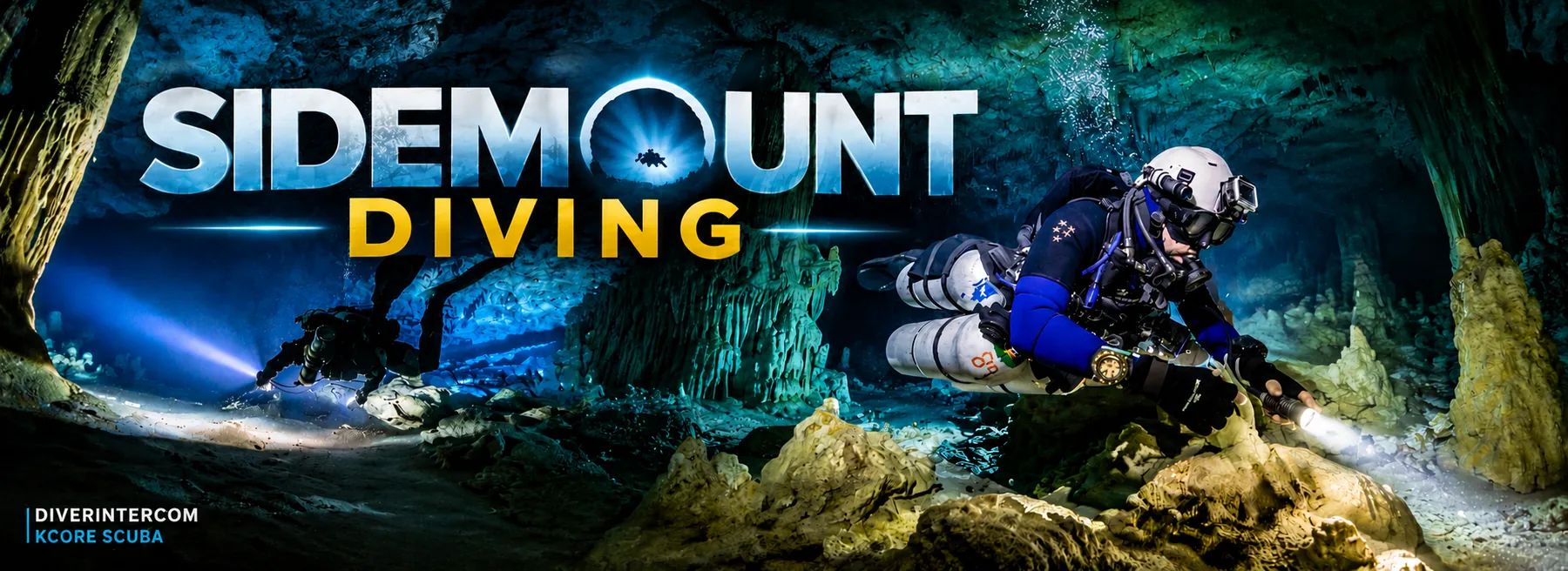
1 | What Is Sidemount Scuba Diving?
Most scuba divers carry their breathing-gas cylinder on their back.
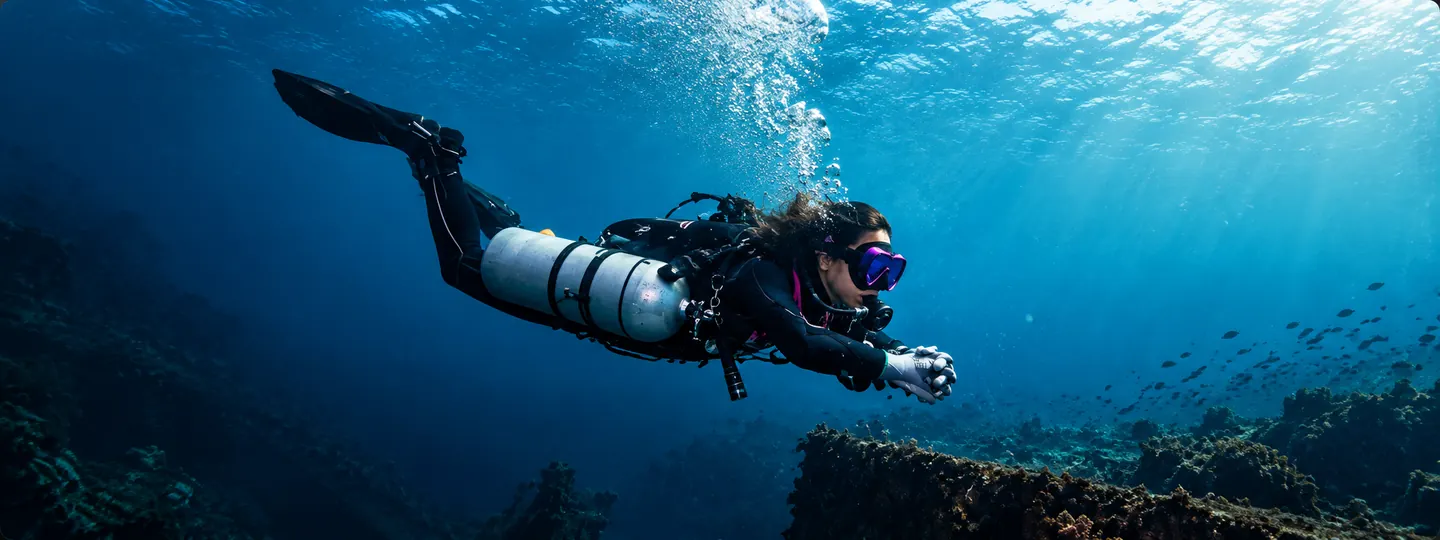
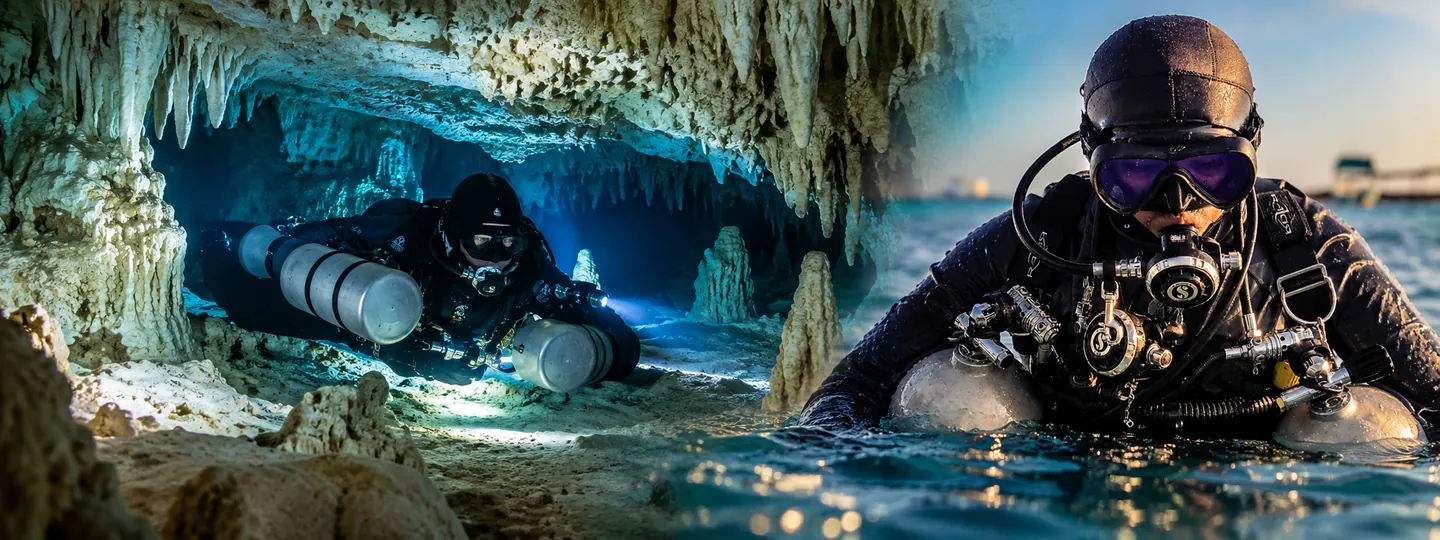
In sidemount diving, one or more cylinders are attached alongside the diver's body, usually beneath the arms and extending toward the hips.
Instead of a conventional backmounted buoyancy compensator, the diver normally uses a specialized harness and buoyancy system designed to support and position these cylinders.
Modern recreational sidemount divers commonly use one or two cylinders. Technical and cave divers may carry additional cylinders when their dive plans require more breathing gas.
Why dive sidemount?
Sidemount offers several potential advantages:
- Cylinders can often be attached and removed individually.
- Cylinder valves and regulators are readily accessible.
- Equipment weight can be distributed differently from backmounted scuba.
- Divers can achieve excellent horizontal trim and streamlining.
- The configuration can be adapted for certain restricted environments.
- Two-cylinder systems can provide independent breathing-gas supplies.
However, sidemount is not automatically safer or easier than conventional scuba.
It requires dedicated training in equipment configuration, gas management, regulator switching, buoyancy control and emergency procedures.
Sidemount is an alternative scuba configuration, not a higher certification level or a replacement for technical-diving training.
2 | A Very Short History
Sidemount originated in cave exploration.
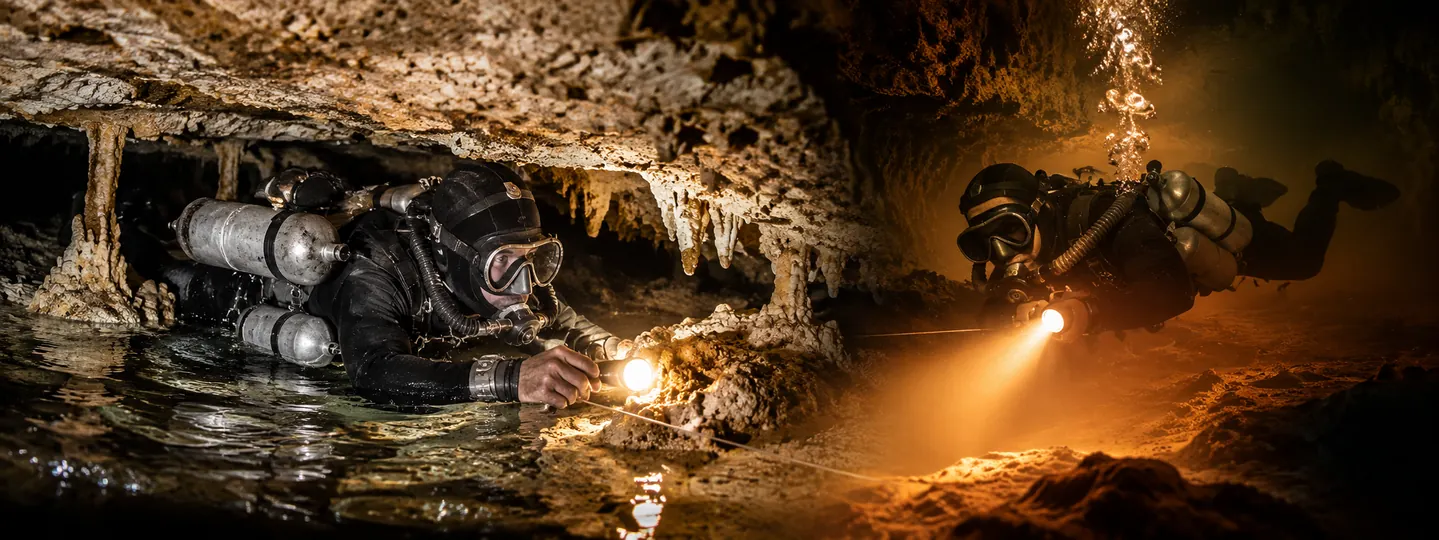
During the early 1960s, British cave explorers began positioning small breathing-gas cylinders alongside their bodies to negotiate narrow flooded passages called sumps.
During the 1980s, American cave divers refined these arrangements, developing more streamlined configurations suitable for extended underwater exploration.
In the 1990s, commercially manufactured sidemount equipment began appearing.
Further innovations in Florida and Mexico during the 2000s produced the foundations of today's modern systems.
Around 2010–2012, sidemount began moving into mainstream recreational scuba education.
What started as an improvised solution to a cave-exploration problem gradually became an internationally recognized diving configuration.
3 | Sidemount Diving Today
Today, sidemount is taught by major international scuba training organizations, including:
PADI, SSI, SDI, TDI, IANTD, RAID and other specialist training organizations.
Courses range from introductory recreational sidemount training to advanced technical and overhead-environment applications.
A recreational sidemount course generally introduces equipment configuration, cylinder attachment, gas management, regulator procedures, buoyancy control and emergency skills.
Technical sidemount training builds on these foundations for more demanding diving environments.
Manufacturers producing dedicated sidemount equipment include Dive Rite, Razor, XDEEP, Hollis, Halcyon, OMS and other specialist companies.
Modern systems vary considerably in harness design, buoyancy distribution, cylinder attachment and intended use.
Despite its popularity, sidemount remains one of several equipment configurations available to divers.
Its greatest strengths emerge when the equipment, environment, training and diving objectives are properly matched.
PART TWO — THE ORIGINS
4 | Before Sidemount: The British Cave-Diving Pioneers
To understand sidemount, we must travel back to a time when scuba diving itself was still developing.
During the 1930s, British cave explorers began investigating submerged passages that blocked access to unexplored underground systems.
These flooded sections were known as sumps.
Among the pioneering locations was Wookey Hole in Somerset, where early underwater cave exploration was undertaken using equipment that would be almost unrecognizable to modern recreational divers.
Graham Balcombe and other early British cave divers experimented with breathing equipment, underwater communication, diving procedures and methods of negotiating submerged cave passages.
In 1946, Balcombe helped establish the Cave Diving Group, or CDG.
The organization became one of the world's most important centers of cave-diving knowledge.
However, the equipment requirements of British cave exploration were fundamentally different from those encountered by ordinary open-water divers.
A cave explorer might spend hours walking, climbing or crawling through dry passages before reaching a short submerged section.
The diving equipment had to be transported underground, often through extremely restrictive terrain.
Heavy backmounted cylinders were frequently impractical.
The explorers needed something smaller, lighter and easier to remove.
The solution would eventually become known as sidemount.
The English System
Early British sump-diving configurations emphasized simplicity.
A diver might carry a small cylinder, regulator, mask and little additional equipment.
The cylinder could be attached to a belt or harness alongside the body.
The diver could then negotiate the flooded passage, remove the cylinder when necessary and continue exploring.
Perfect horizontal trim was not necessarily the priority.
Many British sumps were short, narrow and extremely silty. Some were negotiated by crawling or pulling along the passage rather than swimming freely.
This approach became associated with the English System.
It was equipment designed around the requirements of exploration, rather than equipment designed around a standardized diving configuration.
5 | Mike Boon: The First Recognizable Sidemount Pioneer
One name deserves particular attention.
Mike Boon (1941–2014).
Boon is generally credited with developing one of the earliest recognizable sidemount configurations during British sump exploration in the early 1960s.
His work is associated particularly with Swildon's Hole in Somerset.
In 1961 and 1962, Boon was involved in significant explorations of the cave's submerged passages.
His equipment reflected the practical requirements of the environment.
Rather than relying on conventional backmounted scuba, he positioned a breathing-gas cylinder alongside his body.
This allowed the equipment to be transported and manipulated through narrow cave passages.
One of Boon's original cylinders, recovered from Swildon's Hole in 1972, survives as a remarkable historical artifact.
The cylinder had originally been manufactured for use as an aircraft oxygen cylinder during the Second World War.
It was subsequently adapted for cave-diving exploration.
The cylinder is preserved by the Wessex Cave Club.
An early contribution to gas management
Boon also advocated a conservative gas-management approach.
He recommended using only one quarter of the available breathing gas for inward penetration, retaining the remainder for the return and contingencies.
This is historically interesting because it predates the widespread adoption of the rule of thirds associated with later American cave-diving practices.
It should not be interpreted as a universally applicable modern gas-management rule. Nevertheless, it demonstrates that early British cave explorers were already developing systematic approaches to breathing-gas reserves.
Was Mike Boon the inventor of sidemount?
The historical evidence supports Boon as a major pioneer.
However, identifying a single inventor is difficult.
The practice of carrying breathing-gas cylinders alongside the body may have emerged independently among explorers facing similar restrictions.
What can be established is that Boon's early-1960s equipment represents one of the best-documented foundations of recognizable sidemount diving.
PART THREE — FLORIDA AND THE BIRTH OF MODERN SIDEMOUNT
6 | A Different Environment Creates a Different Diving System
During the 1970s and 1980s, American cave divers were exploring increasingly extensive underwater cave systems.
Florida became a major center of this activity.
Its freshwater springs and flooded limestone passages offered extraordinary exploration opportunities.
Unlike many British sumps, Florida's underwater caves frequently required extended swimming penetrations.
Divers needed greater gas capacity, efficient propulsion, reliable buoyancy control and equipment that remained stable during long underwater journeys.
The early British arrangements provided inspiration, but they were not always suitable for these conditions.
American explorers began experimenting with new ways of carrying cylinders alongside the body.
The central problem was no longer simply how to fit through a restriction.
It was how to combine restricted-passage capability with the performance required for extended underwater diving.
This distinction explains much of the subsequent evolution of sidemount.
7 | Woody Jasper: The Incident That Changed Florida Cave Diving
In 1982, American cave explorer Woody Jasper experienced a frightening incident at Bathtub Spring in Florida.
He was diving with backmounted twin cylinders when he became trapped in a restrictive passage.
During the incident, his primary light was accidentally switched off, leaving him in darkness.
Jasper eventually managed to free himself.
The experience convinced him that a different equipment arrangement was needed.
At approximately the same time, he had obtained a copy of Martyn Farr's book The Darkness Beckons.
The book documented British cave-diving exploration and included photographs of the equipment used by British sump divers.
Jasper studied these photographs carefully.
He recognized the advantages of moving cylinders away from the diver's back.
However, he also recognized that the British configurations would require modification for Florida's underwater caves.
Within weeks, Jasper began experimenting with alternative equipment.
He initially developed a single-cylinder arrangement before progressing to a rudimentary two-cylinder sidemount configuration.
The bicycle inner tube innovation
One of Jasper's most influential contributions was deceptively simple.
He used a bicycle inner tube to hold the upper ends of his cylinders close against his body.
The arrangement pulled the cylinder valves toward the armpits, preventing the cylinders from hanging loosely below the diver.
This improved streamlining and reduced the effective profile of the equipment.
The principle survives in modern sidemount systems.
Today's specialized bungee arrangements perform a similar function, although their construction and attachment methods have evolved considerably.
Why this was a major development
Earlier side-carried cylinders could hang relatively loosely from harness attachment points.
Jasper recognized that cylinder positioning was central to the performance of the entire system.
A properly positioned cylinder could become an integrated part of the diver's profile rather than an object suspended alongside it.
This distinction helped transform sidemount from an improvised method of carrying breathing gas into a coherent underwater equipment configuration.
8 | Wes Skiles, Lamar Hires and the Florida Exploration Community
Woody Jasper did not develop modern sidemount in isolation.
His experiments attracted the attention of other cave explorers, including:
Wes Skiles, Lamar Hires, Mark Long, Tom Morris and Ron Simmons.
These divers experimented with cylinder attachment, buoyancy control, equipment accessibility and methods of negotiating restrictions.
Their work was collaborative and evolutionary.
Individual improvements were tested underwater, modified and adopted by other explorers.
The purpose was not to create a commercial product.
It was to reach cave passages that conventional backmounted equipment could not negotiate.
Lamar Hires
Lamar Hires became one of the most important figures in both sidemount equipment development and training.
He began cave diving in Florida during the late 1970s.
By 1982, he was experimenting with sidemount configurations alongside other Florida explorers.
In later interviews, Hires emphasized that sidemount was initially a specialized exploration tool.
Divers used it when conventional backmounted equipment prevented further progress.
It was not yet a preferred configuration for ordinary diving.
A discarded buoyancy jacket becomes an innovation
Hires also recalled an unusual episode involving Woody Jasper and Wes Skiles.
Skiles was discarding an old Sherwood buoyancy jacket.
Jasper acquired it and adapted it into a sidemount buoyancy platform.
This improvised arrangement proved useful enough that other divers began experimenting with similar designs.
The story illustrates an important feature of early sidemount development.
Equipment innovation often began with existing components rather than purpose-built manufacturing.
Divers modified what was available, tested the result and continued refining the configuration.
The development of modern sidemount buoyancy systems owes much to this experimental approach.
9 | 1985: Sidemount Becomes a Formal Cave-Diving Specialty
In 1985, Lamar Hires developed a sidemount specialty training program for the National Speleological Society's Cave Diving Section.
This represents an important historical milestone.
Sidemount was no longer exclusively an experimental configuration used by individual explorers.
It was becoming a recognized technique that could be taught through structured instruction.
The program remained focused on cave diving.
It was not intended as a mainstream recreational scuba course.
Nevertheless, it established an educational foundation that preceded the recreational sidemount expansion by more than two decades.
Why 1985 matters
When discussing the modern sidemount boom, it is easy to begin the story around 2010.
But by that time, specialized sidemount training already had a history extending back approximately 25 years.
The recreational industry did not invent sidemount training.
It adapted and expanded an established specialist discipline.
PART FOUR — THE BAHAMAS: ANOTHER EXPLORATION TRADITION
10 | The Blue Holes and the British Connection
The Bahamas occupy an important position in the history of underwater cave exploration.
The islands contain extensive flooded limestone systems, including inland and marine blue holes.
These environments attracted explorers interested in underwater passages, cave connections and previously inaccessible underground systems.
Among the early pioneers was Dr. George Benjamin, whose work during the 1960s contributed to the development of specialized cave-diving equipment and exploration methods.
However, not every unusual cylinder configuration used during these early expeditions should be described as sidemount.
Some equipment remained fundamentally backmounted.
The distinction matters when reconstructing the historical development.
Rob Palmer and Martyn Farr
During the 1980s, British cave explorer Rob Palmer became closely associated with Bahamian cave exploration.
Palmer and Martyn Farr undertook important explorations at Conch Sound Blue Hole on Andros.
Their work demonstrated the extraordinary scale and complexity of the Bahamas' underwater cave systems.
Palmer subsequently participated in and organized further expeditions involving increasingly advanced diving techniques.
These included investigations using specialized breathing equipment and mixed-gas technology.
The Bahamas became an important location where British cave-exploration traditions interacted with developments in international technical diving.
11 | Brian Kakuk: The Bahamas Sidemount Connection
Brian Kakuk became one of the important figures in the next phase of Bahamian cave exploration.
His early sidemount configurations were influenced by British cave-diving equipment.
During the late 1980s and early 1990s, Kakuk experimented with homemade systems suited to the environments he was exploring.
These developments occurred independently of the later commercial Razor system.
In 1993, Kakuk extended exploration at Conch Sound using sidemount techniques and staged breathing-gas supplies.
His work illustrates how sidemount could be combined with other technical-diving methods to extend exploration capabilities.
A connection across generations
The relationship between Rob Palmer, Brian Kakuk and Steve Bogaerts is particularly interesting.
All three belong to the broader history of Bahamian cave exploration.
However, it would be inaccurate to describe them as a simple, uninterrupted instructor-student lineage without further documentation.
Their work represents overlapping generations of explorers, shared locations and evolving techniques.
Later collaboration between Kakuk and Bogaerts helped connect Bahamian exploration with developments occurring in Mexico.
The Bahamas therefore deserve recognition as more than a geographical footnote.
They form part of the international network through which cave-diving techniques, equipment ideas and exploration experience were exchanged.
PART FIVE — SIDEMOUNT AND STAGE DIVING: A CRITICAL HISTORICAL DISTINCTION
12 | Not Every Side-Carried Cylinder Is Sidemount
One of the most important distinctions in the history of scuba equipment concerns sidemount and stage cylinders.
They may appear similar in photographs.
Their functions, however, can be fundamentally different.
Stage diving
In conventional technical diving, additional cylinders may be attached alongside the diver.
These cylinders can contain breathing gas for extended penetration, decompression or other planned portions of a dive.
The diver may continue using backmounted cylinders as the primary breathing supply.
The additional cylinders are commonly called stage or decompression cylinders, depending on their intended function.
Dedicated sidemount diving
In sidemount, the cylinders positioned alongside the diver provide the primary breathing supply.
The equipment is configured around their position, accessibility and management.
Modern sidemount configurations generally integrate the cylinders closely with the diver's harness and buoyancy system.
The Wakulla connection
The major Florida cave-exploration projects, including expeditions associated with Wakulla Springs, frequently involved complex breathing-gas arrangements.
Divers carried additional cylinders to support demanding underwater exploration.
However, photographs showing cylinders suspended alongside divers do not automatically demonstrate dedicated sidemount diving.
The primary gas configuration must be identified.
A backmounted diver carrying multiple stage cylinders is not necessarily using sidemount.
Likewise, a sidemount diver may carry additional stage cylinders.
Why this distinction matters historically
Early stage-cylinder practices and modern sidemount development influenced one another.
Both involved problems of cylinder positioning, accessibility and streamlining.
But they were not identical developments.
Understanding this difference prevents the history of sidemount from being confused with the broader history of technical-diving gas management.
PART SIX — FROM EXPERIMENTAL EQUIPMENT TO COMMERCIAL SYSTEMS
13 | The 1990s: Dive Rite and the First Commercial Generation
For many years, sidemount equipment was assembled or modified by individual divers.
There was no universally accepted commercial configuration.
Harnesses, buoyancy devices and cylinder attachment systems were adapted to particular exploration requirements.
During the mid-1990s, Lamar Hires developed a commercial sidemount system manufactured by Dive Rite.
The configuration incorporated the company's TransPac harness.
This was a significant development because it made specialized sidemount equipment commercially available.
The TransPac concept itself reflected practical exploration requirements.
Hires had worked in remote cave environments where equipment needed to be transported through dry passages before being used underwater.
A flexible harness offered advantages over a rigid backplate in some of these situations.
Commercial equipment did not immediately replace homemade systems
Even after dedicated products became available, many experienced cave divers continued building their own configurations.
This reflected both personal preference and the highly specialized nature of cave exploration.
The ideal equipment for one cave system was not necessarily ideal for another.
Commercial sidemount equipment was therefore initially a small specialist market.
14 | 2001: The Armadillo System
In 2001, Brett Hemphill and Curt Bowen developed the Armadillo sidemount harness.
The Armadillo introduced or popularized several features that influenced subsequent designs.
These included specialized rear cylinder attachment arrangements, bungee systems and buoyancy-control features adapted to sidemount requirements.
The system represented another step away from improvised equipment.
Manufacturers were increasingly treating sidemount as a distinct configuration with its own design requirements.
The Armadillo also illustrates an important point about equipment history.
Modern sidemount did not emerge from one manufacturer or one design.
It developed through overlapping innovations by cave explorers, instructors and equipment specialists.
PART SEVEN — MEXICO AND THE MODERN SIDEMOUNT REVOLUTION
15 | The Yucatán Peninsula: A New Environment for Equipment Development
Mexico's Yucatán Peninsula became one of the most influential regions in modern cave-diving development.
Its extensive flooded cave systems include internationally recognized exploration areas such as Ox Bel Ha, Nohoch Nah Chich and Dos Ojos.
These caves offered demanding opportunities for extended underwater exploration.
The widespread use of aluminum cylinders influenced equipment configuration.
Unlike many steel cylinders, aluminum cylinders can become increasingly positively buoyant as their breathing gas is consumed.
This affects how they should be attached and positioned during a dive.
Equipment designers therefore needed solutions that could accommodate changing cylinder buoyancy while maintaining stable trim.
These challenges contributed to the development of what became known as Mexican-style sidemount.
16 | Steve Bogaerts: Refining the Modern Configuration
Steve Bogaerts became one of the most influential figures in the development and international visibility of modern sidemount.
His work in Mexican cave exploration helped refine a minimalist, streamlined approach to equipment configuration.
Bogaerts emphasized precise cylinder positioning, controlled buoyancy, efficient propulsion and reducing unnecessary equipment.
His approach treated the diver and equipment as an integrated system.
2006: The original Razor
Bogaerts developed the original Razor configuration around 2006.
The system reflected his exploration requirements and his preference for a minimalist harness.
Further refinements followed during subsequent cave-diving activities.
The importance of visual demonstration
During the late 2000s, underwater videos showing Bogaerts' sidemount techniques began attracting international attention.
The demonstrations were influential because they showed what a carefully configured sidemount system could achieve.
The cylinders remained closely aligned with the diver.
The equipment appeared streamlined and controlled.
The diver's movements demonstrated precise buoyancy and propulsion techniques.
For many divers, these demonstrations offered their first clear impression of modern sidemount.
The equipment no longer appeared to be an improvised cave-diving arrangement.
It looked like a highly refined diving system.
Razor 2 and commercial development
Around 2010, Bogaerts and HP Hartmann began developing the Razor 2 system.
Manufacturing arrangements were established, including work involving Deep Sea Supply.
Production development continued during 2011.
International commercial distribution expanded subsequently.
In 2013, Razor established a formal instructor program.
This was significant because the company increasingly combined equipment sales with training in the configuration's intended use.
Rather than treating the harness as an isolated product, Razor promoted a system of equipment configuration and diving procedures.
17 | Steve Martin: Bringing Sidemount Beyond Cave Diving
Steve Martin occupies a particularly important place in the transition from specialist cave diving to recreational sidemount.
In November 2008, Martin undertook advanced sidemount cave-diving training with Steve Bogaerts.
The experience influenced his approach to diving and equipment configuration.
Martin recognized that the advantages of sidemount were not necessarily limited to cave exploration.
Cylinder accessibility, equipment handling and alternative weight distribution could also appeal to recreational divers.
2009: Early recreational sidemount education
In February 2009, Martin developed PADI Distinctive Specialty instructor materials covering single- and twin-cylinder sidemount.
These materials preceded the agency's later standardized recreational sidemount program.
Martin subsequently developed his Sidemount Essentials educational activities.
His work helped demonstrate that sidemount could be taught outside the specialized cave-diving environment.
Why Steve Martin matters
The development of modern sidemount required more than equipment innovation.
It also required instructors who could translate specialist techniques into training suitable for a wider diving population.
Martin became one of the influential educators involved in that transition.
His instructional materials, demonstrations and international training activities contributed to sidemount's growing visibility.
The connection between Bogaerts and Martin is particularly significant.
It links the development of highly refined cave-diving equipment with the subsequent expansion of recreational sidemount education.
PART EIGHT — THE MANUFACTURERS THAT SHAPED MODERN SIDEMOUNT
18 | Hollis and the Recreational Equipment Transition
The development of recreational sidemount equipment involved more than Razor and XDEEP.
Jeff Loflin, an important figure in the development of recreational sidemount instruction, worked with equipment manufacturers to promote configurations suitable for open-water divers.
In interviews, Loflin described discussions with the Hollis family during the 2008 and 2009 DEMA trade shows.
He demonstrated sidemount equipment and discussed its potential recreational applications.
Hollis subsequently developed the SMS 100 system, released around 2010.
This was an important commercial milestone.
An established scuba equipment manufacturer was introducing a dedicated sidemount system to a broader dealer and distributor network.
Loflin later participated in international demonstrations and promotional activities.
These efforts helped introduce sidemount equipment to dive professionals in numerous countries.
The development demonstrates how equipment manufacturing, instructor education and commercial distribution became increasingly connected.
19 | XDEEP: Engineering a New Generation
Another important development occurred through the collaboration between cave diver Patrick Widmann and equipment designer Piotr Czernik.
Widmann wanted a sidemount system capable of performing across different environments.
His requirements included Mexican cave diving, European cold-water diving and other technical applications.
After earlier development attempts, Widmann began working with XDEEP.
In June 2011, he met Piotr Czernik in France.
Their collaboration produced the foundations of the STEALTH 2.0 system.
2012: STEALTH 2.0 enters the market
In April 2012, the STEALTH 2.0 received CE certification.
The first production units were delivered to Protec Mexico in May 2012.
The system incorporated design features intended to improve buoyancy distribution, harness adjustment and cylinder attachment.
2015: Technical and recreational configurations
XDEEP subsequently introduced additional STEALTH configurations, including TEC and REC versions.
These reflected different diving requirements and equipment preferences.
The company's development also illustrates the growing distinction between equipment optimized for particular technical environments and equipment intended for broader recreational use.
A commercial indicator
In its tenth-anniversary history published in 2022, XDEEP reported cumulative sales exceeding 50,000 STEALTH systems.
This provides a useful indication of commercial adoption.
However, it does not establish the total worldwide sidemount market, the number of active sidemount divers or annual certification figures.
20 | Halcyon and Other Established Manufacturers
Halcyon, already associated with technical and cave-diving equipment, subsequently developed dedicated sidemount products, including the Contour system.
Other established manufacturers, including OMS, also introduced sidemount solutions.
The entry of established equipment companies reflected the growing commercial significance of the configuration.
By the mid-2010s, sidemount equipment was no longer limited to small specialist workshops or individually modified harnesses.
Divers could choose among commercially manufactured systems designed around different equipment philosophies.
However, the precise introduction dates of some manufacturers' first sidemount products require further archival verification.
PART NINE — TWO DESIGN TRADITIONS
21 | Florida Style and Mexican Style
Modern sidemount development produced two broad design traditions commonly described as Florida style and Mexican style.
These names reflect historical influences rather than strict technical standards.
Florida-style sidemount
Florida configurations developed around the requirements of extended freshwater cave exploration.
Steel cylinders were commonly used.
Equipment designs frequently emphasized robust cylinder attachment and buoyancy characteristics suited to negatively buoyant cylinders.
Mexican-style sidemount
Mexican configurations developed around the requirements of Yucatán cave exploration.
Aluminum cylinders were common.
Equipment arrangements needed to accommodate changes in cylinder buoyancy during the dive.
Minimalist harnesses and specialized cylinder attachment systems became characteristic of many configurations.
The difference is not absolute
Modern systems increasingly combine features from both traditions.
Divers may use different cylinders, attachment points or buoyancy arrangements depending on the environment.
Equipment manufacturers have also developed systems intended to accommodate a wider range of configurations.
The Florida and Mexican traditions are therefore best understood as historical influences on design.
They are not separate diving disciplines.
PART TEN — THE RECREATIONAL SIDEMOUNT BOOM
22 | From Specialist Training to Mainstream Scuba
For decades, sidemount remained largely associated with cave diving and technical exploration.
This began changing during the late 2000s.
Several developments occurred almost simultaneously.
Specialist instructors demonstrated refined sidemount techniques to international audiences.
Manufacturers introduced commercially available systems.
Online videos made modern sidemount visible to divers who had never entered an underwater cave.
Training agencies began developing standardized programs.
These developments reinforced one another.
The early training pioneers
Before standardized recreational programs became widely available, instructors including Steve Martin and Jeff Loflin were already developing approved distinctive specialty courses.
These early programs helped establish the feasibility of teaching sidemount to ordinary recreational divers.
They also provided experience that informed later standardized instruction.
23 | SSI and PADI: The Mainstream Training Milestones
SSI — 2011
SSI publicly introduced its Recreational Sidemount Diving specialty in 2011.
The program was intended to teach recreational divers the fundamentals of sidemount equipment and procedures.
This represented an important step in bringing sidemount into a major international recreational training network.
PADI — 2012
PADI introduced standardized Tec Sidemount training during the first quarter of 2012.
Its standardized recreational Sidemount Diver program followed during the second quarter.
These programs expanded the availability of sidemount training through PADI's international instructor network.
Other training organizations
TDI, IANTD and other technical-diving organizations had already been involved in sidemount instruction before or around this period.
SDI, RAID, NAUI and other agencies subsequently incorporated sidemount into their training offerings.
However, the precise first introduction dates of every agency's standardized programs should not be assumed without historical training bulletins or archived standards.
The significance of 2011–2012
These years mark a major transition.
Sidemount moved from a configuration taught predominantly by specialist instructors toward one offered through mainstream recreational scuba training programs.
The transition did not mean that sidemount immediately became universally popular.
Its broader adoption developed over subsequent years.
PART ELEVEN — THE SIDEMOUNT DEBATE
24 | Not Everyone Welcomed the Revolution
The rapid expansion of sidemount generated considerable discussion within the diving community.
Experienced cave and technical divers sometimes questioned whether recreational divers needed sidemount at all.
Others were concerned that instructors without sufficient practical sidemount experience were beginning to teach the configuration.
Equipment configuration became another subject of debate.
Some divers favored highly standardized systems.
Others preferred individualized configurations adapted to their bodies, cylinders and diving environments.
Sidemount versus side-slung cylinders
Historical forum discussions also revealed disagreement over terminology.
Was a diver carrying loosely attached cylinders using sidemount?
Or did genuine sidemount require a specialized harness, precise cylinder positioning and particular procedures?
These debates reflected the configuration's evolving identity.
They also demonstrated how far sidemount had moved from its original cave-exploration purpose.
What had once been a specialized solution was becoming a widely discussed commercial diving product.
The limits of equipment advantages
Sidemount can offer meaningful benefits.
But it also introduces additional procedures and equipment-management requirements.
Poorly positioned cylinders can create drag and interfere with trim.
Improperly managed independent breathing supplies can introduce gas-management problems.
Inadequate regulator-switching procedures can create additional risks.
Consequently, the effectiveness of sidemount depends heavily on training, configuration and experience.
A sidemount certification alone does not establish competence in cave diving, decompression diving or other advanced activities.
PART TWELVE — SIDEMOUNT IN THE MODERN DIVING WORLD
25 | Who Influences Sidemount Today?
Modern sidemount has no single governing authority.
Its development is influenced by several overlapping communities.
Exploration pioneers
Figures including Lamar Hires, Brian Kakuk and other experienced cave explorers continue to represent the historical foundations of sidemount.
Their work connects modern equipment with the original problems of underwater exploration.
Equipment and configuration specialists
Steve Bogaerts remains an important figure in the development of modern minimalist sidemount techniques.
Patrick Widmann and Piotr Czernik have contributed significantly through the development of XDEEP equipment.
International educators
Steve Martin helped establish sidemount as an internationally taught recreational configuration.
Other educators, including Andy Davis, Garry Dallas and Steve Davis, have contributed through training, technical writing, interviews and specialist media.
Training agencies
Major recreational agencies provide access to sidemount education through their international instructor networks.
Technical and cave-diving organizations remain important in developing and teaching advanced applications.
Manufacturers
Equipment companies influence sidemount through harness design, buoyancy systems, cylinder attachment methods and commercially available configurations.
No reliable worldwide dataset establishes a single most influential sidemount instructor, manufacturer or training organization.
Influence depends on whether the subject is historical innovation, technical exploration, equipment development, recreational instruction or commercial distribution.
PART THIRTEEN — THE HISTORICAL TIMELINE
26 | Major Milestones in Sidemount Development
| Year or period | Location | People or organizations | Development |
|---|---|---|---|
| 1930s | Britain | Early cave explorers | Experimental underwater exploration of submerged cave passages |
| 1946 | Britain | Graham Balcombe and colleagues | Formation of the Cave Diving Group |
| Early 1960s | Britain | Mike Boon | Early recognizable sidemount configurations |
| 1960s | Britain | Cave Diving Group explorers | Development of minimalist sump-diving equipment |
| 1960s–1970s | Bahamas | George Benjamin and others | Specialized blue-hole exploration techniques |
| 1970s | Florida | American cave-diving community | Development of advanced cave-diving procedures and equipment |
| 1982 | Florida | Woody Jasper | Development of streamlined two-cylinder sidemount |
| 1982 | Florida | Lamar Hires and colleagues | Further development of sidemount exploration techniques |
| 1980s | Bahamas | Rob Palmer, Martyn Farr and others | Major blue-hole and underwater cave exploration |
| 1985 | Florida | Lamar Hires, NSS-CDS | Formal cave-diving sidemount specialty |
| Late 1980s–1990s | Bahamas | Brian Kakuk | Development and application of sidemount exploration equipment |
| 1993 | Bahamas | Brian Kakuk | Further exploration of Conch Sound |
| Mid-1990s | Florida | Lamar Hires, Dive Rite | Commercial sidemount equipment development |
| 2001 | United States | Brett Hemphill, Curt Bowen | Armadillo sidemount harness |
| 2006 | Mexico | Steve Bogaerts | Original Razor configuration |
| 2008 | Mexico | Steve Bogaerts, Steve Martin | Advanced sidemount training connection |
| 2009 | International | Steve Martin | Early recreational sidemount specialty materials |
| 2009 | United States | Jeff Loflin, Hollis | Commercial recreational sidemount development |
| 2010 | International | Hollis | SMS 100 commercial system |
| 2010–2011 | Mexico / United States | Bogaerts, Hartmann | Razor 2 development |
| 2011 | Europe | Patrick Widmann, Piotr Czernik | STEALTH 2.0 development |
| 2011 | International | SSI | Recreational Sidemount Diving specialty |
| 2012 | International | PADI | Standardized technical and recreational sidemount programs |
| 2012 | Poland / Mexico | XDEEP | STEALTH 2.0 commercial introduction |
| 2013 | International | Razor | Formal instructor program |
| 2015 | International | XDEEP | STEALTH TEC and REC configurations |
| Mid-2010s onward | Worldwide | Agencies and manufacturers | Broader recreational and technical adoption |
PART FOURTEEN — WHAT THE HISTORY REVEALS
27 | The Evolution of Sidemount Was Driven by Problems, Not Fashion
The development of sidemount reveals an important pattern in diving history.
Each major stage emerged from a practical problem.
British cave explorers needed to transport breathing equipment through narrow dry and submerged passages.
Florida cave divers needed a streamlined configuration suitable for extended underwater exploration.
Bahamian explorers adapted equipment to complex blue-hole environments.
Mexican cave divers refined cylinder positioning and minimalist configurations for extensive flooded cave systems.
Equipment manufacturers transformed specialist solutions into reproducible commercial products.
Training agencies developed programs that made sidemount accessible to a wider diving population.
The result was not the invention of one perfect system.
It was the gradual development of a family of related configurations.
From individual invention to international education
The history also demonstrates how innovations spread through the diving community.
An equipment modification developed by one explorer could be adopted by others.
A book documenting British cave exploration could influence an American diver decades later.
A homemade cylinder-retention system could establish principles still recognizable in modern equipment.
A specialist cave-diving configuration could become the foundation of international recreational training.
The connection between Mike Boon's early equipment, Woody Jasper's bicycle inner tubes, Steve Bogaerts' Razor configuration and today's commercially manufactured systems illustrates this progression particularly clearly.
CONCLUSION
28 | From a Narrow Sump to a Worldwide Diving Configuration
The history of sidemount begins with a simple challenge.
A cave explorer reaches a submerged passage too narrow for conventional equipment.
To continue, the explorer must find another way to carry breathing gas.
During the early 1960s, British cave divers developed practical solutions by positioning cylinders alongside their bodies.
American cave explorers subsequently refined these arrangements into more streamlined underwater configurations.
Innovations in Florida, the Bahamas and Mexico transformed the equipment.
Manufacturers developed specialized harnesses and buoyancy systems.
Instructors translated advanced techniques into structured educational programs.
By the early 2010s, sidemount had begun entering mainstream recreational scuba training.
Today, the configuration is used in recreational diving, technical diving, cave exploration and other specialized applications.
Yet its underlying principle remains closely connected to its origins.
Sidemount was born from the need to adapt equipment to the environment, rather than forcing the environment to accommodate the equipment.
That principle continues to define its evolution.
From Mike Boon's early British sump-diving cylinders to Woody Jasper's improvised equipment, the exploration achievements of Florida and the Bahamas, Steve Bogaerts' streamlined configurations and the modern systems manufactured by companies such as Razor and XDEEP, sidemount represents more than a different way of carrying breathing gas.
It represents decades of experimentation, cooperation, technical innovation and underwater exploration.
And its history is still being written.
DiverInterCom KCore Scuba
Breathe. Float. Observe. Connect. Protect.