1 | What is sidemount diving?
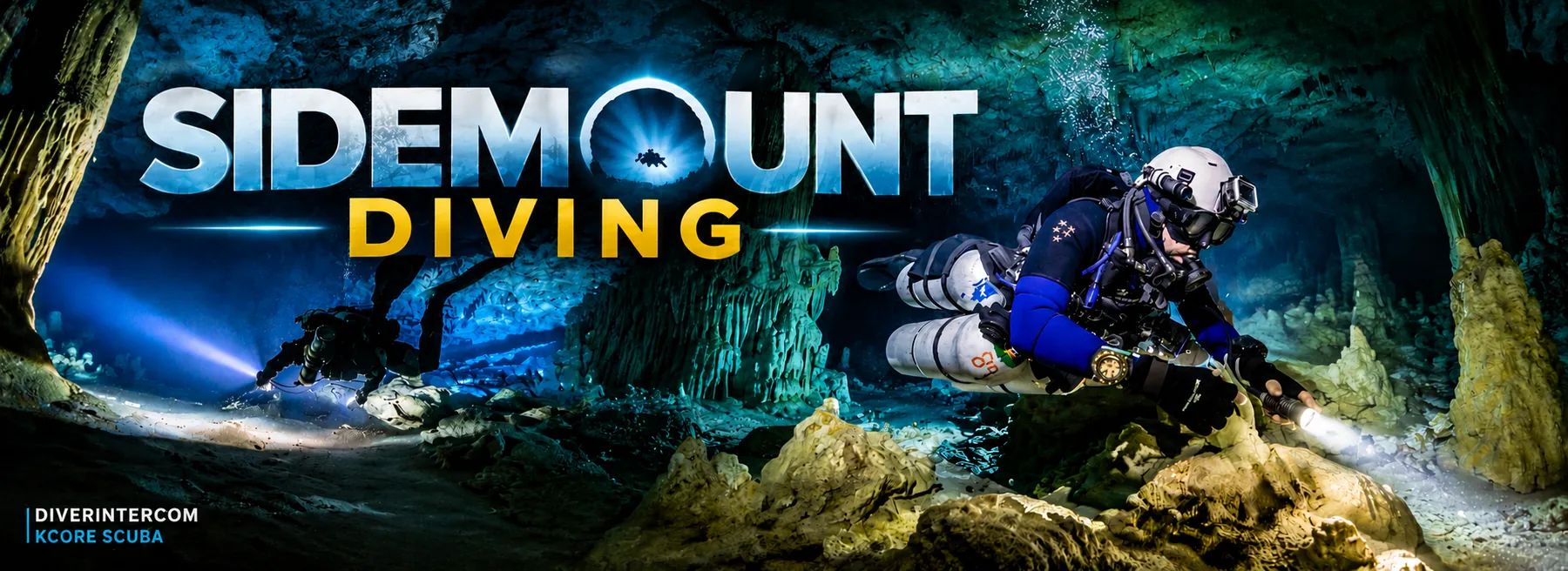
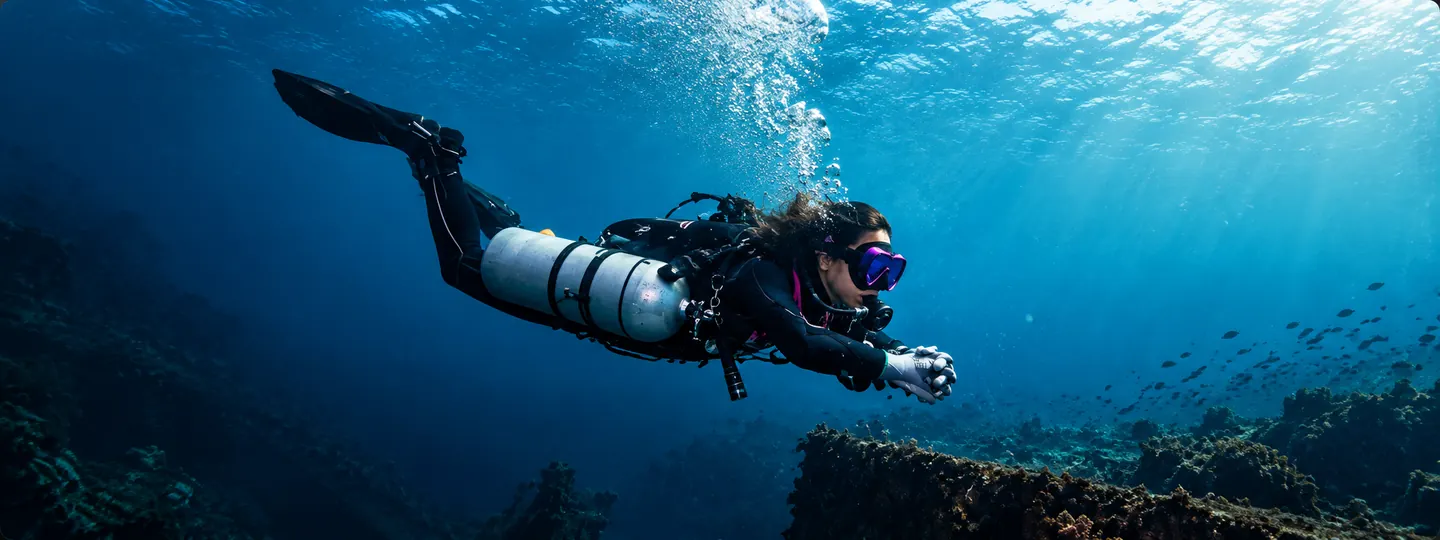
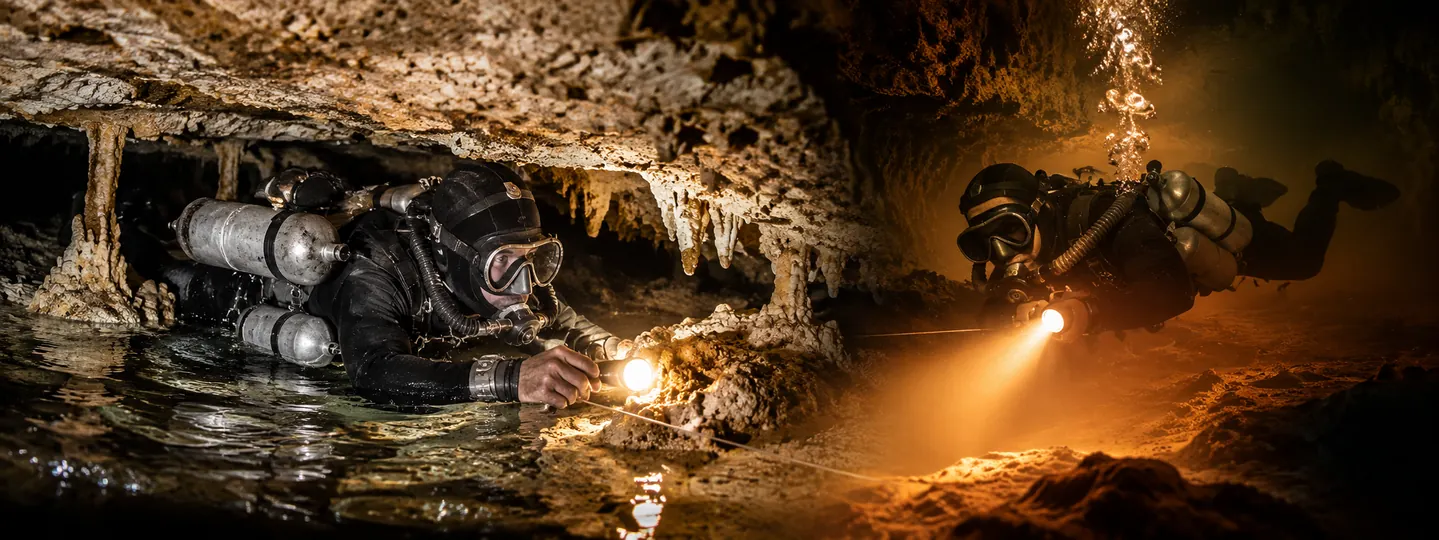
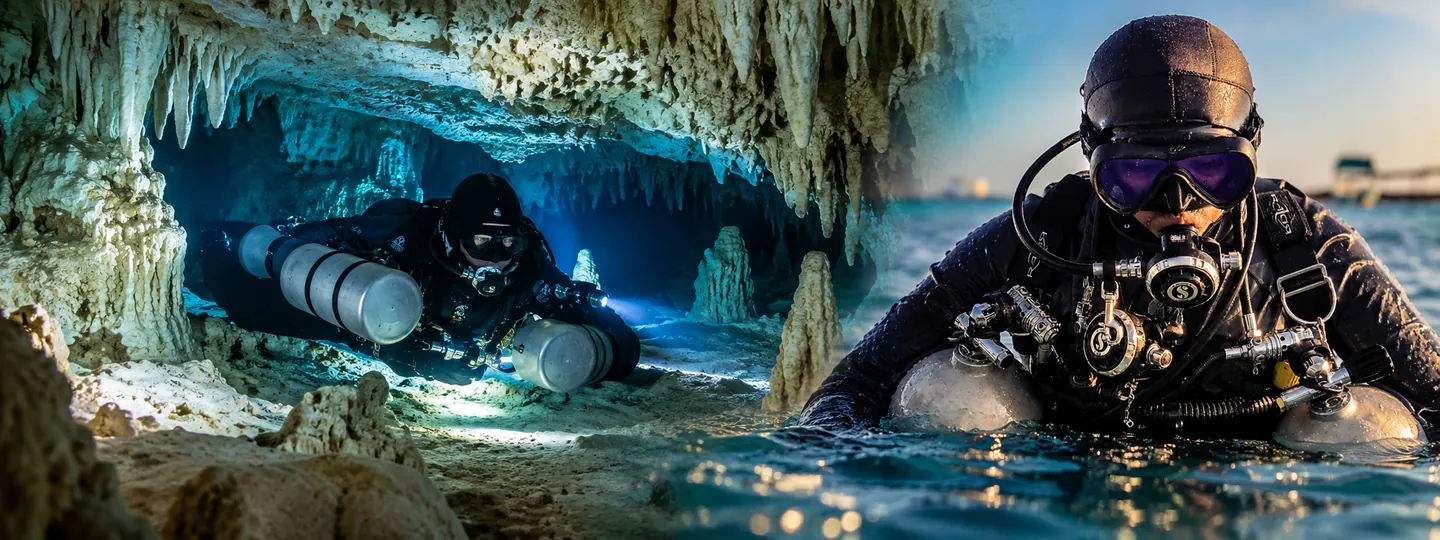
Most scuba divers wear their breathing-gas cylinders on their backs. In sidemount, one or more cylinders are secured alongside the torso, generally below the arms. A purpose-designed harness and buoyancy system help position the cylinders, and the diver can often attach or remove them individually. Two-cylinder sidemount commonly uses independent regulators and requires deliberate gas-balancing and regulator-switching procedures. It is an equipment configuration, not a certification level or an automatic safety upgrade. Its benefits depend on the dive, the equipment, and competent training.
2 | A sixty-second history
British cave explorers began using small side-carried cylinders to negotiate restrictive flooded passages, or sumps, by the early 1960s. Florida cave divers transformed the idea into a more stable, streamlined underwater system in the early 1980s. Exploration in the Bahamas and Mexico, followed by dedicated commercial harnesses, expanded the technique. Specialist instruction preceded the mainstream recreational expansion of approximately 2011–2012. The history is cumulative: there was no single inventor of every element of modern sidemount.
3 | Courses and equipment today
Recreational sidemount specialties are available through major training organizations such as PADI and SSI, while SDI/TDI, IANTD, RAID, NAUI and specialist cave-diving organizations offer related pathways according to their current standards. A basic course addresses cylinder attachment, trim, buoyancy, regulator procedures, gas management and failures. Cave penetration and decompression diving require separate appropriate training. Dedicated equipment has been offered by Dive Rite, Razor, XDEEP, Hollis, Halcyon, OMS and others. No independently audited global ranking establishes the largest sidemount training agency or most influential instructor.
4 | Before the cylinders moved: British cave exploration
The history begins with the difficulty of carrying breathing equipment through dry caves to submerged sumps. Graham Balcombe and other British explorers experimented with underwater methods at Wookey Hole in the 1930s; the Cave Diving Group was founded in 1946. British sump diving was not simply miniature open-water scuba: a diver might crawl for hours, reach a short flooded obstacle, and carry a compact breathing set through it. A small cylinder beside the body was easier to handle or remove than a bulky backmounted set. The loose, minimalist arrangements later called the English approach prioritized passage through restrictions, not the elegant horizontal trim prized in modern open water.
5 | Mike Boon and Swildon’s Hole
Mike Boon is one of the best-documented early practitioners of recognizable sidemount in the early 1960s. His Swildon’s Hole sump explorations used compact cylinders and removable equipment suited to very narrow passages. Accounts of his 1961–1962 dives show the difference between transporting a breathing set through a sump and conducting a long free-swimming penetration. An adapted Second World War-era aircraft oxygen cylinder associated with his diving was later recovered. Boon is a pioneer, but a claim that he was the first human ever to carry a cylinder beside the body cannot be demonstrated conclusively. His conservative gas-reserve thinking also belongs in the wider history of cave-diving planning; historical practices should not be copied as contemporary dive instructions.
6 | Martyn Farr, Rick Stanton and the continuing British tradition
Martyn Farr’s The Darkness Beckons preserved the ingenuity of British sump divers and unexpectedly influenced developments overseas. British cave exploration also continued through divers such as Rick Stanton, whose approach to restrictive underwater passages demonstrates that the original problem never disappeared. Stanton’s later prominence should not obscure the distinctive early British context: small transportable breathing sets, dry-cave logistics, and underwater passages that could demand equipment removal. British methods and later Florida-style systems are related but not interchangeable.
7 | Stage cylinders are not automatically sidemount
A stage or decompression cylinder can hang at a diver’s side while the primary breathing supply remains on the back. In dedicated sidemount the side-mounted cylinders constitute the primary configuration. Both may coexist: a sidemount cave diver can carry additional stages. This distinction matters when examining historical images of large exploration projects such as Wakulla. Sheck Exley and other cave divers pioneered advanced staging and penetration techniques, but an image showing side-slung stages beside backmounted doubles does not establish a sidemount dive. The function of each cylinder, its attachments and the breathing sequence must be identified before classifying the equipment.
8 | Florida, 1982: Woody Jasper’s turning point
Woody Jasper recalled becoming trapped in a restriction at Bathtub Spring while wearing backmounted twin cylinders in 1982. After escaping, he examined photographs in Farr’s The Darkness Beckons and experimented with no-mount and then two-cylinder arrangements. A key improvement was pulling the cylinder necks into the armpits using bicycle inner-tube rubber, an ancestor in principle of modern bungee retention. Rather than letting cylinders swing from low attachment points, he integrated them with the diver’s silhouette. Jasper’s first-person account is unusually valuable, though precise priority claims depend on retrospective testimony. The equipment opened passages that conventional doubles made inaccessible.
9 | The Florida circle: Skiles, Hires, Long, Morris and Simmons
Jasper’s ideas spread among Wes Skiles, Lamar Hires, Mark Long, Tom Morris and Ron Simmons. Skiles combined exploration, photography, conservation and instruction; he later became an influential underwater filmmaker. Hires developed equipment and formal training while running Dive Rite. Morris, Long and Simmons helped test and adapt configurations in the field. One memorable anecdote concerns adapting an old Sherwood buoyancy jacket, illustrating how scavenged components could become working exploration equipment. This was not a single patented design unveiled on one day: it was a network of divers sharing field-tested solutions. Hires recalled using sidemount in 1982 and described it primarily as a mission-specific tool.
10 | Other Florida voices: Sheck Exley, Bill Main, Jim Bowden, Edd Sorenson
Sheck Exley’s long-range cave exploration and staging methods formed the technical environment in which sidemount developed, even when his own major penetrations used backmounted configurations. Bill Main and Jim Bowden likewise belong to the broader context of Florida and deep cave exploration, rather than automatically to the invention of sidemount. Edd Sorenson later contributed practical harness and buoyancy modifications and became prominent in cave rescue and training. Jeff Loflin recalled seeing Sorenson use sidemount in open water and recognizing its potential for divers who struggled with backmounted doubles. These adjacent contributions must be described precisely rather than attributing the same invention to every celebrated cave diver.
11 | Formal teaching before the recreational boom
Lamar Hires is credited with developing a cave-diving sidemount specialty for the NSS Cave Diving Section in 1985. This matters because the technique had structured instruction decades before its later recreational marketing. Specialist programs and instructors continued to develop under cave and technical organizations. Exact first-standard dates for every technical agency remain incompletely documented and should not be guessed. Formal cave-sidemount instruction also did not imply that ordinary open-water divers were widely learning the technique in the 1980s.
12 | The Bahamas: Benjamin, Palmer, Farr and Parker
The Bahamian blue holes were a separate laboratory for underwater exploration. Dr George Benjamin and collaborators experimented with specialized breathing equipment during earlier blue-hole work, but their devices must not all be classified as sidemount. Rob Palmer and Martyn Farr made important 1980s explorations at Conch Sound on Andros; Rob Parker and Julian Walker also appear in accounts of Bahamian cave projects. Palmer’s exploration legacy connects British cave-diving culture to the Bahamas. It is tempting to draw a straight Palmer-to-Kakuk-to-Bogaerts succession, but a direct teacher–student lineage has not been demonstrated. Expedition reports, dated photographs and original equipment descriptions are needed to establish individual configurations and priority.
13 | Brian Kakuk and the Bahamas–Mexico exchange
Brian Kakuk developed homemade sidemount arrangements in the late 1980s and used sidemount with staged gas during later Bahamian explorations, including Conch Sound in the 1990s. He subsequently collaborated with Steve Bogaerts, exchanging equipment ideas and exploration techniques. The Bahamas story is therefore not an isolated sidemount invention but a place where British and North American traditions met the demands of blue-hole exploration. Kakuk’s conservation and exploration work gives this chapter a broader significance than equipment alone. Claims about precise dates and specific record distances should be checked against original expedition logs before publication as records.
14 | A forgotten bridge to Mexico: Dan and Bil Phillips
A particularly revealing recollection from Lamar Hires identifies a cave diver named Dan, whom he trained in 1987, as an early conduit for sidemount into the Mexican cave community. Hires stated that Dan later taught influential Mexican cave divers, including Steve Bogaerts and Bil Phillips. The interview does not establish Dan’s full name in the passage cited here, so it would be irresponsible to invent it. This account complicates the familiar narrative that Mexican sidemount began with Razor. Bil Phillips and other early Mexico-based explorers deserve recognition alongside the later, more visible equipment designers. Independent documentation of this training lineage remains a research priority.
15 | Mexico and the geometry of aluminum cylinders
The Yucatán cave systems—Ox Bel Ha, Nohoch Nah Chich and Dos Ojos among them—rewarded equipment that could be carried to remote cenotes and managed during long underwater penetrations. Aluminum cylinders change buoyancy as gas is consumed, making lower attachment placement and cylinder rotation important to trim. This helped shape minimalist harness arrangements commonly called Mexican-style sidemount. Florida-style and Mexican-style are useful historical shorthand, not rigid standards: cylinder materials, water conditions, exposure protection and diver anatomy all influence the best configuration. No harness alone guarantees excellent trim.
16 | Steve Bogaerts and the Razor development
Steve Bogaerts, an explorer of major Mexican cave systems, refined a streamlined approach that attracted worldwide attention through underwater skills demonstrations. The original Razor dates to approximately 2006. Bogaerts and HP Hartmann developed the later Razor 2 concept around 2010, with manufacturing arrangements and broader distribution following. The Razor instructor network emerged subsequently. His videos made precise cylinder positioning, propulsion and body control visible to divers far outside the cave community. He did not invent all modern sidemount, but he helped define its recognizable contemporary visual language. Later accounts also document that decompression illness ended his active diving career.
17 | Steve Martin and the open-water teaching bridge
Steve Martin trained with Bogaerts in advanced sidemount cave diving in 2008 and went on to develop the Sidemount Essentials teaching approach. His own chronology places PADI Distinctive Specialty materials in 2009. Such instructor-developed specialties are distinct from a standardized agency-wide program. Martin’s importance lies in converting specialist configuration principles into repeatable instruction and demonstrating their relevance to open-water divers. He is one of the most influential educators of the recreational transition, though influence cannot be measured from publicity alone.
18 | Jeff Loflin: another early recreational pioneer
Jeff Loflin provides an important corrective to any account crediting one person with bringing sidemount into recreational diving. Following an injury that made heavy backmounted doubles difficult, Loflin explored sidemount in open water. In a first-person interview he reported obtaining approval for PADI sidemount and sidemount-instructor distinctive specialties in 2008—before the 2009 materials Martin described. Loflin also worked with industry contacts on recreational equipment and promoted sidemount at trade events. The dates concern distinct instructor initiatives and should not be conflated with PADI’s standardized 2012 courses.
19 | From TransPac and Armadillo to dedicated buoyancy
Lamar Hires and Dive Rite were early commercial pioneers, developing TransPac-based sidemount equipment in the 1990s and later Nomad systems. Brett Hemphill and Curt Bowen developed the Armadillo around the beginning of the 2000s. Edd Sorenson recalled modifying wings with shock cord to move buoyancy lower, because a wing designed for backmounted doubles could lift in the wrong place for sidemount cylinders. This engineering problem—where the gas bubble sits relative to the diver and cylinders—is more fundamental than branding. It helps explain the evolution from modified backmount components to purpose-built sidemount buoyancy systems.
20 | Hollis, Razor, XDEEP, Halcyon and OMS
Hollis entered the growing recreational market with the SMS family, associated with Jeff Loflin’s early promotional work. Razor paired a minimalist system with configuration-specific teaching. XDEEP’s STEALTH 2.0 grew from Patrick Widmann’s exploration and teaching requirements and Piotr Czernik’s engineering; they met in France in June 2011. The STEALTH 2.0 Classic was delivered to Protec Mexico in May 2012; TEC and REC variants followed in 2015. XDEEP reported more than 50,000 cumulative systems sold by its 2022 tenth-anniversary account—manufacturer-reported units, not a count of certified divers. Halcyon’s Contour and OMS offerings show the later participation of established technical-equipment manufacturers. Exact first-launch dates for some models remain to be verified.
21 | More designers and testers behind XDEEP
The STEALTH story extends beyond two founders. XDEEP’s own history names Artur Sartowski as the contact who introduced Widmann and Czernik. Its later TEC development credits testing input from Marcin Chochorowski, Nabil Elbendary and Tomasz Michura. Their appearance in the manufacturer record is a useful reminder that equipment development requires testing, iteration and collaboration. Commercial histories are primary evidence of a manufacturer’s own chronology, but claims of first-ever or best-ever status should be treated as marketing assertions unless independently substantiated.
22 | 2011–2012: standardized recreational courses
SSI publicly announced a Recreational Sidemount Diving specialty in 2011. PADI introduced standardized Tec Sidemount in the first quarter of 2012 and a standardized recreational Sidemount Diver program in the second quarter. Instructor-developed distinctive specialties existed earlier, notably Loflin’s reported 2008 approvals and Martin’s 2009 materials. TDI, IANTD and cave-training groups had specialist sidemount instruction, while SDI, RAID and NAUI also offer sidemount-related training. The exact initial standard dates for each agency require archived bulletins. The key historical point is not that sidemount began in 2012, but that major recreational networks began to distribute it widely then.
23 | Debate, forums and the limits of fashion
By 2013, forum debates distinguished genuine sidemount from loosely side-slung cylinders and questioned whether rapid commercial growth could outpace instructor experience. These are contemporary community reactions, not proof that sidemount training was generally poor. Sidemount can help with individual cylinder handling and valve access, but creates its own demands: secure attachment, trim, gas balancing, regulator switching and failure management. A streamlined photo does not establish competence. Cave and wreck penetration, decompression obligations and mixed gases require qualifications beyond an introductory sidemount course.
24 | The Philippines: Andy Davis and Southeast Asian adoption
Andy Davis is a documented connection between the international sidemount evolution and the Philippines. His professional biography states that he has dived nearly exclusively in sidemount since 2008 and was among the early recreational and technical sidemount instructors qualified in Southeast Asia. His Scuba Tech Philippines work, associated with Subic Bay and technical wreck diving, has contributed training, configuration writing and regional visibility. Subic’s wreck environment provides a different application from Mexican cave exploration. This does not establish that Davis was the first sidemount diver or instructor in the Philippines; that claim requires older Philippine cave, wreck and training records. His inclusion in InDEPTH’s 2023 sidemount interview collection documents his standing among specialist educators.
25 | Contemporary voices and the wider community
The history extends beyond its best-known pioneers. Garry Dallas is associated with specialist instruction and international sidemount education; Steve Davis hosts Speaking Sidemount and has interviewed many of the people in this story. Andy Davis contributes technical writing. Rick Stanton and Jill Heinerth connect sidemount to demanding cave exploration and the wider public understanding of underwater environments. Edd Sorenson remains known for exploration, rescue and training. The 2023 InDEPTH Who’s Who also recognizes Aleš Procháska, Andrew Goring, Audrey Cudel, Christophe Le Maillot, Daniele Pontis, Marissa Eckert, Mauro Bordignon, Michael Thomas, Mike Young, Mikko Paasi, Natalie Gibb, Phillip Lehmann, Rob Neto, Robbie Schmittner, Robin Cuesta, Skanda Cophield, Steve Lewis, Thorsten Waelde and Tom Steiner, among others. Inclusion records recognition in a specialist editorial collection, not an independently measured ranking of influence.
26 | What the record supports—and what it does not
Strongly documented themes include British sump-diving origins, the early-1980s Florida refinement, the influence of Farr’s book on Jasper, specialist training before recreational adoption, and the 2011–2012 commercial/training convergence. Less certain are a unique first inventor, precise first use in the Bahamas or Philippines, the full Palmer–Kakuk–Bogaerts personal lineage, every manufacturer’s launch year, and agency-by-agency annual certification counts. For these, original CDG logs, Bahamas expedition reports, Wakulla equipment inventories, training bulletins and historical dealer catalogs would improve the evidence. Responsible history preserves the unknowns rather than turning plausible anecdotes into facts.
27 | Historical timeline at a glance
1930s: British submerged-cave experiments. 1946: Cave Diving Group founded. Early 1960s: Mike Boon’s British side-carried-cylinder work. 1970s: advanced American cave staging and penetration techniques. 1982: Woody Jasper and Lamar Hires refine Florida sidemount. 1980s: Palmer, Farr and colleagues explore Bahamian blue holes. 1985: NSS-CDS sidemount specialty associated with Hires. Late 1980s–1990s: Kakuk’s Bahamian sidemount development. Mid-1990s: Dive Rite commercial systems. Around 2001: Armadillo. Around 2006: Bogaerts’ Razor. 2008: Loflin’s reported distinctive-specialty approval; Martin trains with Bogaerts. 2009: Martin’s distinctive-specialty materials. 2011: SSI recreational specialty; STEALTH design collaboration. 2012: PADI standardized courses; STEALTH commercial delivery. 2013: Razor instructor program. 2015: STEALTH TEC/REC. 2022: XDEEP reports 50,000-plus cumulative systems sold.
28 | Conclusion: a tool becomes a discipline
Sidemount began as a practical answer to a restrictive cave passage, not as a recreational fashion. British sump divers made cylinders portable and removable; Florida explorers pulled them into the body and made the configuration swim efficiently; Bahamian and Mexican explorers tested new arrangements in very different cave systems; designers solved the buoyancy and attachment problems; educators brought the skills into open water. The most interesting history is not a single inventor or brand. It is the exchange of ideas across generations, locations and diving communities. From a wartime cylinder in a British sump to modern modular harnesses in Philippine wrecks, the essential principle has remained: adapt the equipment to the task, and develop the skill to use it responsibly.
Historical Sources and References
The following publications, historical accounts, interviews and manufacturer records provide the documentary foundation for this article. Where historical accounts differ or the available evidence is inconclusive, those uncertainties are acknowledged.
InDEPTH — Who’s Who of Sidemount — https://indepthmag.com/the-whos-who-of-sidemount/
InDEPTH — Woody Jasper interview — https://indepthmag.com/sidemount-woody-jasper/
InDEPTH — Lamar Hires interview — https://indepthmag.com/sidemount-lamar-hires/
InDEPTH — Wes Skiles profile — https://indepthmag.com/sidemount-wes-skiles/
InDEPTH — Steve Bogaerts profile — https://indepthmag.com/sidemount-steve-bogaerts/
InDEPTH — Steve Martin interview — https://indepthmag.com/sidemount-steve-martin/
InDEPTH — Jeff Loflin interview — https://indepthmag.com/sidemount-jeff-loflin/
InDEPTH — Edd Sorenson interview — https://indepthmag.com/sidemount-edd-sorenson/
XDEEP — STEALTH 2.0 anniversary timeline — https://www.xdeep.eu/10thanniversary/
Scuba Tech Philippines — Andy Davis biography — https://scubatechphilippines.com/scuba_blog/andy-davis-technical-diving/
Razor — historical timeline — https://razorgosidemount.com/razor-history/
NSS-CDS — historical publications — https://nsscds.org/history/
Steve Martin — Sidemounting — https://www.sidemounting.com/
ScubaBoard — historical community discussions — https://scubaboard.com/community/
This historical overview is intended for educational reading and does not provide equipment configuration instructions or diving procedures.