
Recreational Core
Primarily exterior wreck diving within normal recreational depth and conditions. Penetration is never implied.
recreational wrecks · technical wrecks · deep-ocean history · archaeology · marine life
A growing DiverInterCom KCore research catalogue built recreational-first — from shallow reef-covered wrecks and classic destination dives to technical wreck exploration, expedition depths and the great historic wrecks far beyond the reach of scuba.
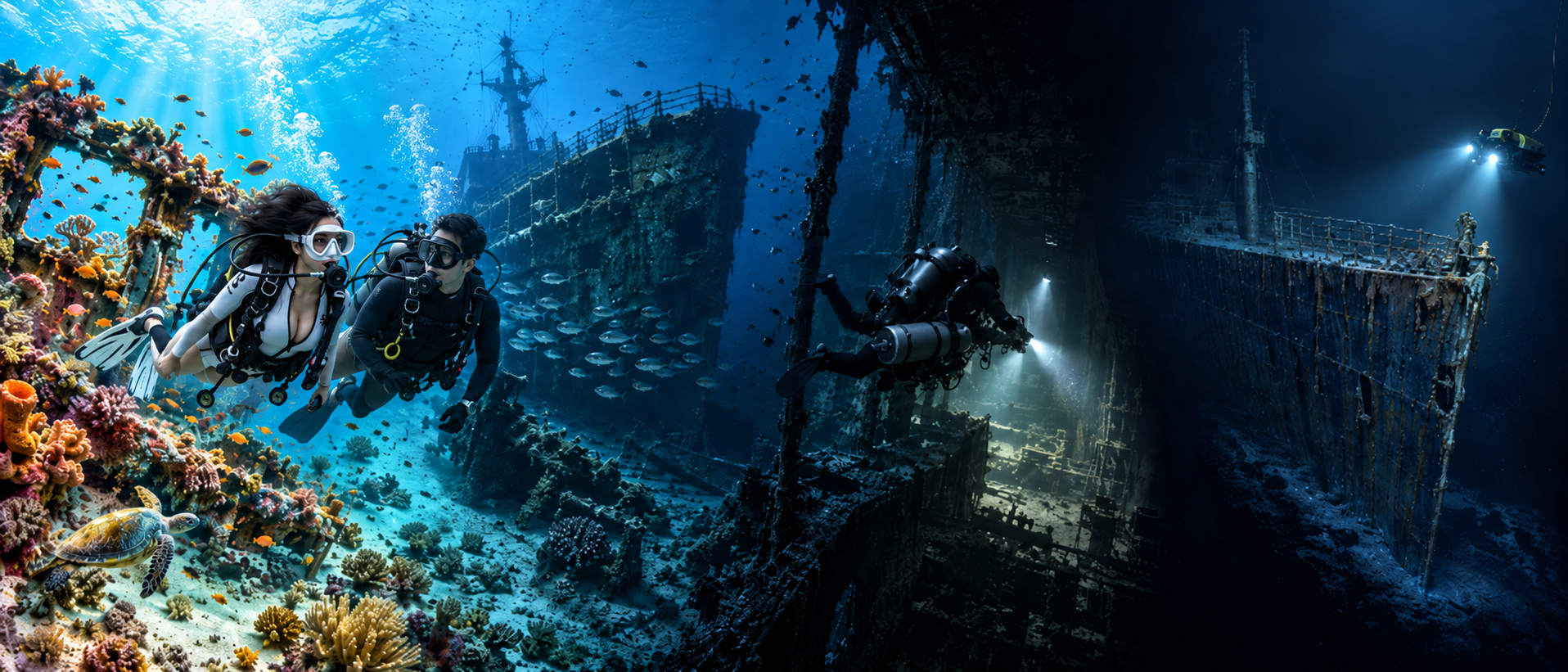
global wreck diving catalogue · recreational to deep-ocean history
Wreck Dive World is being built as a global wreck-diving knowledge base. The practical heart of the project is recreational wreck diving: wrecks that ordinary trained divers can visit, observe and enjoy without turning every site into a penetration objective.
From there the catalogue expands into deeper recreational/technical crossover wrecks, dedicated technical and expedition wrecks, protected archaeology and memorial sites, purpose-sunk artificial reefs, and finally famous deep-ocean wrecks whose place in history remains immense even when only ROVs or submersibles can reach them.
Wreck Dive World is a research and orientation catalogue — not a dive plan, penetration guide, salvage guide or guarantee of current legal access. Depths, structural condition, restrictions, moorings, access rules and heritage status can change. Always verify current local information before diving.
classification system
One wreck can belong to several layers. Depth and overhead are classified independently, while protection, memorial and artificial-reef status remain visible.
Primarily exterior wreck diving within normal recreational depth and conditions. Penetration is never implied.
Accessible exterior or shallower sectors with deeper, decompression or complex overhead layers for appropriately trained divers.
Depth, decompression, gas planning, current or serious overhead makes the wreck primarily a technical objective.
Human-divable only by highly specialized teams with major support, advanced CCR/mixed-gas logistics or expedition control.
Deep-ocean history reached by ROV or submersible rather than scuba — Titanic, deep warships and other monumental wrecks.
Archaeology, war-grave, disaster or heritage status may restrict or prohibit access and always outranks dive-tourism value.
Purpose-sunk or deliberately prepared wrecks belong to a different historical category from accidental losses.
Fish, coral, sponges, crustaceans and ecological succession are part of the story — often more alive than the steel itself.
global wreck catalogue
Search the catalogue or filter by diving layer. Wreck entries are grouped by country or ocean region, with recreational diving at the core and technical, expedition and deep-ocean historical layers clearly separated.
Quick-depth display: “Avg Depth” is a representative midpoint of the listed shallowest/deepest wreck profile for fast recognition, not a dive-plan depth. “Depth” always refers to water depth, so future wreck length data can be shown separately without ambiguity. Multi-wreck clusters are marked “Depth: varies by wreck”.
Historic passenger wreck; biodiversity flagship.
Townsville / Great Barrier ReefPurpose-sunk warship; major artificial reef.
QueenslandPurpose-sunk destroyer escort.
Western AustraliaPurpose-sunk guided missile destroyer.
Western AustraliaPurpose-sunk frigate.
New South WalesHistoric wreck; current access and exact depth should be checked locally.
QueenslandRegional small-wreck layer; requires site-by-site catalogue rather than one flagship shipwreck.
Upper Austria / SalzburgPurpose-sunk wreck and artificial reef.
Grand BahamaClassic recreational wreck.
Grand BahamaConcrete-hulled historic wreck; shallow snorkel/dive context.
BiminiLarge open wreck under government heritage framework.
Bermuda reef platformShallow historic open wreck.
Bermuda reef platformProtected/open wreck.
Bermuda reef platformProtected/open wreck.
Bermuda reef platformProtected/open wreck.
Bermuda reef platformPopular recreational wreck.
Bermuda reef platformHistoric wreck.
Bermuda reef platformHistoric wreck; not the famous ghost ship.
Bermuda reef platformIsland's flagship wreck; exterior recreational, penetration requires separate treatment.
BonaireClassic Caribbean historical wreck and marine-life site.
Salt IslandCold freshwater preservation; recreational-to-technical depth profile.
Fathom Five / Georgian BayHistoric Great Lakes wreck.
Fathom Five / Georgian BayPurpose-sunk dive wreck.
TobermoryVery shallow preserved schooner, primarily snorkel/shallow-diving heritage.
TobermoryMajor liner disaster; technical current/cold-water wreck.
St. Lawrence River, QuebecGlobal flagship; recreational exterior and major technical penetration layer.
LarnacaPurpose-sunk artificial reef.
LarnacaPurpose-sunk recreational wreck.
LarnacaSmaller wooden wreck near Zenobia.
LarnacaMajor Adriatic passenger wreck.
IstriaPopular historic cargo wreck.
CresRecreational-to-advanced wreck.
VisLarge cargo wreck.
VisDeeper technical wreck.
VisWWI battleship; archaeology/protection first.
AdriaticCore global wreck; WWII cargo and heavy visitor pressure.
Strait of GubalHistoric steamship; recreational wreck.
Abu NuhasClassic Red Sea cargo wreck.
Abu NuhasCargo wreck; penetration layer to verify.
Abu NuhasCargo wreck.
Abu NuhasHistoric Red Sea wreck.
Beacon RockDeeper WWII wreck; technical/advanced.
Gulf of SuezHistoric wreck on steep reef; strong current/depth gradient.
Brothers / Red SeaMemorial-sensitive ferry wreck; ethics/access need explicit treatment.
SafagaPurpose-sunk technical/artificial reef wreck.
HurghadaHistoric sailing wreck.
ÅlandCold-water wreck.
ÅlandProtected archaeological wreck; not routine sport access.
Archipelago SeaSubmarine wreck; one of France's major dive wrecks.
MediterraneanClassic Mediterranean wreck.
HyèresClassic Mediterranean cargo wreck.
HyèresDeeper technical wreck.
CavalaireModern ferry disaster; memorial/protection sensitivity.
BalticCold-water merchant wreck heritage across the German Baltic coast; individual sites require archaeology- and access-specific verification.
Baltic coastExtreme technical/expedition liner wreck; protected historical site.
Kea ChannelWWI-era wreck near Britannic.
KeaUnderwater archaeological visitor site; heritage-first.
AlonissosRecreational wreck.
AtticaHistoric steamship wreck.
KeaLarge passenger liner, advanced/technical icon.
GrenadaCargo wreck.
GrenadaShallower recreational wreck.
GrenadaDeeper wreck.
GrenadaGlobal recreational flagship; 3-28 m and heavily colonized by marine life.
Tulamben, BaliShallow small wreck.
BaliPurpose-sunk artificial reef.
Kubu, BaliProtected liner wreck; major WWI historical site.
Old Head of KinsaleGerman U-boat wreck.
West CorkMajor loss; heritage/memorial first.
Irish Sea1916 historical context.
Cork Harbour approachesLarge tanker wreck with major technical profile.
ArenzanoTechnical WWII wreck.
AdriaticShallow recreational wreck.
ElbaLarge purpose-sunk wreck; official tourism lists max depth ~36 m.
MaltaPurpose-sunk patrol boat.
CirkewwaPurpose-sunk patrol boat.
CominoPurpose-sunk tug.
CirkewwaPurpose-sunk ferry.
GozoPurpose-sunk ferry.
GozoPurpose-sunk ferry; condition/orientation requires current verification.
GozoWWII destroyer remains; shallow heritage wreck.
VallettaDeep historic liner wreck.
MaltaAircraft carrier; flagship nuclear-test wreck.
Bikini LagoonBattleship wreck.
Bikini LagoonBattleship wreck.
Bikini LagoonDestroyer wreck.
Bikini LagoonDestroyer wreck.
Bikini LagoonSubmarine wreck.
Bikini LagoonJapanese cruiser wreck.
Bikini LagoonPurpose-sunk naval wreck.
CozumelPurpose-sunk minesweeper.
CozumelPopular drift and wreck dive.
Playa del CarmenGlobal flagship; aircraft/cargo and strong marine-life layer.
ChuukLarge oiler, famous biological colonization.
ChuukDeeper technical cargo wreck.
ChuukCargo/armament wreck.
ChuukLarge passenger-cargo vessel.
ChuukLarge submarine tender.
ChuukCargo wreck.
ChuukCargo wreck.
ChuukCargo wreck.
ChuukLarge armed merchant cruiser; deeper.
ChuukDestroyer.
ChuukJapanese submarine; memorial sensitivity.
ChuukCountry pass should be archaeology-led and conditions-focused rather than tourism-first.
North SeaIconic historic/political wreck now artificial reef.
Cavalli IslandsPurpose-sunk wreck, active recreational/technical community.
Bay of IslandsPurpose-sunk frigate.
Bay of IslandsPurpose-sunk research vessel.
NorthlandHighly photogenic preserved cargo wreck.
GulenDeeper technical wreck.
KristiansandWWII heavy cruiser; deep and historically significant.
OslofjordMajor WWII wreck cluster; individual destroyers require separate cards.
NarvikLarge Japanese refrigeration ship; deeper technical/advanced.
CoronLarge tanker.
CoronSeaplane tender.
CoronCargo vessel.
CoronCargo wreck.
CoronCargo wreck.
CoronCargo wreck.
BusuangaVery shallow wreck/snorkel-dive site.
CoronHistoric cruiser wreck.
Subic BayCargo wreck.
Subic BayHistoric wreck remains.
Subic BayMass-casualty wreck; memorial/protection first.
Baltic SeaMass-casualty wreck; technical/memorial.
Baltic SeaMass-casualty wreck; technical/memorial.
Baltic SeaPurpose-sunk frigate/artificial reef.
MadeiraShallow WWII-era wreck.
São Miguel, AzoresGerman U-boat wreck.
PortoLarge cargo wreck and fish-life site.
Aliwal ShoalHistoric wreck.
Aliwal ShoalArtificial reef/wreck.
DurbanCluster of intentionally sunk vessels; separate cards needed.
Cape PeninsulaPopular Mediterranean wreck.
Costa BravaCargo wreck.
MurciaLarge cargo wreck.
Gran CanariaShallow recreational wreck.
TenerifeMajor intact WWII cargo wreck; one of Red Sea's classic wreck dives.
Port SudanDeep, steeply oriented wreck.
Port Sudan16th-century warship; archaeology/research-first.
Baltic Sea17th-century warship; major archaeological site.
Baltic SeaProtected disaster/memorial wreck; no ordinary wreck-diving framing.
Baltic SeaWWI battleship wreck.
DardanellesWWI battleship wreck.
DardanellesWWI battleship wreck.
DardanellesWWI battleship wreck.
DardanellesFrench battleship wreck.
DardanellesWWI battleship wreck.
DardanellesTop ~22 m, max ~35-36 m; scheduled monument.
Scapa FlowMax ~25 m; scheduled monument.
Scapa FlowMax ~38 m; scheduled monument.
Scapa FlowLight cruiser; scheduled monument.
Scapa FlowBattleship; deeper technical.
Scapa FlowBattleship; technical.
Scapa FlowBattleship; technical.
Scapa FlowProtected war grave; not normal recreational wreck.
Scapa FlowProtected war grave.
Scapa FlowClassic Channel wreck.
DorsetSubmarine/aircraft-carrier experiment wreck.
DorsetDeep WWI wreck.
English ChannelWWI battleship, technical.
North Atlantic / Ireland-UK contextCore artificial reef wreck.
Key LargoPurpose-sunk Coast Guard cutter.
Key LargoPurpose-sunk Coast Guard cutter.
Key LargoWWII casualty wreck.
Key LargoPurpose-sunk freighter.
IslamoradaPurpose-sunk cable layer.
MarathonPurpose-sunk freighter.
Lower KeysPurpose-sunk wreck.
Key WestLarge purpose-sunk former military vessel.
Key WestGerman U-boat; iconic 'Graveyard of the Atlantic' wreck.
Crystal CoastMerchant wreck.
Crystal CoastHistoric tanker wreck.
Crystal CoastArtificial reef wreck.
Crystal CoastCoast Guard cutter/artificial reef.
Crystal CoastNearly 100 identified sanctuary wrecks; major cold-freshwater heritage cluster.
Lake Huron, MichiganExceptionally preserved sailing vessel; discovered/identified by NOAA-led work.
Lake HuronDeep preserved schooner.
Lake HuronRecreational heritage wreck.
Lake HuronPurpose-sunk artificial reef.
OahuLarge wreck dive.
OahuAircraft wreck, recreational/advanced.
OahuOne of the world's largest shore-accessible wreck-diving complexes; rec-to-tech spectrum.
Espiritu Santo~3,800 m; archaeology/memorial and submersible/ROV only.
North AtlanticDeep-ocean battleship wreck; ROV/submersible research.
North Atlantic~3 km; war-grave memorial wreck.
Denmark Strait~5,500 m.
Philippine Sea6,456 m.
Philippine Sea6,895 m.
Philippine Sea~1,200 m.
Sibuyan Sea~5,000 m.
Midway / Papahānaumokuākea~5,400 m.
Solomon Islands region~3,000 m.
Coral Sea~350 m.
East China Sea / Kyushu approachesDeep-ocean polar exploration wreck; heritage and conservation first.
Weddell Seawhat the deeper research will add
Future country catalogues will add vessel type, build and service history, loss event, casualties and survivors, discovery and identification, top and seabed depth, orientation, current structural condition, recreational exterior route, technical/penetration sectors, access and permits, war-grave or archaeological status, marine life, conservation, notable divers and survey teams, accident/recovery history and dated source references.