01 — Introduction: A computer that grows with the diver
The Suunto Nautic is a dedicated large-format dive computer that brings a high-contrast AMOLED display, straightforward four-button controls, long battery endurance and recreational-to-technical diving functions into a rugged housing. It is not designed to be an everyday smartwatch. Its purpose is to provide clear, useful diving information.
After working through the menus, configuring dive views and examining the planning, navigation and app functions, my assessment is strongly positive. The Nautic combines genuinely serious features with an attractive price. It is one of the best-value dive computers I have handled.
Its strength is the progression it allows: a new diver can start with air and Nitrox and continue using the same instrument when training advances toward multigas decompression, Trimix or CCR. This is capability, not a substitute for the corresponding training or procedures.
02 — Construction and controls
The housing is substantial, with a protective bezel and a wide front-facing screen. Suunto specifies a glass-fibre-reinforced polyamide construction, a 3.26-inch AMOLED display and four mechanical controls. The instrument feels purposeful rather than decorative.
My experience: I particularly like the four-button menu navigation. It is easy to learn and works the same way at the surface and underwater. The Garmin X50i's touchscreen is more convenient for manipulating maps above water, but the Nautic's button interface is consistent and direct. The Nautic is also a beautiful unit: clean proportions, a large readable display and a rugged appearance.
03 — The exceptional AMOLED display
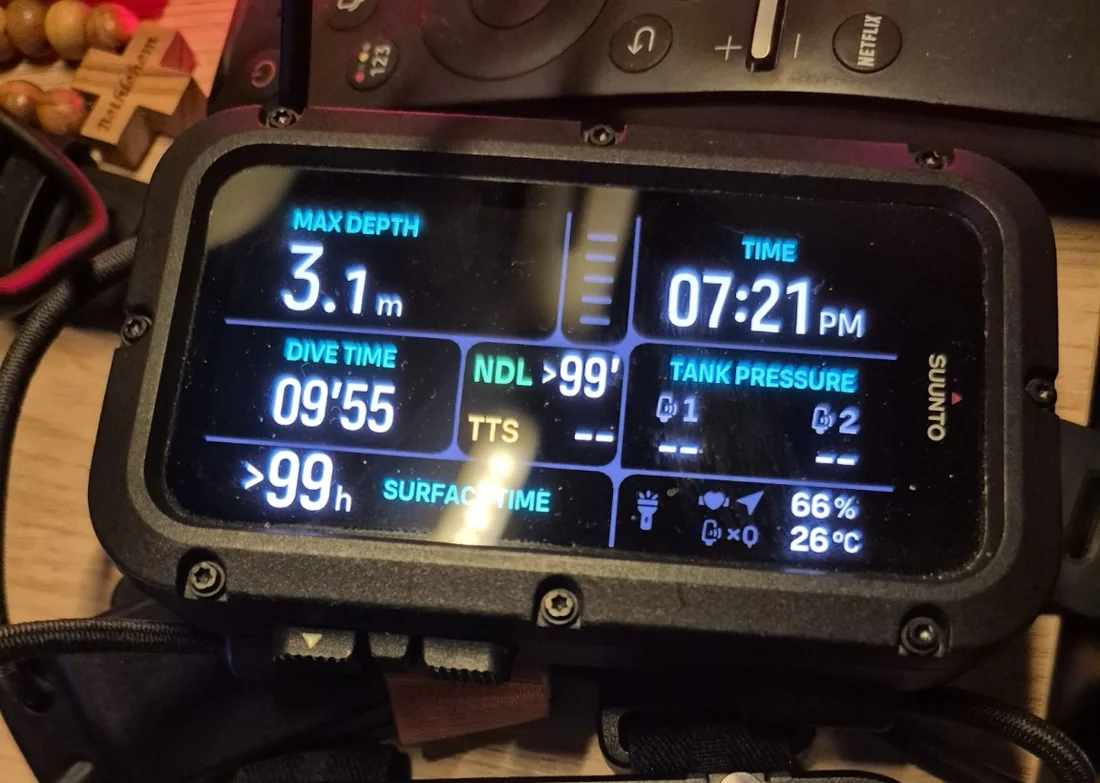
The bright, crisp display is the first feature I notice every time I use the Nautic. Its 3.26-inch AMOLED screen, with 720 × 382 pixels, produces sharp lettering, deep blacks and clear separation between data fields. Depth, time, NDL, TTS and gas information are easy to find without searching the page.
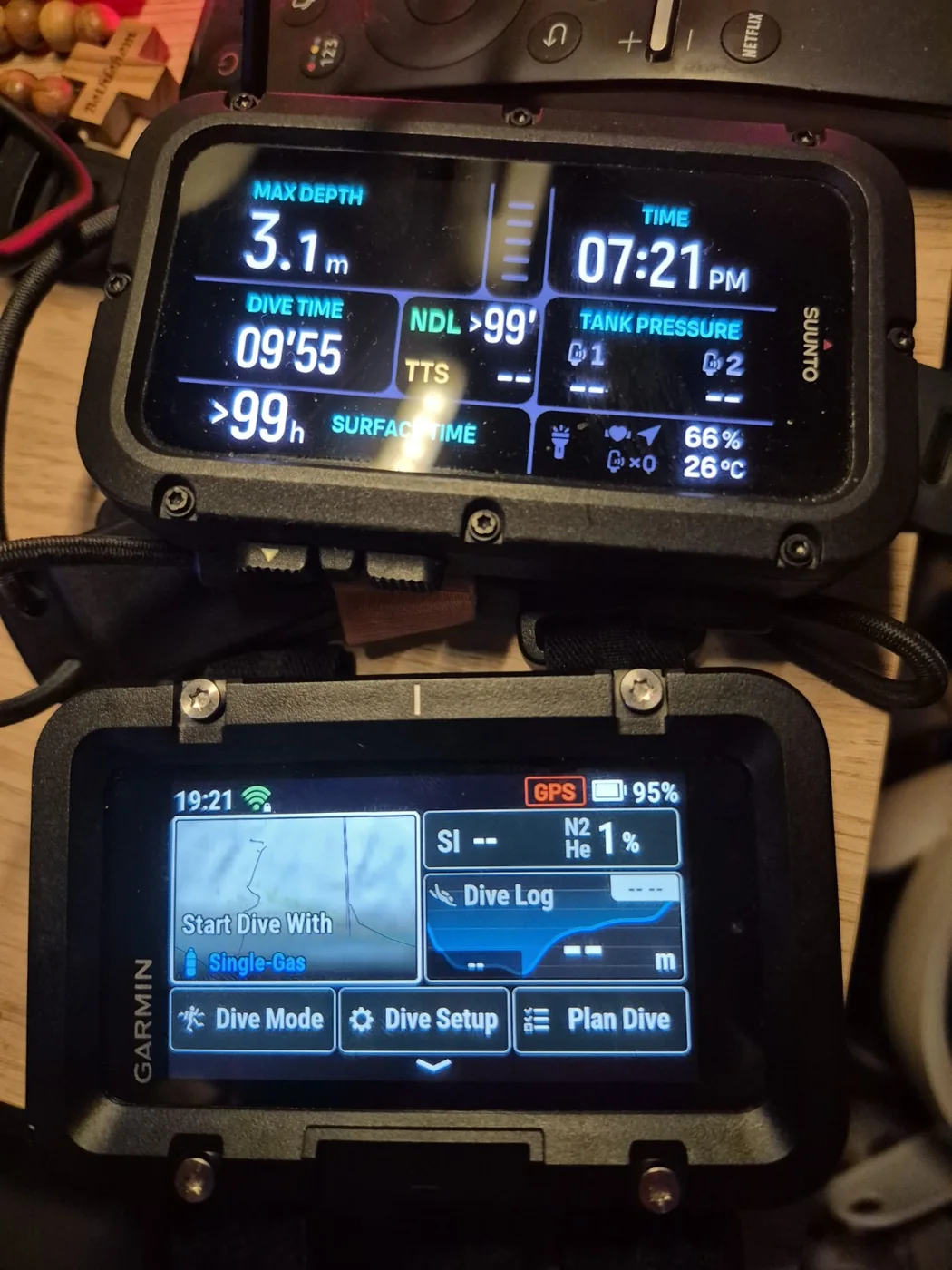
The Garmin X50i uses a 3-inch, 640 × 360 colour LCD. Both are capable displays, but for appearance, contrast and visual clarity I favour the Nautic. This reflects my experience viewing both computers rather than a controlled underwater legibility test.
The large screen is especially appealing for a diver who values uncomplicated access to core information rather than filling every possible part of the display.
04 — Battery endurance: a major advantage
Suunto publishes dive-battery estimates of up to 80 hours at maximum brightness, 90 hours in night mode and 120 hours at medium brightness, under its specified test conditions. These are manufacturer estimates, not guaranteed results for every combination of settings and accessories.
My experience: With moderate use, my Nautic may last several weeks without a recharge. This is exceptionally convenient during ordinary ownership and travel.
For perspective, Garmin rates the X50i at approximately 13 to 20 hours of diving, depending on display mode. My X50i also needs charging about every second day during extensive everyday map and menu use. Those figures and observations represent different workloads, but the practical endurance advantage of the Nautic is unmistakable in my ownership experience.
05 — Single-Gas: clear, approachable recreational diving
Single-Gas operation covers conventional air and Nitrox diving, presenting current and maximum depth, dive time, remaining NDL, ascent information, gas data and relevant oxygen exposure. Large primary fields and readable supporting data make it appropriate for a new diver without limiting the user to entry-level functionality.
The Nautic provides alarms and configurable conservatism, while retaining the technical foundation needed for more demanding profiles. A beginner can grow into the computer rather than immediately grow out of it.
06 — Multi-Gas, Trimix and gas switches
The Nautic supports oxygen–nitrogen–helium mixtures, multigas decompression and manual gas switching. A significant August 2026 firmware update expanded configured gas capacity from five to eight; older instructions referring to five gases should not be mistaken for the latest firmware capability.
Its gas list distinguishes enabled from disabled gases. Enabled gases can contribute to predicted decompression schedules. This deserves attention when a diver carries a contingency mixture that is not intended for the normal ascent.
Compared with Garmin: the X50i has explicit bottom, deco and backup gas categories; the reserve gas can stay outside planned TTS calculations until activated. I consider Garmin's classification more convenient for complex technical setups. For standard multigas dives, however, the Nautic remains a serious technical instrument. Actual breathing-gas switches must always match the selected mixture and its appropriate operating limits.
07 — CCR support and setpoints
The Nautic's 2026 firmware development introduced dedicated CCR support with setpoint, diluent and bailout configurations. This significantly strengthens its long-term usefulness to divers progressing into closed-circuit rebreathers.
The computer calculates based on its configured oxygen setpoint. It does not independently measure the actual ppO₂ inside the rebreather loop through oxygen-cell monitoring. Loop ppO₂ needs to be monitored by the rebreather's appropriate instrumentation; a programmed setpoint is not proof of actual loop conditions.
The addition is impressive at this price point. It turns the Nautic from an advanced recreational computer into an instrument with credible technical-diving reach.
08 — Bühlmann 16 GF and decompression data
The Nautic uses Suunto Bühlmann 16 GF, based on ZHL-16C, with adjustable Gradient Factors. It supplies NDL, decompression status, ceiling and ascent information, and useful tissue and oxygen-exposure displays.
For my own recreational air and Nitrox evaluation I have been considering GF 85/85; for planned decompression and Trimix profiles, 45/85 is a common starting point in my own planning. These are personal configuration choices, not general prescriptions.
In one matched test at GF 90/90, the Nautic and X50i both gave a 37-minute NDL. That demonstrates agreement under the tested conditions, not guaranteed identical decompression results for every multilevel profile.
09 — Customizable dive views
The Nautic offers configurable dive information views, allowing the diver to emphasize data relevant to the current discipline. My preference is to keep the frequently needed numbers immediately accessible and use other views for more specialized information.
The X50i provides a greater degree of data-field customization: I confirmed seven customizable pages per dive mode, plus a dedicated optional diver dashboard. Garmin's very detailed GF and TTS prediction fields remain an advantage for information-heavy technical setups. The Nautic's design is more straightforward but remains flexible and readable.
10 — Planning functions and limitations
The Nautic provides no-decompression and decompression planning functions and can take configured gases into account. These are useful for estimating a conventional planned profile and reviewing ascent obligations.
It is not a full variable-depth cave expedition planner with multiple timed route segments, turn-point travel, cylinder-volume scenarios and complex bailout modelling. Neither the Nautic nor the X50i should be confused with specialist planning software for those applications.
A useful distinction is that the planner's gas assumptions and manual gas switches in an actual dive are not the same thing. Live decompression follows the actual depth and gas history.
11 — GPS, offline maps and underwater route estimation
The Nautic includes surface satellite positioning, compass navigation, offline maps and points of interest. Map regions are managed through the Suunto mobile ecosystem. These features make the unit useful beyond the active dive display.
The computer also offers underwater route estimation using available location and motion-related information. It is a reconstruction, not live underwater satellite positioning: GPS signals cannot provide normal underwater navigation. The resulting track should not be treated as a precise measured route, particularly in complex overhead environments.
Compared with Garmin: my X50i with DiveView Extended Coverage has much more dedicated underwater bathymetry. Around Eagle Point and Mabini I can inspect depth contours, steep slopes and a broad collection of dive-site markers. The Suunto's maps are useful and meaningful, but the Garmin's marine-oriented mapping is the clear winner.
12 — Suunto Tank POD and wireless pressure
With optional Suunto Tank POD transmitters, the Nautic can display wireless cylinder-pressure information and related gas estimates, depending on configuration. This extends the instrument to divers who prefer integrated gas monitoring or use multiple cylinders.
The Nautic does not offer Garmin SubWave preset diver-to-diver messaging. The X50i can do so with compatible T2 hardware, and Garmin also offers wider surface-supported systems. Those features require additional accessories and cost, and I have not yet tested their underwater communication functions.
Tank POD support is an advantage, but the Nautic remains a compelling computer even without air integration.
13 — Suunto app and connectivity
Bluetooth connectivity links the Nautic with the Suunto app for dive-log review, records, maps and device maintenance. The phone is the natural place to inspect profiles and organize information after diving.
My assessment: the application connection is good and sufficiently straightforward. Garmin's ecosystem is more extensive but also spread across Garmin Dive, Explore and Express. Suunto offers a simpler companion experience for my everyday use.
14 — Compass, lighting and additional capabilities
The Nautic includes a digital compass, integrated light and useful alarm options. Suunto also provides features for navigation, sidemount configurations and additional diving information. These support varied diving styles without compromising the basic readability of the main screen.
They are worthwhile additions but do not distract from what I consider the two real headline strengths: the display and endurance.
15 — Direct comparison with the Garmin Descent X50i
I own and have explored both units. The X50i is the more specialized mapping and technical-display platform. The Nautic offers the brighter-looking AMOLED screen, simpler operation and exceptional endurance for substantially less money.
The Garmin also has explicit gas-role management, wider device ecosystem functions, and optional acoustic diver communication. The Suunto retains proper Multi-Gas, Trimix, CCR, adjustable GF, GPS, maps and optional Tank POD functionality. It is not an entry-level-only instrument.
For a diver who particularly wants underwater contour maps and highly granular technical screens, Garmin has a meaningful advantage. For a diver who prioritizes a delightful screen, easy operation, battery endurance and value, I favour the Nautic.
| Feature | Suunto Nautic | Garmin X50i |
|---|---|---|
| Display | 3.26-inch AMOLED · 720 × 382 | 3-inch LCD · 640 × 360 |
| Surface control | 4 physical buttons | Touchscreen + buttons |
| Technical modes | Multi-Gas, Trimix, CCR | Multi-Gas, Trimix, CCR, Gauge |
| Gases | Up to 8 on updated firmware | Up to 12 total |
| Battery, medium-brightness dive rating | Up to 120 h | Up to 16 h |
| Offline maps | General offline maps / POIs | Dedicated DiveView bathymetry / dive sites |
| Wireless gas monitoring | Optional Tank POD | Optional T1/T2 |
| Underwater messaging | No SubWave equivalent | Optional SubWave equipment |
| My standout quality | Display, battery, price | Mapping, configuration, gas management |
16 — Final verdict: best bang for the buck
The Suunto Nautic is a beautiful, capable dive computer with a bright, crisp and easy-to-read AMOLED display, long-lasting battery and an intuitive four-button menu. It combines ordinary air and Nitrox diving with the ability to progress into serious multigas, Trimix and CCR applications.
GPS, offline maps, smartphone integration and optional tank-pressure transmission make the overall package even more attractive. Garmin's X50i remains the stronger tool for detailed DiveView bathymetry and more elaborate technical information, but the Suunto retains the essential capability at a far lower price point.
My verdict: the Nautic is outstanding value — probably the best bang for the buck in this class. It is a dive computer a beginner can buy with confidence and keep using as skills and diving ambitions progress.
17 — Sources and Independent Assessment
This article combines my hands-on ownership observations with publicly documented manufacturer features. The display, menu navigation, battery behaviour and application experience reflect my own use. Manufacturer-rated dive battery figures and firmware capabilities are not substitutes for controlled field testing.
Manufacturer references: Suunto Nautic product information · Suunto Nautic software release notes · Suunto Nautic user guide · Garmin Descent X50i product information.
Independent owner review · DiverInterCom KCore Scuba · 1 November 2026.