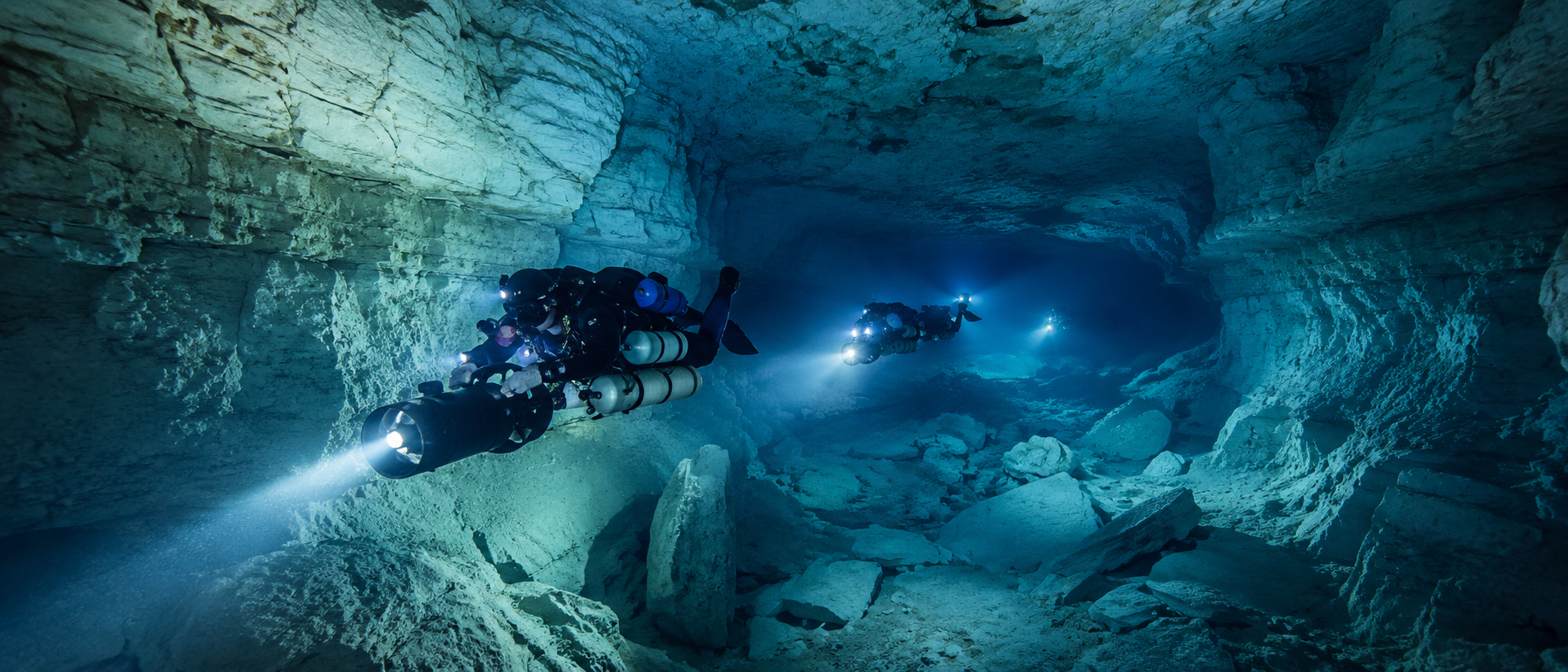
The Philippines is internationally sold through coral reefs, whale sharks, thresher sharks, wrecks and tropical islands. Cave diving is different. It exists mostly outside the tourism spotlight: in technical-diving circles, local exploration groups, scientific papers, cave-management documents and expedition reports.
What emerges from those sources is a surprisingly mature underground story. Some sites are approachable caverns or established training caves. Others are deep mixed-gas dives, low silty restrictions, kilometer-scale hydraulic tunnels, or protected systems entered only for authorized exploration and research.
1. Recreational Caverns — The Visible Edge
For many divers, the first contact with the Philippine underground is not a true cave dive. It is a cavern, swim-through or daylight overhead environment integrated into ordinary reef diving.
Marigondon Cavern — Mactan, Cebu
Marigondon is routinely described by Cebu operators as a large cavern dive. It sits in the deeper advanced range, around 27–30 m depending on the route and reference, and offers an overhead experience while remaining associated with the light zone. It is an excellent example of why terminology matters: a diver may see rock overhead without yet being in a fully developed cave penetration.
Pescador Cathedral — Moalboal
At Pescador Island, shafts, caverns and dramatic light openings create one of the Visayas' classic overhead-style recreational experiences. It is scenic rather than expeditionary — but it introduces the psychological difference between open water and rock above your head.
2. Pawod — A Philippine Training Cave
Pawod Underwater Cave System in Barangay Agus, Mactan Island is one of the most important places in the development of modern Philippine cave diving. Its entrance is almost absurdly ordinary: an urban Cebu water hole not far from roads, houses and the airport. Underneath is a genuine cave environment.
Pawod is shallow enough to tempt the uninitiated, but its low passages, heavy silt and restrictions make it precisely the kind of cave where depth alone gives a false sense of security. It became a proving ground for Filipino technical divers who previously often had to travel abroad for cave training.
3. Mapating Deep — Batangas Has an Underground Side
For divers who know Anilao and Maricaban Island as reef, macro and technical boat-diving country, Mapating Deep is a wonderful surprise. The cave entrance is generally reported in the mid-40 m range, with deeper exploration around 60 m.
Alex Santos names Mapating among his important early Philippine cave dives after becoming cave qualified in North Florida in 1993. He recalls discovering a chamber at approximately 60 m together with MG Ebro and Al Filart.
4. Hinatuan Enchanted River — The Great Philippine Cave Story
The brilliant blue Hinatuan Enchanted River in Surigao del Sur is the surface expression of a complex submerged karst system now known in research literature as the Hinatuan Enchanted River Underwater Cave System (HERUCS).
1999 — Alex Santos
Filipino Cave Divers credits Alex Santos with the first recorded cave exploration of the system in 1999.
2010 — systematic exploration
A major new phase began in February 2010 with Dr. Alfonso “Doc” Amores, Bernil Gastardo and collaborators. Subsequent exploration produced an internal geography that feels wonderfully human: Doc's Door, Bernil's Crawl, Patrice's Way, Mayor's Chamber and Kelvin's Kneecap.
Mayor's Chamber was reported at roughly 37 × 31 m and about 8 m high. Earlier exploration reports mention depths considerably beyond the later scientific sampling route, with expedition accounts referring to approximately 87 m.
2014 — the loss of Doc Amores
On 17 June 2014, Doc Amores died during an exploration dive. Filipino Cave Divers later attributed the death to an undiagnosed heart condition. Jake Miranda recovered him in the main chamber at approximately 40 m.
From exploration to science
The story did not stop with the fatality. Controlled work continued with conservation and scientific partners. A published biophysical survey recorded an entrance around 27.3 m, a sampling station at 41.6 m and an inner station at 49.6 m. Alex Santos and Bernil Gastardo later appeared as co-authors on the scientific work.
5. Lake Bababu — 650 m From Sea to Lake
Lake Bababu in the Dinagat Islands is connected to the sea through an extraordinary fully submerged conduit widely described as approximately 650 m / 2,200 ft long.
Exploration teams approached it from both sides. In 2012 Xavier Garay and Lyndon Cubillan worked from the lake side, while Garay and Jake Miranda worked from the sea. The lines were eventually connected.
In January 2013, Jake Miranda, Daniel Burgaud, Ivar Almhjell and Ho Beng Chia completed a sea-to-lake traverse in 69 minutes. A later traverse was faster. But a reverse attempt demonstrated the cave's hydraulic personality: flow conditions prevented the team from forcing the return and they turned the dive.
6. The Wider Underground — Cebu to Siargao
Casili Underwater Cave System — Balamban, Cebu
Published FCD material reports roughly 250 m of penetration and a maximum depth around 40 m. Casili is remembered for restrictions such as MAD Gate and the Snake Crawl — low, silty passages where equipment configuration matters more than headline depth.
Pamutuanan — Lianga, Surigao del Sur
More than 450 m of passage was documented in a system whose main route can be only 3–6 m deep. A later branch descends through a chimney and a spiral restriction nicknamed the Corkscrew, reaching approximately 25 m. It is a perfect demonstration that shallow cave does not mean easy cave.
Kantaloi Twin Cenotes — Pilar, Siargao
Early penetration was reported around 73 m and later work pushed a route to approximately 120 m. Adjacent openings suggested further cavities, leaving the feeling that the map remained unfinished.
Inner Sanctum — Del Carmen, Siargao
This system combines cave diving with local culture. Expedition reports describe a place regarded by some local traditions as forbidden or inhabited by supernatural beings. Explorers used local guides, bamboo ladders and rappelling just to reach the sump. Below lay a large vertical feature called The Abyss and a restriction near 27 m named Milowka's Restriction.
Paglugaban Cave — El Nido, Palawan
Paglugaban is a submerged geological time capsule. Government cave literature describes very old limestone, large chambers, submerged speleothems, fossils and preserved sediment. Reported chambers reach roughly 30 m high and 45 m wide.
The Bohol reconnaissance
Not every spring becomes a famous cave. FCD reports from Bohol describe reconnaissance at Tigdao, Kabagno, Banilad, Kalorenzo, Convento, Canawa, Dahonog and other sites. Some ended quickly. Some showed promise. Some were simply left as question marks. That is a vital part of exploration culture: turning a dive because there is not enough information is still successful exploration.
7. The People — Building a Filipino Cave-Diving Culture
Alex A. Santos
A Batangas diver who moved into technical diving in the early 1990s and became IANTD cave qualified in North Florida in 1993. His Philippine exploration history includes Mapating Deep, Blue Lagoon, Tumbali, Bohol, Leyte, Palawan and the first recorded Enchanted River cave exploration in 1999. He later became a cave instructor and senior technical educator.
Dr. Alfonso “Doc” Amores
A Mactan native and plastic surgeon who trained in Florida cave diving and became one of the central figures behind Pawod and the modern Central Philippine cave scene. His work with Bernil Gastardo helped turn scattered exploration into a local community and eventually into Filipino Cave Divers.
Bernil H. Gastardo
Merchant mariner, instructor, technical diver and cave explorer. His partnership with Doc Amores became one of the important threads running through Pawod, Hinatuan and Philippine cave development. Later work bridged exploration, survey and scientific collaboration.
Jake Miranda
Former Philippine Navy officer with Special Warfare Group scuba background, cave diver, technical instructor and expedition organizer. His name is closely tied to Lake Bababu, Mindanao exploration, FCD and the idea that Philippine cave safety must include LOCAL knowledge.
Filipino Cave Divers — FCD
Filipino Cave Divers was established in late 2012 through the work of Jake Miranda, Doc Amores, Bernil Gastardo and collaborators. Its identity is broader than sport diving: exploration, survey, documentation, scientific support and protection of Philippine underwater caves.
That interdisciplinary character matters. The most mature cave communities are not just searching for farther penetration. They create maps, preserve line systems, document biology and hydrology, work with local communities and give government agencies enough information to protect places that previously existed only as stories.
8. Philippine Underwater Cave & Cavern List
Published dimensions vary by survey date, route and source. Where reliable numbers were not found, the table says so rather than inventing precision.
| Cave / site | Location | Published depth | Length / penetration | Character / notes |
|---|---|---|---|---|
| Marigondon Cavern | Mactan, Cebu | ~27–30 m | Commercial cavern route; varies | Advanced recreational cavern/light-zone environment. |
| Pawod Underwater Cave | Agus, Mactan, Cebu | ~11 m chamber; Well ~21 m | ~258.42 m mapped directionality reported | Silty genuine cave; major Philippine training/history site. |
| Mapating Deep | Maricaban / Batangas | Entrance ~45–46 m; chamber ~60 m | Reliable full public survey not located | Deep technical cave in famous Batangas diving region. |
| Hinatuan Enchanted River / HERUCS | Hinatuan, Surigao del Sur | Entrance ~27–30 m; scientific stations to 49.6 m; exploration reports ~87 m | Scientific sampling route 98.8 m; exploration farther | Protected research/exploration system; not tourist cave diving. |
| Lake Bababu sea-lake cave | Dinagat Islands | Varies through conduit | ~650 m / 2,200 ft submerged connection | Tidal/flow-sensitive full traverse. |
| Casili Underwater Cave | Balamban, Cebu | ~40 m | ~250 m | Restrictions including MAD Gate and Snake Crawl. |
| Pamutuanan Cave | Lianga, Surigao del Sur | Main route ~3–6 m; branch ~25 m | >450 m explored | Long shallow penetration plus restrictive sidemount branch. |
| Kantaloi Twin Cenotes | Pilar, Siargao | Public depth data limited | ~120 m penetration reported | Cenote system with continuing exploration potential. |
| Inner Sanctum | Del Carmen, Siargao | Restriction ~27 m | Final public dimension unresolved | Vertical access, sump, local folklore and expedition logistics. |
| Paglugaban Cave | El Nido, Palawan | Variable submerged passages | Full public dive-survey metric not located | Large chambers (~30 m high × 45 m wide reported), fossils and submerged speleothems. |
| Tigdao | Bohol | ~8 m reconnaissance | Limited public information | One of several Bohol exploration/reconnaissance springs. |
| Canawa | Bohol | ~15 m reached in reconnaissance | Limited public information | Exploration site; not an established tourist cave dive. |
| Dahonog | Bohol | Reliable public metric not located | Continuing system reported | Part of Bohol reconnaissance history. |
| Blue Lagoon / Tumbali | Tuguegarao / Northern Luzon | Reliable public metric not located | Reliable public metric not located | Named in Alex Santos' exploration history. |
| Campomento Cave | Lanuza, Surigao del Sur | Reliable public metric not located | Reliable public metric not located | Known FCD exploration site. |
9. What Makes Philippine Cave Exploration Different?
The Philippines does not resemble Florida or Mexico, where famous cave systems often sit inside an established cave-diving tourism ecosystem. Here the underground world is dispersed across thousands of islands and tied to local hydrology, village knowledge, difficult logistics and variable access.
Depth is not difficulty
Pamutuanan may be only a few meters deep along much of its main passage, yet hundreds of meters of penetration transform the risk profile. Mapating, by contrast, adds deep mixed-gas demands before the diver has even begun meaningful cave penetration.
The journey to the water can be part of the expedition
Some sites require boats, road travel, local guides, climbing, ladders or rappelling. A cave team may need cooperation from a barangay, landowner or local government before equipment ever touches water.
Folklore and modern exploration overlap
At places such as Inner Sanctum, traditional beliefs are not trivia to be mocked or ignored. They are part of how communities have interpreted dangerous or inaccessible landscapes for generations. Successful explorers work with that culture rather than treating a cave as an empty technical playground.
Science naturally follows the guideline
Once a team can safely reach the dark zone, it can carry cameras, water sampling equipment, biological containers and survey tools. The development of HERUCS from exploration site into scientific study is an excellent example of the cave diver becoming a research platform.
10. Access, Law & Conservation — Certification Is Not Permission
Philippine caves are protected under national cave-management law, including Republic Act No. 9072. DENR cave classification and local management can determine whether a cave is suitable for tourism, specialist visitation, mapping, research or restricted protection.
A cave-diving card does not grant a right of entry. The correct question is not only “Am I trained for this cave?” but also “Is this cave legally and locally open for this purpose today?”
The Philippines Has Two Dive Maps
One map shows Anilao, Puerto Galera, Coron, Moalboal, Malapascua, Apo Island and Tubbataha.
The other shows Pawod, Mapating, Paglugaban, Hinatuan, Bababu, Casili, Pamutuanan, Kantaloi and Inner Sanctum.
The second map is quieter. It is less commercial, less complete and far more dependent on people who are willing to carry line, cylinders, survey tools and scientific equipment into places that still do not have finished maps.
That unfinished quality is exactly what makes Philippine underwater cave exploration so fascinating.
Research trail & further reading
- Filipino Cave Divers (FCD) — primary expedition histories, explorer biographies and cave reports.
- Alex A. Santos profile.
- Pawod Underwater Cave System.
- Hinatuan exploration 2010.
- Hinatuan expedition 2013.
- FCD 2014 retrospective.
- Biophysical Survey of HERUCS.
- Dinagat Islands — Bababu Lake.
- Casili Underwater Cave System.
- Pamutuanan exploration.
- Kantaloi Twin Cenotes.
- Inner Sanctum, Del Carmen.
- 2007 Bohol cave reconnaissance.
- Mapating Cave technical dive-site reference.
- Savedra Cebu cave/cavern diving reference.
- Philippine cave-management reference / DENR-BMB material.
- Republic Act No. 9072.