Music is set to start automatically. If your browser blocks autoplay, click Music On once.
Site Navigation

Cave Dive World · country catalogue

Sweden

Arctic cave exploration · flooded mines · industrial heritage · cold-water overhead.

Cave Dive World banner

approved research integrated · v0.1

Arctic Sumps • Flooded Mines • Karst Research • Industrial Heritage • Cold-Water Overhead

Professional catalogue v0.1 — September 2026

Research and information catalogue. This page is not a dive guide and does not replace training, permissions, current access checks, local knowledge or expedition planning.

Sweden · research catalogue

KCore identity - Arctic cave exploration plus industrial overhead

Sweden combines two distinct overhead cultures. In Jämtland, Bjurälven is a winter-only natural karst exploration project shaped by low-flow Arctic conditions. Farther south, centuries of mining produced a highly organised mine-diving network with common rules, site-specific progression and strong industrial-heritage documentation.

Natural karst research and flooded-mine diving are separate categories and are kept separate throughout this catalogue.

Sweden · research catalogue

National priority catalogue

Bjurälven / Dolinsjögrottan

Region: Jämtland

Type: NATURAL KARST / MULTI-SUMP

Published scale: Dolinsjö 2,432 m surveyed; ~3.35 km mapped across Bjurälven cluster; ~19 m max depth

Status: RESEARCH / PERMIT

KCore note: Sweden’s flagship natural underwater cave; Arctic winter expedition with multiple sumps and dry passages.

Lummelundagrottan

Region: Gotland

Type: NATURAL KARST / ACTIVE WATER CAVE

Published scale: ~4.5 km total cave; active system contains many sumps

Status: PROTECTED / RESEARCH

KCore note: Major Gotland karst system; inner active sections require sump diving.

Korallgrottan

Region: Jämtland

Type: NATURAL KARST / MOSTLY FOSSIL + WET SECTIONS

Published scale: ~6.3 km / 128 m vertical

Status: PROTECTED / RESEARCH

KCore note: Sweden’s longest dry cave system; underwater sections have been explored by divers.

Tuna-Hästberg / Äventyrsgruvan

Region: Dalarna

Type: FLOODED IRON MINE

Published scale: 7+ km permanent guideline; multiple depth zones

Status: ACTIVE / MANAGED

KCore note: World-class mine-diving facility with direct-ascent illuminated zones and full overhead system.

Sala Silvergruva

Region: Västmanland

Type: FLOODED SILVER / LEAD / ZINC MINE

Published scale: Historic mine bottom ~190 m below ground; submerged routes include ~30 m class and deeper technical levels

Status: ACTIVE / PROJECT-MANAGED

KCore note: Industrial archaeology with structured project, experience and guest-diving pathways.

Långban

Region: Värmland

Type: FLOODED IRON / MANGANESE / DOLOMITE MINE

Published scale: Mine ~370 m deep; diving exploration ~100-115 m level

Status: ACTIVE / CLUB-MANAGED

KCore note: Premier deep mine-diving environment and internationally important mineral locality.

Nordmarksberg

Region: Värmland

Type: FLOODED IRON MINE

Published scale: Exploration documented around 60-70 m levels

Status: ACTIVE / MANAGED

KCore note: Industrial archaeology project; submerged mine equipment preserved in situ.

A-gruvan

Region: Sweden · sensitive location

Type: FLOODED MINE

Published scale: Detailed metrics intentionally limited

Status: ACTIVE / MANAGED

KCore note: Established organised site; KCore preserves its deliberately low-profile public treatment.
Sweden · research catalogue

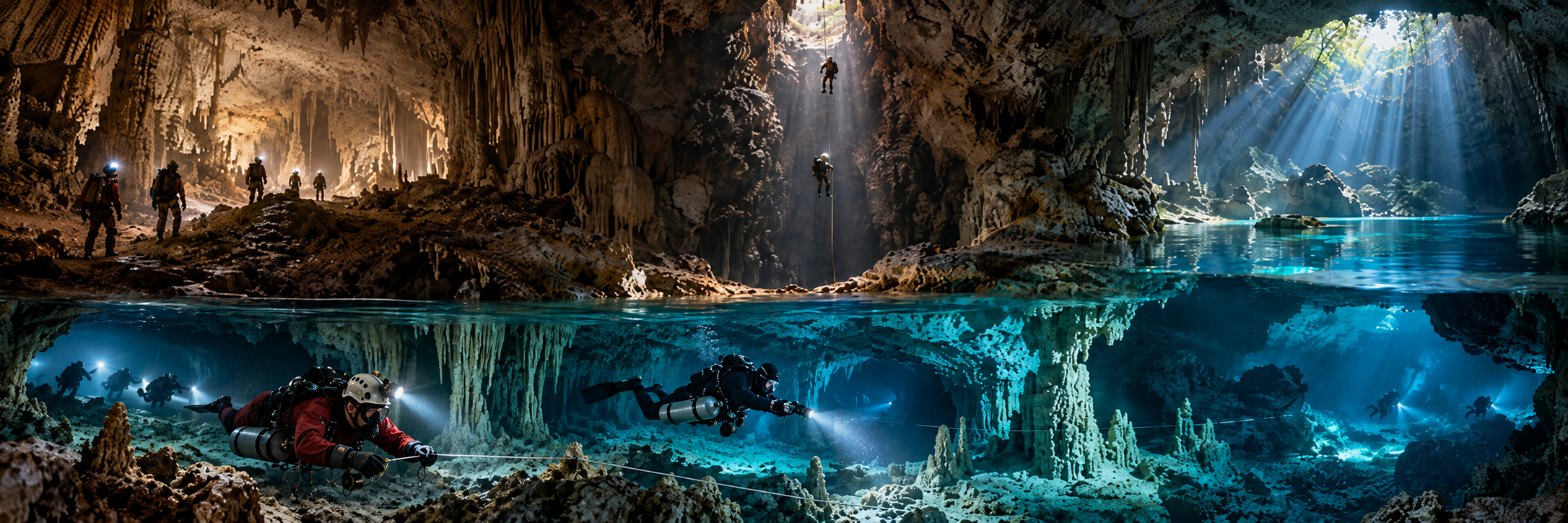
Bjurälven - Sweden’s Arctic underwater cave frontier

The Bjurälven river disappears into a narrow limestone belt near Stora Blåsjön and resurges kilometres downstream. Bo Lenander identified the possible Dolinsjön entrance in 1979. Summer flow proved extreme, so the modern project established late winter as the practical exploration window.

Expedition Bjurälven began in 2007 and has become a long-running research project. Dolinsjögrottan is surveyed to 2,432 m and the wider cave cluster to roughly 3.35 km. The route is shallow by depth standards but demanding: tight sidemount entry, a first sump approaching 500 m, five sumps, four dry sections, sand restrictions, loose rock and multi-hour logistics.

Access is research-based. The valley is a nature reserve and Natura 2000 area; underwater cave diving requires County Administrative Board permission, with separate permissions for protected-valley transport.

Sweden · research catalogue

Lummelunda, Korallgrottan and northern karst

  • Lummelundagrottan — ~4.5 km Gotland system with active sump passages; protected show cave and research environment.
  • Korallgrottan — ~6.3 km / 128 m vertical, mostly fossil but with explored wet sections; protected nature reserve.
  • Bjurälven and Korallgrottan demonstrate that Sweden, unlike Finland, has nationally significant natural karst cave-diving environments.

Sweden · research catalogue

Swedish mine-diving culture and organised sites

SvenskGruvdykning coordinates core rules across A-gruvan, Långban, Nordmarksberg, Sala Silvergruva and Tuna-Hästberg. Shared principles include no solo diving, protection of permanent lines and artefacts, formal overhead competence for relevant routes, and progressive approval for deeper or more complex dives.

  • Tuna-Hästberg / Äventyrsgruvan — 7+ km guideline, heated facilities, gas support, open-water and full-overhead zones.
  • Sala Silvergruva — project-managed industrial archaeology; guest teams remain on approved routes, with deeper sectors requiring site-specific progression.
  • Långban — deep technical mine exploration to roughly 100-115 m levels in a ~370 m-deep historic mine.
  • Nordmarksberg — documented 60-70 m-level exploration and industrial archaeology.
  • A-gruvan — nationally established but deliberately low-profile; sensitive location/details are not reproduced.
  • Utö and other Bergslagen workings — project or case-by-case only; existence of flooding does not imply public access.

Sweden · research catalogue

Rescue and accident history - factual, not sensational

  • Sala Silvergruva 2007 — serious post-dive neurological event; later military investigation identified an oxygen-fraction problem linked to incorrect equipment/manufacturer information.
  • Tuna-Hästberg 2018 — Finnish technical diver died around 400 m into the system at about 20 m depth; police found accidental drowning and no equipment defect.
  • Tuna-Hästberg 2025 — two further fatalities; the December recovery required specialist assistance from the Finnish Coast Guard.
  • August 2026 — police closed the December 2025 investigation, reporting an acute medical cause and no equipment fault.

Sweden · research catalogue

People, teams and exploration culture

  • Bo Lenander — recognised the Dolinsjön entrance in 1979.
  • Nicklas Myrin and Johan Utas — key leaders in the modern Bjurälven winter-expedition era.
  • Mats Fröjdenlund — long-term Bjurälven leader and public voice for exploration/3D work.
  • Micke Tilja — cave diver/photographer and major Bjurälven documentarian.
  • Anders Etander — technical/cave/mine instructor, Tuna-Hästberg dive manager, active across organised Swedish mines.
  • Jonas Pavletic — key Sala Silvergruva Dykarklubb figure.
  • In Water Under Land (IWUL) — mine exploration and 3D-photogrammetry team.
  • Sveriges Speleologförbund (SSF) — national speleological federation supporting research access and documentation.

Sweden · research catalogue

Modern training - documented, but not the centre of the story

Domestic cave and mine training is available through Swedish technical instructors and agencies, including work in organised mines. Tuna-Hästberg explicitly recognises cave/mine qualifications for its overhead network. KCore separates certification from site-specific experience ladders and from exploration history.

Sweden · research catalogue

Discovery frontiers - unfinished underground water

Bjurälven hydrological connection

Frontier: Connect Dolinsjö, Bjurälvsgrottan, Meander Cave and adjacent sinks/resurgences into a continuous humanly explored route.

Meander Cave

Frontier: Sand-removal work and camera footage beyond a restriction indicate larger passage.

Lummelunda active system

Frontier: Upstream hydrology between Martebo mire sinks and the inner sump network remains incomplete.

Bergslagen flooded-mine archaeology

Frontier: Identify stable, permitted mines where industrial heritage justifies organised documentation.

Digital mine preservation

Frontier: Expand 3D documentation at Sala, Långban, Nordmarksberg, Tuna-Hästberg and selected historic workings.

Deep Långban

Frontier: The mine extends far deeper than the routinely explored ~100-115 m zone; future work is constrained by access, cold, decompression and project purpose.

Sweden · research catalogue

Access, protection and publication discipline

  • Bjurälven — RESEARCH / PERMIT; protected reserve and Natura 2000.
  • Lummelundagrottan — PROTECTED / RESEARCH; show-cave access does not imply sump access.
  • Korallgrottan — PROTECTED / RESEARCH; cave access restricted except approved research/documentation/guiding.
  • Tuna-Hästberg — ACTIVE / MANAGED; site-specific progression rules.
  • Sala Silvergruva — ACTIVE / PROJECT-MANAGED; guest routes and depth limits are controlled.
  • Långban — ACTIVE / CLUB-MANAGED; booking through local club.
  • A-gruvan — ACTIVE / MANAGED but deliberately low-profile; do not publish sensitive location details.

Sweden · research catalogue

Selected source backbone

  • Expedition Bjurälven — project overview, cave details and history
  • Jämtland County Administrative Board — Bjurälven reserve and permit rules
  • SGU — Bjurälven karst landscape and Korallgrottan context
  • Lummelunda Cave / Gotland County Administrative Board — cave and reserve information
  • Äventyrsgruvan — current mine-diving information and common mine rules
  • Swedish Diving Federation — Grott- och Gruvdykning 2025
  • Sala Silvergruva Dykprojekt — current FAQ and project access
  • Värmlands Museum — Långban underwater documentation
  • Nordmarks Hembygdsförening — Nordmarksberg history and exploration
  • In Water Under Land — mine exploration and photogrammetry
  • Swedish public-service reporting — Sala and Tuna-Hästberg incident investigations
Publication rule: separate natural karst from mine diving; distinguish depth below ground from diving depth below the current water surface; preserve sensitive site information and conservation permit requirements.