Music is set to start automatically. If your browser blocks autoplay, click Music On once.
Site Navigation

Cave Dive World · country catalogue · integrated

Spain

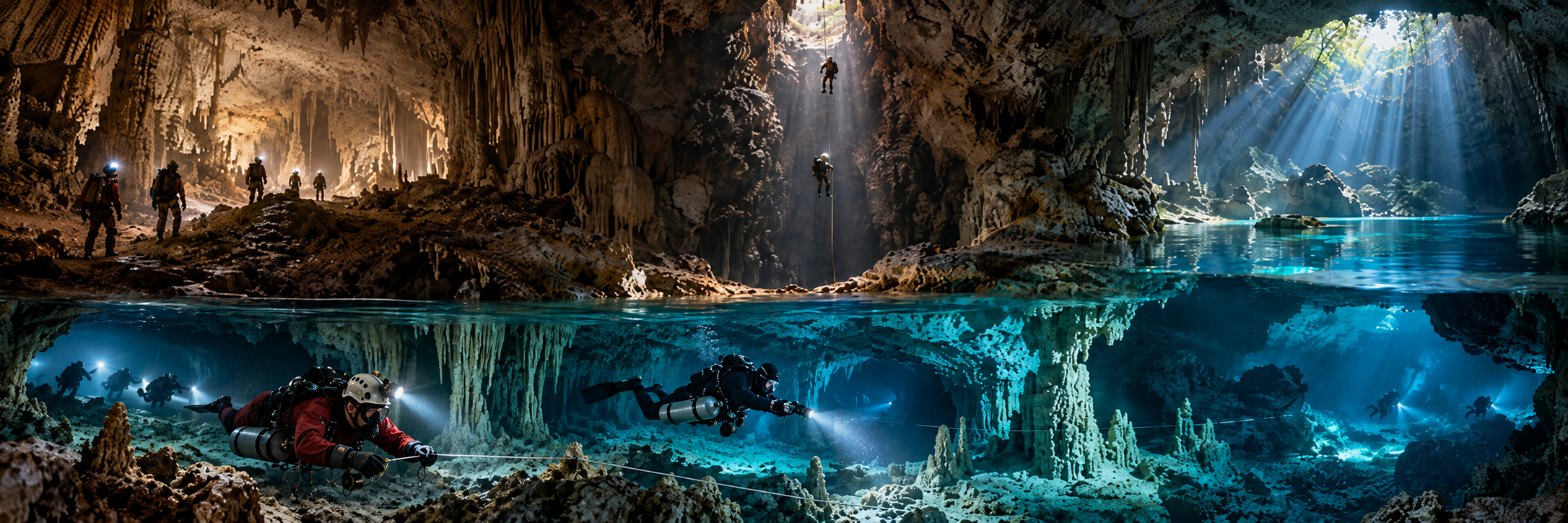
Spain is one of Europe's most varied cave-diving countries. Burgos contains the extraordinary long-range Pozo Azul and the deepest documented Spanish siphon at Fuente Azul; Mallorca contains some of Europe's largest coastal anchialine cave systems; Murcia has the warm hydrothermal labyrinth of Cueva del Agua; the Mediterranean coast adds major resurgences such as Moraig; and the Canary Islands add volcanic underwater tunnels.

Cave Dive World banner

approved research integrated · v0.1

Natural Caves • Springs • Anchialine Systems • Volcanic Tunnels • Mines • Quarries • Exploration Frontiers

Research draft v0.1 — September 2026

Research and information catalogue. This page is not a dive guide and does not replace training, permissions, current access checks, local knowledge or expedition planning.

Spain · research catalogue

Spain in cave-diving history and people

Spain combines cold-water expedition speleo-diving, warm hydrothermal cave training, anchialine scientific exploration and volcanic underwater caves. Its history is unusually international: local Spanish groups opened the major systems and later multinational teams extended several of them to world-class scale.

People to know — short notes

  • Joaquín Plana - Grupo Edelweiss pioneer; began Pozo Azul exploration in 1964 and reached 200 m by 1966.
  • Jason Mallinson - British Cave Diving Group explorer; central to modern extreme-distance pushes in Pozo Azul.
  • Rick Stanton & John Volanthen - British long-range cave divers involved in Pozo Azul’s major modern exploration era.
  • René Houben - Dutch cave diver and major Pozo Azul expedition participant.
  • Martín Burgui - Spanish explorer associated with Fuente Azul; reached the -135 m level in the 2000s.
  • José Luis Llamusí & Andrés Ros - Foundational figures in the long-term Cueva del Agua project in Cartagena.
  • Juan Sánchez - Important Cueva del Agua explorer; key work beyond the early known system.
  • Francesc Gràcia - Major Mallorcan speleo-diver/researcher; decades of exploration and scientific work in coastal underwater caves.
  • Bernat Clamor, Pere Gamundí & Joan J. Fornós - Core collaborators in Mallorca underwater-cave exploration, surveying and karst research.
  • Joel Borrazás - Modern Spanish speleo-diver associated with Mediterranean resurgence exploration.

Spain · research catalogue

National cave-diving catalogue

Pozo Azul

Region: Castilla y León / Burgos

Location: Covanera, Tubilla del Agua

Type: Karst resurgence / multi-sump system

Length: 13,755 m total (2017 catalogue)

Depth: +55/-71 m; S2 5,160 m / -71 m

Status: EXPLORATION / ADVANCED

Explorers: Joaquín Plana; G.E. Standard; Gaia; CDG; Jason Mallinson, Rick Stanton, John Volanthen, René Houben and Spanish support teams

KCore note: One of Europe’s great long-range cave-diving systems; S6 still continued at last published data.

Fuente Azul

Region: Castilla y León / Burgos

Location: Hortigüela

Type: Deep resurgence / siphon

Length: 580 m

Depth: +4/-135 m

Status: EXTREME / EXPLORATION

Explorers: GEE, STD, CDG, AGET, IZURDE; Martín Burgui

KCore note: Deepest documented Spanish siphon.

Pozo San Vicente

Region: Castilla y León / Burgos

Location: Pesquera de Ebro

Type: Resurgence / major siphon

Length: 390 m

Depth: -69 m

Status: RESEARCH / TECHNICAL

Explorers: Regional cave-diving teams; Grupo Edelweiss

KCore note: Compact but deep system in the Ebro-Rudrón canyon karst.

Ojo Guareña submerged sectors

Region: Castilla y León / Burgos

Location: Merindades

Type: Huge dry cave system with active submerged connections

Length: >110 km connected system; submerged sectors variable

Depth: source-dependent

Status: RESEARCH / EXPEDITION

Explorers: Grupo Edelweiss and collaborating cave divers

KCore note: Diving helped connect resurgence sectors to the immense Ojo Guareña network.

Cueva del Agua - Isla Plana

Region: Murcia

Location: Cartagena

Type: Warm hydrothermal flooded labyrinth

Length: 7,169 m surveyed (Dec 2024)

Depth: ~ -34 m catalogue metric; ~28°C water

Status: ACTIVE EXPLORATION + TRAINING

Explorers: Llamusí, Ros, Sánchez, García and Grupo Cueva del Agua LIMITE10000

KCore note: Spain’s key warm-water cave-training environment; exploration lines are not tourist/training lines.

Sima Destapada flooded terminal zone

Region: Murcia

Location: Isla Plana / Cartagena

Type: Deep dry shaft cave ending in flooded continuation

Length: >3,000 m dry development

Depth: flooded section at ~-230 m cave depth

Status: RESEARCH / EXPEDITION

Explorers: Llamusí, Ros, Romans and Cueva del Agua project teams

KCore note: Major hydrothermal-network frontier near Cueva del Agua; underwater continuation follows a serious dry-cave descent.

Cueva del Moraig / Riu Blanc

Region: Comunitat Valenciana

Location: Benitatxell, Alicante

Type: Coastal resurgence / long submerged cave

Length: ~5,087 m current exploration figure

Depth: to ~-100 m

Status: EXPLORATION / ACCESS TO VERIFY

Explorers: OTXOLA and modern Mediterranean cave-diving teams; Joel Borrazás

KCore note: One of Spain’s great Mediterranean resurgences; strong flow and salt/fresh-water mixing.

Font Bordonera

Region: Catalonia

Location: Coll de Nargó, Alt Urgell

Type: Karst spring / submerged cave

Length: ~955 m

Depth: -80 m

Status: RESEARCH / TECHNICAL

Explorers: Catalan cave-diving teams

KCore note: Major Catalan deep-spring system and Pre-Pyrenean exploration target.

La Falconera

Region: Catalonia

Location: Sitges / Garraf

Type: Coastal karst resurgence

Length: ~600 m+ documented sector

Depth: -81 m

Status: RESEARCH / TECHNICAL

Explorers: Catalan speleo-diving groups

KCore note: Historic Garraf coastal-karst site important for Mediterranean groundwater and cave-diving history.

Cueva de Zarzalones

Region: Andalusia / Málaga

Location: Yunquera

Type: Spring cave / long submerged system

Length: ~1,726 m

Depth: source-dependent

Status: EXPLORATION / LOCAL ACCESS

Explorers: Proyecto Zarzalones and Andalusian cave-diving teams

KCore note: Major Andalusian submerged cave and regional exploration project.

Sistema Gleda - Camp des Pou

Region: Mallorca / Manacor

Type: Anchialine coastal cave system

Length: 14,620 m total; 13,720 m underwater

Depth: ~25 m

Status: PROTECTED / RESEARCH / SPECIALIST

Explorers: Francesc Gràcia, Bernat Clamor, Pere Gamundí, Joan J. Fornós and teams

KCore note: One of Europe’s longest underwater littoral cave systems.

Cova des Coll

Region: Mallorca / Manacor-Felanitx

Type: Anchialine coastal cave

Length: ~5,529 m underwater; ~7,020 m total historical figure

Depth: shallow/moderate

Status: PROTECTED / RESEARCH

Explorers: Societat Espeleològica Balear and collaborators

KCore note: Another major Mallorcan coastal labyrinth.

Cova d’en Bessó / Genovesa

Region: Mallorca / Manacor

Type: Anchialine cave

Length: multi-kilometre research system

Depth: shallow/moderate

Status: PROTECTED / RESEARCH

Explorers: Balearic speleologists and UIB-associated research teams

KCore note: Important archaeologically and paleontologically as well as hydrologically.

Cova des Pas de Vallgornera

Region: Mallorca / Llucmajor

Type: Huge coastal cave with flooded sectors

Length: one of Mallorca’s giant cave systems

Depth: submerged sectors variable

Status: STRICTLY PROTECTED / SPECIALIST

Explorers: Mallorcan speleological organisations and research teams

KCore note: Internationally important system; permissions and conservation restrictions are fundamental.

Cova des Drac des Rafal des Porcs

Region: Mallorca / Santanyí

Type: Coastal/anchialine cave

Length: research system; ongoing survey

Depth: shallow/moderate

Status: PROTECTED / RESEARCH

Explorers: Gràcia, Clamor, Perelló, Cirer, Gamundí and SEB collaborators

KCore note: Modern research continues to document new sectors and coastal-karst evolution.

Túnel de la Atlántida / Jameos del Agua volcanic tube

Region: Lanzarote, Canary Islands

Location: Haría

Type: Submerged lava tube / volcanic cave

Length: ~1,072 m submerged

Depth: to ~-52.1 m

Status: RESEARCH / PROTECTED

KCore note: Ocean-flooded lava tube connected to the Corona volcanic system; completely different genesis from limestone caves.

Spain · research catalogue

Flooded mines, quarries and artificial overhead

Spain has many flooded mining and quarry workings, but legitimate scuba access is much harder to verify than their physical existence. For KCore, “flooded” is not enough: a site is promoted as diveable only when current operator, club or authority information confirms legal access.

Iberian Pyrite Belt flooded workings

Location: Huelva / Andalusia

Type: FLOODED MINES / OPEN PITS

Scale: Many inactive historic mines are partly flooded

Status: ACCESS GENERALLY NOT VERIFIED

KCore note: Major industrial-overhead potential for future heritage/scientific projects, but no current general public mine-diving operation was verified.

Cueva de la Mora mine

Location: Almonaster la Real, Huelva

Type: PARTLY FLOODED OPEN MINE / PIT

Scale: historic open cut partly flooded

Status: NOT VERIFIED AS DIVE SITE

KCore note: Industrial-hydrological context only, not a dive recommendation.

Spanish quarry training sites

Location: multiple provinces

Type: FLOODED QUARRIES / OPEN WATER

Scale: site-specific

Status: LOCAL / CLUB-SPECIFIC

KCore note: Future passes should add only quarries with current operator, published rules and verified depth/access.

Spain · research catalogue

Where cave-diving training is available today

Spain has one unusually practical advantage: warm-water cave training in Murcia. Scuba Murcia currently advertises Cavern, Intro to Cave and Full Cave programmes conducted in Cueva del Agua, with 28°C spring water. Mallorca centres also advertise guided cave/cavern dives, but protected anchialine systems require specialist permissions.

  • Scuba Murcia - TDI/PSAI technical and cave training, Cueva del Agua
  • Scuba Murcia - PSAI Full Cave course
  • Scuba Murcia - PSAI Intro to Cave course
  • Scuba Mallorca - guided cavern/cave-style coastal dive sites
  • Balearic Federation - protected cave/Natura 2000 framework

Spain · research catalogue

Discovery frontiers - where Spain may still surprise us

Pozo Azul / Burgos plateau

Context: The sixth siphon is still recorded as continuing.

Potential: Extension beyond S6, new dry entrances, bypasses and plateau connections reducing extraordinary underwater logistics.

Discovery year: 20?? - thirteen kilometres was apparently only the beginning.

Fuente Azul and Burgos deep resurgences

Context: Fuente Azul reached -135 m but remains compact within a karst region full of active groundwater routes.

Potential: Deeper continuation, side windows, new connections and additional deep springs.

Discovery year: 20?? - short cave, deep secrets.

Mallorca eastern and southern coastal karst

Context: More than 50 km of submerged coastal passage had already been investigated in long-term research.

Potential: Additional cave connections, collapse entrances, submerged extensions and archaeological/biological discoveries.

Discovery year: 20?? - probably shallow, enormous and under somebody’s garden.

Cueva del Agua hydrothermal network - Cartagena

Context: The project links Cueva del Agua with nearby shafts, caves and mines in a hydrothermal network.

Potential: Connection of neighbouring cavities, new labyrinth sectors and progress toward the 10 km survey objective.

Discovery year: 20?? - the project name already tells us the target.

Moraig / Marina Alta coastal karst

Context: Riu Blanc/Moraig exceeds 5 km and reaches around -100 m.

Potential: Deeper inland continuation, new sea/spring connections and parallel conduits.

Discovery year: 20?? - one of Spain’s strongest Mediterranean candidates.

Cantabrian Mountains

Context: Gigantic dry alpine cave systems often terminate on active underground rivers and sumps far from entrances.

Potential: Major post-sump systems, links between deep vertical caves and valley resurgences, and new expedition-scale underwater routes.

Discovery year: 20?? - first carry the dive kit a few kilometres underground.

Andalusian karst - Málaga / Grazalema / Sierra de las Nieves

Context: Zarzalones and other springs prove significant submerged development.

Potential: Longer resurgence systems, post-sump dry cave and hydrological links from high karst to valley springs.

Discovery year: 20?? - when the winter rain allows it.

Canary volcanic tubes

Context: Atlántida proves that overhead exploration in Spain is not limited to limestone.

Potential: New submerged volcanic passages, biological discoveries and coastal tube connections.

Discovery year: 20?? - the lava stopped; exploration did not.

Spain · research catalogue

Local culture - what makes Spain distinctive

Spain does not have one cave-diving culture. Burgos is long-range cold-water expedition diving; Mallorca is shallow scientific anchialine exploration; Murcia is warm-water labyrinth diving with a strong training component; Mediterranean coastal resurgences add deep flow-driven exploration; Cantabria and Asturias bring classic dry-cave-to-sump expeditions; Lanzarote adds volcanic overhead.

The history is unusually international. Pozo Azul began with local Grupo Edelweiss divers and later became a multinational long-range project. Mallorca’s underwater karst has been advanced by local speleologists working closely with university researchers. Cueva del Agua represents another long-lived multidisciplinary model combining exploration, surveying, hydrothermal science and safety protocols.

Spain · research catalogue

Historical and modern KCore sidebars

1964 - Pozo Azul begins

Story: Joaquín Plana of Grupo Edelweiss makes the first documented modern exploration dives.

1966 - 200 m means a record

Story: Plana reaches 200 m penetration with equipment primitive beside modern CCR/DPV systems.

Pozo Azul becomes international

Story: Mallinson, Stanton, Volanthen, Houben and multinational support teams transform the cave into a great long-range exploration project.

Fuente Azul - Spain goes deep

Story: Burgos divers push a compact resurgence to -135 m.

Cueva del Agua - from 30 m map to 7.169 km

Story: The Cartagena project grew from tiny early surveys to a 7.169 km mapped hydrothermal labyrinth by December 2024.

Mallorca - a thousand days underwater

Story: Francesc Gràcia’s doctoral research was based on more than 1,000 days of immersion and over 50 km of submerged cave exploration.

Atlántida - when cave diving becomes volcanology

Story: Lanzarote adds a flooded lava-tube system to a catalogue otherwise dominated by limestone.