Music is set to start automatically. If your browser blocks autoplay, click Music On once.
Site Navigation

Cave Dive World · country catalogue

South Africa

Boesmansgat · Komati Springs · Wondergat · Bobbejaansgat · Sterkfontein · deep exploration · mine diving · rescue.

Cave Dive World banner

integrated research · v0.1

South Africa — depth, altitude, dolomite and a genuine mine-diving culture

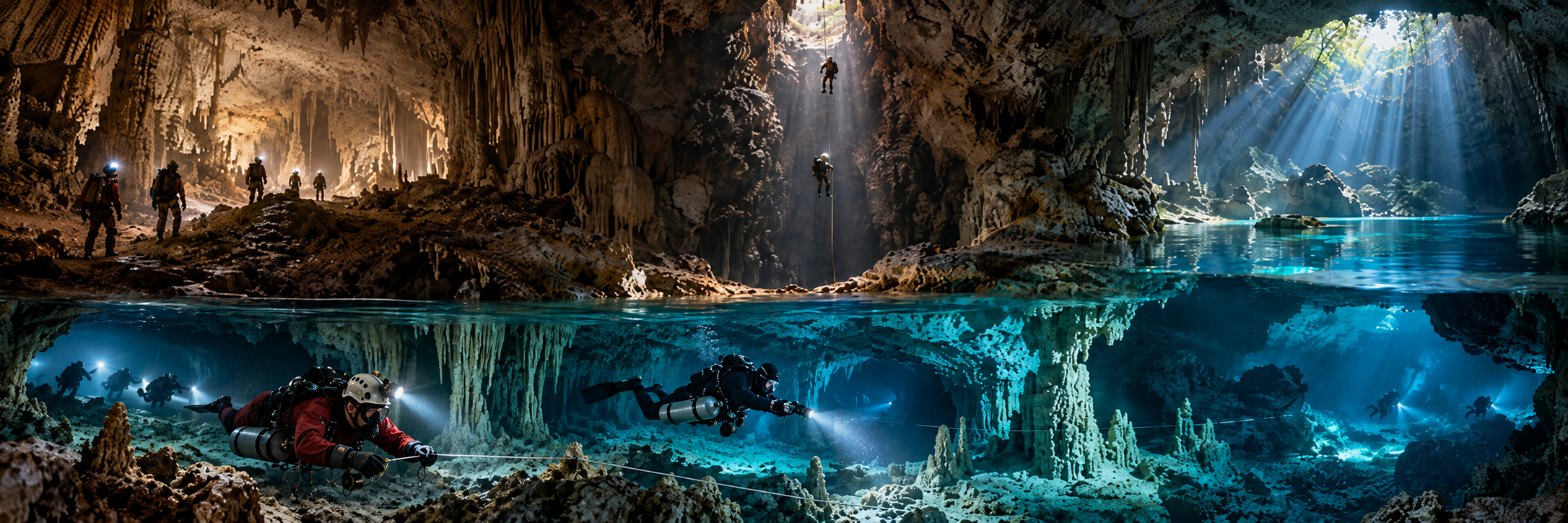
South Africa’s cave-diving identity is unusually vertical and inland: deep dolomite sinkholes, altitude, collapsed caverns, a true flooded mine and an expedition culture that helped shape mixed-gas and rebreather practice.

Boesmansgat, Komati, Wondergat, Bobbejaansgat and Sterkfontein are different classes of overhead environment. Their access, geometry and accident histories must never be collapsed into one generic ‘cave-diving’ category.

South Africa · research catalogue

National priority cave and overhead catalogue

Boesmansgat / Bushman’s Hole

Region: Northern Cape

Type: EXTREME DEEP FRESHWATER CAVE / SINKHOLE

Published scale: floor ~283–284 m; altitude ~1,500–1,550 m

Status: EXTREME EXPEDITION / PRIVATE ACCESS

KCore note: Historic extreme-depth site: Gomes 282.6 m, Dreyer/Shaw recovery tragedy, 2024 hydrogen dives.

Komati Springs / Badgat

Region: Mpumalanga

Type: FLOODED ASBESTOS MINE + CAVE SYSTEM

Published scale: open water ~55 m; 8 interconnected levels; explored to ~186 m

Status: ACTIVE / MANAGED / TRAINING / TECHNICAL

KCore note: South Africa’s flagship true flooded-mine overhead and technical-training site.

Wondergat

Region: North West

Type: COLLAPSED DOLOMITE CAVERN / SINKHOLE

Published scale: surface ~75 × 100 m; main shaft ~36 m; max ~58 m

Status: ACTIVE / MANAGED / ADVANCED TRAINING

KCore note: Classic inland altitude site with side caverns and long accident history.

Bobbejaansgat

Region: North West / Ottoshoop

Type: PRIVATE COLLAPSED DOLOMITE CAVE

Published scale: main chamber ~120 m long; ~48 m deep; side caves unresolved

Status: PRIVATE / PERMISSION / EXPEDITION

KCore note: Gear-hauling and owner access are integral to the dive.

Sterkfontein underground lake / passages

Region: Gauteng / Cradle of Humankind

Type: NATURAL CAVE / HISTORIC CAVE DIVING

Published scale: complex underground pools and creeks

Status: PROTECTED / NO CAVE DIVING

KCore note: 1984 Peter Verhulsel tragedy; now a major science and heritage site.

Sudwala cave water passages

Region: Mpumalanga

Type: DRY CAVE / WET SPELEOLOGY

Published scale: tour ~600 m; deeper adventure sectors involve water and crawling

Status: SHOW CAVE / SPELEOLOGY

KCore note: Important caving culture; no major current scuba route verified.

Cradle of Humankind dolomite caves

Region: Gauteng / North West

Type: PALEOKARST / SCIENCE

Published scale: 2,100+ caves documented regionally by SASA across Southern Africa

Status: RESEARCH / CONSERVATION

KCore note: World-class palaeoanthropology; generally not cave-diving sites.
South Africa · research catalogue

National KCore identity — depth, altitude, dolomite and expedition culture

South Africa’s best-known submerged caves are deep dolomitic sinkholes, collapsed caverns and a genuine flooded mine rather than long shallow spring conduits. Altitude is integral: Wondergat and Boesmansgat sit around 1,400–1,550 m above sea level, so depth and decompression cannot be viewed as sea-level equivalents.

The national culture grew from inland club diving, technical experimentation and strong dry speleology. South African divers also became central to the wider Southern African expedition network in Namibia and Zimbabwe.

South Africa · research catalogue

Boesmansgat — extreme depth and the hydrogen era

Boesmansgat is a small-looking surface pool above a vast flooded dolomite chamber. Nuno Gomes reached 282.6 m in 1996, a landmark freshwater-cave depth achievement. Verna van Schaik reached 221 m in 2004, and Karen van den Oever reached 246.56 m in 2022.

In May 2024 Richard Harris and Craig Challen returned for the ‘Dark Side of the Moon’ project. Published reports place Harris near 283.9–284 m using hydrogen in a twin-rebreather breathing strategy, with Challen later around 272 m. Harris subsequently suffered spinal decompression sickness requiring hospital treatment.

KCore treats all of these as dated expedition figures, not timeless records.

South Africa · research catalogue

Deon Dreyer and Dave Shaw — recovery at the edge of survivability

Deon Dreyer disappeared in Boesmansgat in December 1994. In October 2004 Dave Shaw unexpectedly located his body at roughly 270 m while diving a modified Mk15.5 rebreather.

Shaw returned on 8 January 2005 to attempt recovery and died after becoming entangled during the task; deep support diver Don Shirley also suffered a severe event and narrowly survived. Both bodies later floated upward and were recovered.

This history is not adventure marketing. It is a classic case of extreme depth, task loading, breathing-gas density, work of breathing, entanglement and human commitment converging in a recovery mission.

South Africa · research catalogue

Komati Springs / Badgat — true flooded mine overhead

Komati was an asbestos mine until 1972. When pumping stopped, groundwater flooded the open pit and connected underground workings. Current site information gives about 55 m open-water depth and eight interconnected submerged levels explored to approximately 186 m.

The site is therefore a true artificial-overhead mine system, not merely a flooded quarry. It is also a major training facility with shallow grids, gas support and IANTD Southern Africa based on site.

Dave Shaw reached roughly 182 m in the mine in 2003; Don Shirley reached the bottom of the deepest shaft near 186 m shortly afterward. Komati became a technical laboratory for techniques later taken to Boesmansgat.

South Africa · research catalogue

Wondergat and Bobbejaansgat — inland dolomite cave culture

Wondergat is a collapsed dolomite cavern with a large open central shaft and side caverns, reaching about 58 m at approximately 1,440 m altitude. It remains an active managed advanced-training site with camping, fills and emergency oxygen.

Its accident history is long, but KCore separates ‘fatality at Wondergat’ from ‘fatality caused by cave penetration’. Depth, darkness, altitude, visibility and side-cavern exposure can interact even when the dive begins in open water.

Bobbejaansgat is the less polished private-site counterpart: significant cave roof over the water, a main chamber roughly 120 m long and 48 m deep, unresolved side caves and real rope/gear-hauling logistics.

South Africa · research catalogue

Sterkfontein 1984 — he survived the dive, but nobody found the island

In September 1984 Peter Verhulsel became separated from the guideline while exploring Sterkfontein’s underground water passages. He did not drown. He reached a small dry island at the end of a blind water passage and waited in darkness.

Search divers repeatedly worked the cave and apparently passed within tens of metres. His body was found roughly six weeks later; evidence indicated he survived for about three weeks before dying from starvation and exposure.

Modern diving is not permitted at Sterkfontein. The cave is now a globally important protected paleoanthropology site. The rescue history remains one of the clearest demonstrations that reaching air beyond a sump does not guarantee rescue.

South Africa · research catalogue

Speleology, science and the Cradle of Humankind

The South African Speleological Association, founded in 1954, links national cave exploration, science, conservation and rescue history. Its clubs form the dry-caving culture behind many underwater projects.

Sterkfontein, Swartkrans, Rising Star, Kromdraai and related Cradle caves are world-class palaeoanthropological sites. They belong in Cave Dive World for geology, hydrology and cave culture, not because every water body is a dive target.

Sudwala similarly represents wet speleology and active caving rather than a verified modern scuba-cave route.

South Africa · research catalogue

Training, rescue and artificial-overhead discipline

South Africa has mature technical training. IANTD Southern Africa at Komati lists cave, mine, wreck and rebreather pathways; Wondergat remains a major inland advanced/technical training environment.

Artificial-overhead classification must stay strict. Komati is verified true flooded mine overhead. Other flooded mines, quarries and pits should not be called mine dives without legal access and documented submerged workings.

South Africa · research catalogue

People and organisations

Nuno Gomes — South African deep/cave pioneer and 282.6 m Boesmansgat diver.
Don Shirley — Komati technical/cave instructor and Boesmansgat recovery participant.
Dave Shaw and Deon Dreyer — central to the Boesmansgat recovery history.
Verna van Schaik and Karen van den Oever — major women’s deep-diving milestones at Boesmansgat.
Richard Harris and Craig Challen — 2024 hydrogen-based Boesmansgat project.
Peter Verhulsel — Sterkfontein 1984 rescue-history figure.
SASA / SEC / IANTD Southern Africa — core speleological and technical-diving institutions.

South Africa · research catalogue

Discovery and research frontiers

Boesmansgat: detailed modern bottom geometry and sediment mapping remain less developed than the site’s fame.
Komati: eight mine levels invite photogrammetry and industrial-heritage mapping, not just deeper diving.
Bobbejaansgat: unresolved side caves remain on private land.
Dolomite sinkhole inventory: not every flooded collapse is a legitimate dive site.
SASA archives: decades of bulletins may preserve overlooked surveys and accident history.
Cradle groundwater: science and heritage must dominate any exploration interest.
Southern African atlas: the cultural network extends across South Africa, Namibia and Zimbabwe without erasing country boundaries.

South Africa · research catalogue

Selected source backbone

South African Speleological Association archives; Wondergat and Komati Springs current site information; IANTD Southern Africa; Nuno Gomes biography and Guinness records; Outside Magazine’s Dave Shaw / Dreyer account; Don and André Shirley expedition material; Wits University Sterkfontein research; archival reporting on Peter Verhulsel; 2024 Boesmansgat Dark Side of the Moon project reports.

Publication rule: do not reduce South Africa to the Shaw tragedy or to depth records. Distinguish natural sinkhole, flooded mine, collapsed cavern and protected historic cave; include altitude in deep-site context; treat recovery histories respectfully; preserve private access; and never infer mine-diving permission from the country’s mining scale.