Music is set to start automatically. If your browser blocks autoplay, click Music On once.
Site Navigation

Cave Dive World · country catalogue · integrated

Slovenia

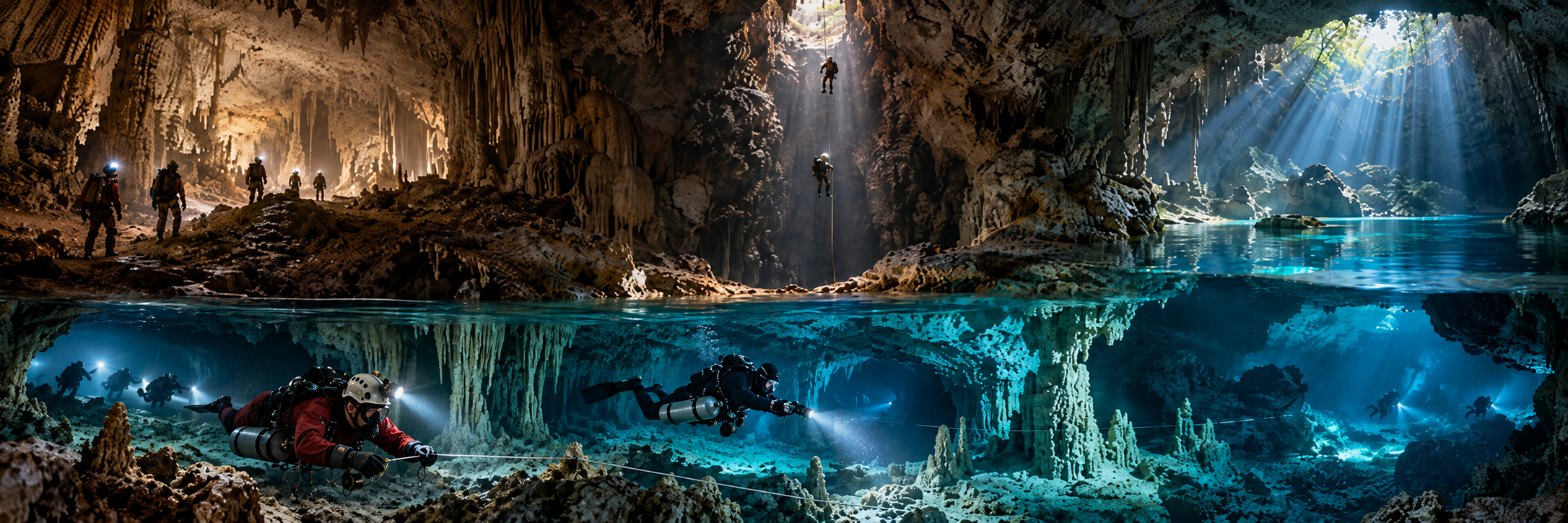
Slovenia is one of the world's great karst countries and one of the birthplaces of karst science itself. Its cave-diving culture is primarily exploration- and research-driven rather than destination-style tourism. Major underground rivers such as the Pivka, Rak and Reka disappear into vast limestone systems, while deep vauclusian springs, siphons and protected cave networks remain active research frontiers. This catalogue also retains Slovenia's significant man-made overhead environments, especially flooded mining systems, while clearly distinguishing them from natural caves.

Cave Dive World banner

approved research integrated · v0.1

Country Catalogue • Exploration History • Access • Training • Overhead Sites • Discovery Frontiers

Research draft v0.1 — September 2026

Research and information catalogue. This page is not a dive guide and does not replace training, permissions, current access checks, local knowledge or expedition planning.

Slovenia · research catalogue

How to read the Slovenia catalogue

NATURAL CAVE / SIPHON: Natural submerged cave passage, spring, sump or underground river.

RESEARCH / PERMIT: Diving is tied to approved exploration, science, landowner/manager permission or a protected-cave regime.

PROHIBITED / CLOSED: Ordinary diving is not permitted.

MANAGED OVERHEAD: A man-made underground site where public access is managed for qualified visitors/divers.

ARTIFICIAL / FLOODED WORKING: Mine, tunnel, quarry or industrial underground system containing permanent water.

EXPLORATION FRONTIER: Known system remains physically, hydrologically or speleologically incomplete.

Slovenia · research catalogue

Slovenia in cave-diving history

Slovenia's cave-diving story is inseparable from the development of karst science. The word 'karst' itself derives from the Classical Karst (Kras) plateau, and Slovenian caves became laboratories for understanding disappearing rivers, underground drainage and cave biology. In the modern era, cave divers have repeatedly turned hydrological hypotheses into physical cave connections: crossing siphons in the Postojna-Planina system, extending the Škocjan Caves beyond terminal lakes, and pushing deep springs such as Divje jezero. The culture is club-based, conservation-conscious and heavily integrated with scientific institutes and cave-management authorities.

People to know — very short notes

  • Luka Čeč - Early Postojna Cave explorer; symbol of Slovenian cave exploration history.
  • Janko Brajnik & Samo Morel - Crossed the terminal siphon in Škocjan in 1991 and opened new passages beyond Dead Lake.
  • Igor Vrhovec, Sebastjan Gantar & Matej Koršič - Key divers in the modern Pivka/Postojna exploration that extended the system by kilometres.
  • Primož Krivic & Anton Praprotnik - Toto - Important early deep Divje jezero exploration; reached 83 m depth and ~200 m penetration in 1981.
  • Olivier Isler - Swiss explorer; pushed Divje jezero to 122 m using his RI 2000 semi-closed rebreather.
  • Luigi Casati - Italian cave diver; reached about 160 m depth and roughly 450 m penetration in Divje jezero.
  • Peter Gedei - Prominent Slovenian cave photographer and exploration documentarian; closely associated with modern Postojna-region expeditions.
  • Florian Symoens and 2026 Križna Jama expedition team - Modern deep scientific cave-diving project investigating the Križna-Nova Križna connection.

Slovenia · research catalogue

Where cave-diving training is available

Unlike France, Slovenia does not have a large public natural-cave training circuit. Most serious natural cave work is tied to research, permissions and local cave organisations. However, Slovenian technical schools do advertise formal cave courses, and international training organisations list active Slovenian cave/mine instructors.

  • Watersports.si - PSAI Cavern / Cave courses
  • International Diving Federation - Slovenian cave/mine instructor listings
  • Slovenian Police - technical-diving notification and safety rules
  • SPOT Slovenia - permits for exceptional actions in caves

Slovenia · research catalogue

National catalogue - major natural cave-diving systems

Divje jezero (Wild Lake)

Region: Idrija / Črni Vrh karst

Location: Near Idrija

Type: Vauclusian spring / submerged cave

Length: ~426-462 m explored passage

Depth: -160 m explored depth

2026 status: PROHIBITED / PROTECTED

Explorers: First recorded dive 1957 by Rupnik and Štraus; Krivic/Praprotnik 83 m in 1981; Isler 122 m; Casati 160 m.

KCore note: Slovenia's iconic deep spring. Cold 7-10 °C water, violent high-flow behaviour and a history of fatalities. Nature monument.

Pivka Cave / Zvezni siphon / Magdalena connection

Region: Postojna karst

Location: Postojna

Type: Underground river / multi-siphon

Length: Postojna system 24.12 km in 2015; later connection adds surveyed passage

Depth: Zvezni siphon ~422 m long / 17 m deep

2026 status: RESEARCH / MANAGED SYSTEM

Explorers: Vrhovec, Gantar, Koršič and support teams; 2015-17 breakthroughs through multiple siphons.

KCore note: One of Slovenia's most important modern cave-diving achievements: divers physically extended the famous Postojna system toward Planina.

Planinska jama - Pivka branch

Region: Postojna-Planina karst

Location: Planina

Type: Major underground river / terminal siphon

Length: Planina cave ~6.5 km historical survey

Depth: Pivka terminal siphon ~50 m / -24 m

2026 status: PERMIT / CLUB-MANAGED

Explorers: Long history; modern Slovenian and international cave-diving teams.

KCore note: One arm of Europe's great underground river confluence; the direct human connection toward Postojna remains a major frontier.

Planinska jama - Rak branch

Region: Postojna-Planina karst

Location: Planina

Type: Underground river / terminal siphon

Length: Rak branch ~2.5 km plus side galleries

Depth: terminal Rak siphon ~345 m / -16 m

2026 status: PERMIT / CLUB-MANAGED

Explorers: Multiple Slovenian and international teams; French documentation records extensive 1990s work.

KCore note: The Rak river enters Planina from Rakov Škocjan. A physical cave connection through Tkalca jama remains unresolved.

Tkalca jama terminal siphons

Region: Rakov Škocjan

Location: Rakov Škocjan

Type: Underground river / siphon

Length: ~3 km cave system in scientific summaries

Depth: unresolved

2026 status: RESEARCH / PROTECTED

Explorers: Regional Slovenian cave teams.

KCore note: Hydrologically connected with Planina; roughly 1 km straight-line gap remained unexplored in a 2021 scientific review.

Škocjanske jame - Dead Lake / Marchesetti siphon

Region: Classical Karst / Škocjan

Location: Škocjan

Type: Underground river canyon / terminal siphon

Length: ~6 km mapped main system; 205 m vertical range

Depth: terminal siphon depth not used as a recreational metric

2026 status: RESEARCH / UNESCO-PROTECTED

Explorers: Janko Brajnik and Samo Morel crossed the siphon in 1991; over 200 m of new cave opened.

KCore note: Historic milestone. Modern goal is understanding downstream Reka continuation toward Kačna jama and Timavo.

Križna jama - Nova Križna jama connection zone

Region: Lož / Cerknica karst

Location: Bloška Polica / Lož Valley

Type: Lake cave / deep siphon system

Length: Križna jama 8.273 km

Depth: 2026 project dives >125 m

2026 status: STRICT PERMIT / SCIENTIFIC EXPEDITION

Explorers: Slovenian exploration since 1926; current scientific work includes international technical cave-diving teams.

KCore note: One of Europe's best-preserved water caves. The 2026 expedition targets the submerged connection between Križna and Nova Križna.

Križna jama main water cave

Region: Classical / Inner Carniola karst

Location: Bloška Polica

Type: Chain of underground lakes

Length: 8.273 km

Depth: final downstream route continues through deep siphons

2026 status: CONTROLLED TOURISM; DIVING RESEARCH-ONLY

Explorers: Water sections explored by Slovenian speleologists from 1926 onward.

KCore note: Famous for 20+ lakes, cave-bear remains and exceptional biodiversity. Conservation limits are unusually strict.

Slovenia · research catalogue

Flooded mines and artificial overhead environments

Slovenia's industrial underground is important enough to stay inside the Cave Diving World catalogue. Not every flooded mine is a legitimate scuba site, so entries are classified by what is actually documented: managed public underground water access, research interest, or non-diving heritage.

Mežica lead-zinc mine / Podzemlje Pece

Location: Mežica, Koroška

Type: FLOODED MINE / ARTIFICIAL OVERHEAD

Scale: More than half the lower mine levels (12th-20th) flooded after pumping stopped; underground lakes and flooded workings around 700 m below the surface.

Status: MANAGED UNDERGROUND KAYAKING; SCUBA ACCESS NOT VERIFIED

History / use: Former lead-zinc mine. Tourism operator runs underground train, walking and kayak exploration through flooded galleries.

KCore note: A major man-made flooded underground environment. KCore keeps it because of scale and heritage, but does not label it a dive site without verified scuba access.

Idrija mercury mine

Location: Idrija

Type: HISTORIC MINE / PARTLY WATER-MANAGED UNDERGROUND

Scale: Huge historic mercury mining complex; public heritage galleries exist.

Status: HERITAGE / NOT LISTED AS A DIVE SITE

History / use: UNESCO mercury heritage; long history of mine drainage and underground water management.

KCore note: Important industrial-underground context near Divje jezero, but no verified public flooded-mine scuba access found in this research pass.

Research note: Slovenia certainly contains additional flooded extraction voids and quarries, but this draft does not promote them unless a current operator, club or authoritative source confirms legitimate access. For the KCore world catalogue, 'flooded' is not enough - the site must be documented and its status made clear.

Slovenia · research catalogue

Discovery frontiers - where Slovenia may still surprise us

Postojna - Planina Pivka corridor

Context: Modern divers extended the Postojna system by kilometres beyond Pivka Cave, but a direct navigable connection to Planina remains incomplete. Scientific literature still shows an unexplored gap between known Pivka passages and Planina.

Potential: Final siphon breakthrough, side branches, old river levels and a complete Postojna-Planina human traverse.

Discovery year: 20?? - only a few hundred metres on the map can mean years underground.

Rakov Škocjan - Planina Rak corridor

Context: The Rak river is hydrologically continuous, yet Tkalca jama and Planina remain physically separated by unexplored submerged passage.

Potential: New siphon continuations, bypasses and the missing underground Rak connection.

Discovery year: 20?? - the river already knows the way.

Škocjan - Kačna jama - Timavo underground Reka

Context: Divers passed terminal siphons in Škocjan and opened new downstream cave, but the full Reka route toward Kačna jama and the Timavo springs is still a classic karst mystery.

Potential: Enormous river passages, deep siphons, new chambers and direct physical links.

Discovery year: 20?? - one of Europe's great underground-river puzzles.

Križna jama - Nova Križna jama

Context: A 2026 scientific expedition is specifically testing whether the two systems connect through deep flooded passage, with dives exceeding 125 m.

Potential: Confirmed system connection, new deep branches, ecological and hydrological discoveries.

Discovery year: 2026? - this is the rare one where we can at least circle a year in pencil.

Divje jezero / Črnovrška plateau

Context: The steep vauclusian conduit has been pushed to 160 m but remains unfinished. The plateau feeding the spring contains extensive karst and unresolved deep drainage.

Potential: Greater depth, bends into horizontal collectors, alternative branches or separate feeding conduits.

Discovery year: 20?? - the lake is called Wild for a reason.

Classical Karst / Kras plateau

Context: The very landscape that gave karst its name contains sinking rivers, large caves and complex links toward the Adriatic and Timavo system.

Potential: Additional submerged links between known caves and regional groundwater collectors.

Discovery year: 20?? - karst science began here and it is still not finished.

High Alpine karst - Kanin, Migovec, Julian Alps

Context: Slovenia's deepest and longest caves are concentrated in alpine limestone massifs. Many systems terminate in deep zones where water and sumps become the limiting factor.

Potential: Deep terminal sumps, lower collectors, links between enormous vertical systems and valley springs.

Discovery year: 20?? - first someone has to carry the cylinders down there.

Slovenia · research catalogue

Local culture - why Slovenia matters

Slovenia's identity is unusually close to the scientific roots of speleology. Cave exploration, karst hydrology and cave biology overlap constantly. The olm (Proteus anguinus) is not just a tourist symbol: its distribution and habitat are part of why submerged passages are biologically sensitive. Major projects often bring together cave clubs, specialist divers, the Karst Research Institute ZRC SAZU, universities, cave managers and conservation authorities.

KCore editorial principle: Slovenia is a place where the catalogue should tell the story of the underground river as much as the diver. The Pivka, Rak and Reka are protagonists: divers repeatedly enter the water to discover where those rivers go.

Slovenia · research catalogue

Next research pass for Slovenia

  • Verify current local-access contacts for Planinska jama and research permissions for natural cave-diving sites.
  • Add more documented terminal-sump projects in the Julian Alps, Kanin and Trnovski gozd where underwater exploration has been published.
  • Deepen the industrial-overhead search for legitimate scuba-accessible flooded mines/quarries; keep Mežica classified as non-scuba until confirmed.
  • Add a dedicated Postojna-Planina-Rakov Škocjan hydrology diagram for the website.
  • Cross-link Divje jezero explorer notes to the future KCore Cave Diving History profiles of Isler and Casati.
  • Update the Križna-Nova Križna connection after publication of the 2026 expedition results.