Music is set to start automatically. If your browser blocks autoplay, click Music On once.
Site Navigation

Cave Dive World · country catalogue · integrated

Germany

Germany is not a cave-diving destination in the same sense as the Lot, Florida or Yucatán. It is, however, an important cave-diving research country. Its major submerged systems are concentrated especially in the Swabian Alb, the Danube-Aach karst, the Franconian Alb and several regional limestone areas. Many famous German water caves are private, legally closed, research-only, gated, or highly sensitive to flood conditions. This catalogue therefore separates research significance from recreational access.

Cave Dive World banner

approved research integrated · v0.2

Country Catalogue • Exploration History • Access • Training • Discovery Frontiers

Research draft v0.2 - September 2026

Research and information catalogue. This page is not a dive guide and does not replace training, permissions, current access checks, local knowledge or expedition planning.

Germany · research catalogue

How to read this catalogue

OPEN / MANAGED TRAINING: A managed overhead site in Germany where diving/training is presently advertised. In practice these are mainly flooded mines rather than natural karst caves.

CONDITIONAL / PERMIT: Entry may require a local permit, landowner agreement, insurance, club coordination or specific water conditions.

RESEARCH ONLY: Diving is reserved for approved exploration/scientific work; not a recreational dive site.

PROHIBITED: Current public diving is explicitly forbidden.

EXPLORATION FRONTIER: Known cave ends at a sump, constriction, collapse or unsolved hydrological connection and active exploration remains plausible.

Germany · research catalogue

Germany in cave-diving history

German cave diving developed primarily from speleology and karst research rather than from destination-style cave tourism. The Swabian Alb became the defining region. In the 1950s and 1960s divers such as Manfred Keller and Jochen Hasenmayer crossed sumps that had stopped generations of dry cavers. Hasenmayer's work at the Aachtopf, Falkensteiner Höhle and especially the Blautopf became internationally significant because exploration, equipment development and hydrological interpretation evolved together. After his 1989 diving accident, Hasenmayer and organ builder Konrad Gehringer developed the Speleonaut, a very small cave-research submersible, allowing him to continue research. Later generations, including Andreas Kücha and numerous regional cave-research groups, combined diving with surveying, dry-cave access shafts, biology, archaeology and groundwater science.

People to know - very short notes

  • Jochen Hasenmayer - Germany's best-known pioneering cave diver; Aachtopf, Falkensteiner Höhle and Blautopf; later Speleonaut.
  • Manfred Keller - Early Swabian Alb cave diver; first scuba crossing of the first Falkensteiner siphon (1953) and first Mordloch siphon (1959).
  • Konrad Gehringer - Organ builder who worked with Hasenmayer on the purpose-built Speleonaut cave submersible.
  • Andreas Kücha - Modern Swabian Alb exploration diver; Blautopf/Blauhöhle, Wimsener Höhle, Schlossbergbröller and other HFGOK projects.
  • Josef Schneider - Important Grabenstetten-area cave diver; pushed the Büchelbrunner Bröller through multiple siphons in 1982/83.
  • Harald Schetter - Longtime Aach cave researcher and survey contributor; important in documenting the Aachtopf system.
  • Dieter Gebelein, Steffen Hoffmann & Manfred Walter - The 'Karstprinzen' who made the decisive 2001 breakthrough into the Mühlbachquellhöhle.
  • Karstgruppe Mühlbach e.V. - Local team that discovered and continues to scientifically explore the Mühlbachquellhöhle.
  • HFGOK / Arge Blautopf / Arge Grabenstetten - Regional groups central to modern German cave-diving exploration, mapping and conservation.

Germany · research catalogue

A distinctly German cave-diving culture

The Verband der deutschen Höhlen- und Karstforscher (VdHK) describes German cave-diving conditions as often much colder, tighter and lower-visibility than the famous cave-diving regions of France, Florida or Mexico. Its cave divers commonly come from the cave-research community, and underwater surveying, scientific sampling, hydrology, biology and documentation are central motives. In many German projects the dive is only one part of a much larger expedition: equipment may have to be carried for hours through mud, constrictions and dry cave before a short sump can be crossed.

KCore editorial principle: in Germany especially, credit the local club, surveyors, diggers, carriers and repeat explorers - not only the diver who reached the final metre.

Germany · research catalogue

Where can a diver train in Germany today?

Natural German research caves are generally poor choices for routine cave-diver training because of access restrictions, conservation, cold water, low visibility, flood sensitivity and difficult logistics. German instructors therefore commonly use controlled flooded mines/cavern sites in Germany and travel to established natural cave regions such as the Lot in France for full cave courses.

Note: Nuttlar and Felsendome Rabenstein are flooded mines/artificial underground workings, not natural limestone caves. They belong in the training/access sidebar, not in the natural-cave catalogue.

Germany · research catalogue

Flooded mines and artificial overhead sites - kept inside the Germany catalogue

KCore catalogue policy: flooded mines, former quarries, tunnels and artificial overhead systems remain part of each country catalogue. They are not natural karst caves, so they are clearly labelled as MINE / ARTIFICIAL OVERHEAD, but they are important to diving culture, training, industrial history and modern overhead-diving practice.

Schieferbergwerk Nuttlar

Location: Bestwig-Nuttlar, Sauerland, North Rhine-Westphalia

Type: Flooded slate mine

Scale / depth: About 12 km of the lower two levels are flooded; maximum published dive depth 39 m

Status: MANAGED / ACTIVE

KCore note: Germany's largest diveable mine according to the operator. Cavern/guidance options exist; independent deeper access is for appropriately certified cave/mine divers.

Operator / info: Operator / info

Bergwerk Felicitas

Location: Schmallenberg-Bad Fredeburg, Sauerland, North Rhine-Westphalia

Type: Flooded slate mine

Scale / depth: More than 3 km of guideline; two principal depth levels around 30 m and 50 m

Status: MANAGED / ACTIVE

KCore note: Historical machinery, rails, halls, jump lines and circuits. Operator offers guidance, training and access formats for suitably qualified divers.

Operator / info: Operator / info

Felsendome Rabenstein

Location: Chemnitz-Rabenstein, Saxony

Type: Former limestone mine / show mine

Scale / depth: Third and fourth levels are diveable; published recreational dive-site depth about 18 m

Status: MANAGED / ACTIVE

KCore note: Long-established German training site. Diving is arranged through Tauchschule Sachsenluft and is available by prior booking.

Operator / info: Site / booking info

Why keep them? In Germany these managed mine systems are some of the most practical places to learn or maintain overhead skills without turning sensitive natural research caves into training destinations. They also preserve a separate branch of underwater history: abandoned industrial landscapes, machinery and transport networks now submerged and accessible to trained divers.

Future Germany revisions should add further verified mine/industrial overhead sites where current legal access and operator information can be confirmed. The natural-cave and mine sections remain separate in the catalogue, but both stay under Cave Diving World / Overhead Germany.

Germany · research catalogue

National catalogue - major natural cave-diving systems

Blautopf - Blauhöhlensystem

Region: Swabian Alb / Blaukarst

Location: Blaubeuren, Baden-Württemberg

Length / development: 18.149 km total system (10/2024); historic submerged route ~1.25 km to Mörikedom, Speleonaut to ~1.8 km

Depth / underwater: Blautopf basin 20.6 m; submerged cave profile varies

2026 status: RESEARCH ONLY / SENSITIVE

Early / notable explorers: Hasenmayer began systematic exploration in 1961; Mörikedom reached 1985; later Arge Blautopf/HFGOK/Blaukarst teams.

KCore note: Germany's iconic cave-diving system. Modern dry entrances and shafts transformed exploration, but underwater research remains central.

Aachtopf / Aachhöhle - 'Schwarze Donau'

Region: Swabian Alb / Donau-Aach

Location: Aach, Baden-Württemberg

Length / development: Complex active system; exact total changes with ongoing exploration

Depth / underwater: multiple siphons; highly flow-dependent

2026 status: PROHIBITED at Aachquelle; APPROVED RESEARCH via project access

Early / notable explorers: Tauchclub Singen attempts in 1950s; systematic dives from 1962; Hasenmayer ~300 m in 1967/68 and later to end collapse; Schetter and modern Aach project teams.

KCore note: Hydrological key to the Danube sinking. In 2026 research is still producing new passages and active sump work.

Wimsener Höhle / Friedrichshöhle

Region: Swabian Alb

Location: Hayingen-Wimsen, Baden-Württemberg

Length / development: ~995 m explored

Depth / underwater: to about -60 m

2026 status: RESEARCH ONLY - private property; diving not permitted except approved research

Early / notable explorers: Long research history; modern work by HFGOK and Andreas Kücha among others.

KCore note: Only boat-accessible show cave in Germany; beyond the tourist section lies a deep underwater research cave.

Falkensteiner Höhle

Region: Swabian Alb / Grabenstetten

Location: Grabenstetten, Baden-Württemberg

Length / development: about 5 km class; historic farthest dive reached 26th siphon near 5,000 m

Depth / underwater: siphon depths vary; cave dominated by flood hazard rather than great depth

2026 status: PERMIT / RESTRICTED beyond first constriction; cave diving for experienced research teams

Early / notable explorers: Klaus Böhm first crossed S1 in 1953; Matz/Kolb crossed S2/S3 in 1959; Hasenmayer reached S26 in 1980.

KCore note: A classic German multi-sump expedition cave. Sudden floods are the defining hazard.

Elsachbröller

Region: Swabian Alb / Grabenstetten

Location: Grabenstetten, Baden-Württemberg

Length / development: ~2.204 km

Depth / underwater: multiple difficult siphons; exact maximum depth source-dependent

2026 status: RESEARCH / EXPEDITION

Early / notable explorers: Hasenmayer explored beyond the Schattensiphon in the 1960s; later Arge Grabenstetten teams continue survey and exploration.

KCore note: Likely part of the ancient Grabenstetter Großhöhle; arduous muddy access and multiple siphons.

Büchelbrunner Bröller

Region: Swabian Alb / Grabenstetten

Location: Grabenstetten, Baden-Württemberg

Length / development: ~430 m currently described by Arge page

Depth / underwater: S5 / Trichtersiphon to ~25 m; S4 and S5 ~65 m long each

2026 status: RESEARCH / EXPEDITION

Early / notable explorers: 1960s/70s attempts; pumping 1978/79; Josef Schneider pushed to the present endpoint in 1982/83.

KCore note: Tiny on the map, brutal in practice: almost continuous restrictions and siphons. Current endpoint remains open in principle.

Schlossbergbröller

Region: Swabian Alb / Lenninger Tal

Location: Gutenberg / Lenningen, Baden-Württemberg

Length / development: ~600 m already surveyed by 2022; further exploration ongoing

Depth / underwater: multiple siphons; one unresolved tight siphon at frontier

2026 status: RESEARCH / EXPEDITION

Early / notable explorers: Modern discovery; Andreas Kücha and Jörg Haußmann/HFGOK-associated teams.

KCore note: Young cave with real discovery potential beneath the Schopflocher Moor.

Mordloch

Region: Swabian Alb / Roggental

Location: Böhmenkirch-Steinenkirch, Baden-Württemberg

Length / development: ~4.576 km current survey

Depth / underwater: S2 78 m long / 3.5 m deep; S4 82 m / 7 m; later siphons shallow but extremely tight

2026 status: CONDITIONAL / RESEARCH; flood-sensitive

Early / notable explorers: Manfred Keller crossed S1 in 1959; Hasenmayer and Alexander Wunsch crossed terminal siphons 1964/65; later regional teams.

KCore note: Known for the dramatic 1977 flood entrapment. New survey work shows the cave remains scientifically active.

Wulfbachquellhöhle

Region: Swabian Alb / Upper Danube

Location: Mühlheim an der Donau, Baden-Württemberg

Length / development: major documented source-cave system; dedicated 245-page monograph

Depth / underwater: multiple flooded passages; exact public metrics not consistently published online

2026 status: RESEARCH ONLY / SENSITIVE

Early / notable explorers: HFGOK long-term project; cave-diving research is a central method.

KCore note: Important enough to have a dedicated regional monograph; detailed data are deliberately less public than destination-cave data.

Mühlbachquellhöhle

Region: Franconian Alb / Altmühltal

Location: Dietfurt-Mühlbach, Bavaria

Length / development: 11.096 km surveyed (3/2025)

Depth / underwater: generally shallow sump diving; e.g. OS6 ~9 m, NE 'Menschenfresser' >9 m; siphons up to ~120 m long

2026 status: RESEARCH ONLY - locked access

Early / notable explorers: Karstgruppe Mühlbach; decisive breakthrough 3 Jan 2001 by Dieter Gebelein, Steffen Hoffmann and Manfred Walter.

KCore note: Germany's great modern cave discovery. Eight east-branch siphons lead to a collapse, while dye tracing proves the underground river continues much farther.

Frettermühler Wasserhöhle

Region: Sauerland / Attendorn-Elspe limestone

Location: Finnentrop-Fretter area, North Rhine-Westphalia

Length / development: ~500 m surveyed after new dry access was opened

Depth / underwater: historic water endpoint ~9 m deep

2026 status: RESEARCH / PRIVATE ACCESS

Early / notable explorers: K. Scheller and D. Stoffels discovered source section; first dives early 1980s; later regional teams and new entrance work in 2017/18.

KCore note: One of the few significant Sauerland systems directly entered through a spring; links a water cave to a later dry access.

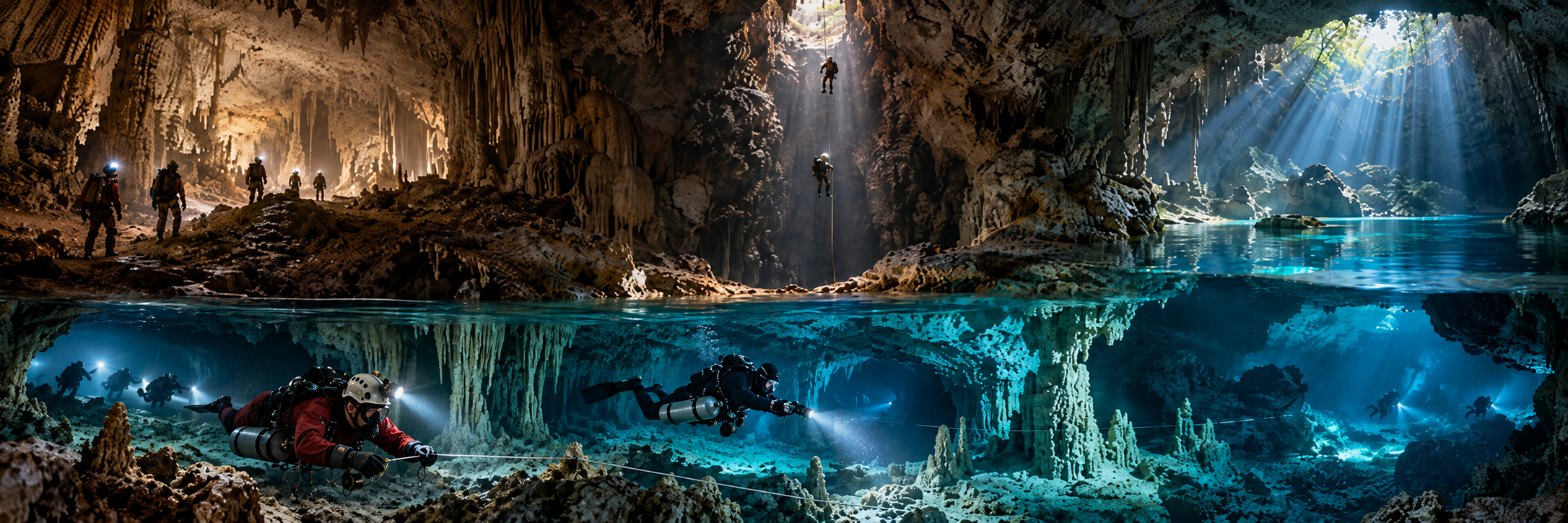
Systems worth a second catalogue pass

Germany contains many additional sump caves that matter locally but are not appropriate to publish with destination-style coordinates or unsupported technical metrics. Future country revisions should add more individual cards from the Upper Danube, Lenninger Tal, Grabenstetten, Jura/Franconian Alb, Sauerland and Alpine research areas after direct confirmation with the responsible clubs. The German cave registers themselves often restrict detailed data for conservation and legitimate-interest reasons; KCore should respect that culture rather than turning sensitive research caves into a tourism list.

Germany · research catalogue

Discovery frontiers - where Germany may still surprise us

Blaukarst / Blaubeurer Alb

The Blauhöhlensystem already exceeds 18 km, yet the large catchment, multiple cave levels and history of new dry entrances show that the known system is not the whole underground picture.

Potential: New dry entrances, submerged bypasses, connections between known branches and additional high-level fossil passages.

Discovery year: 20?? - the Blautopf is still keeping secrets.

Donau-Aach karst / Hegau

The Danube loses water over a broad zone and the Aach system remains actively explored. In 2026 the local project reported another newly discovered passage system, while diving and shaft work continue to chase the underground 'Black Danube'.

Potential: New access dolines, collector passages, connections between the sinking Danube and known Aach passages, and biological discoveries.

Discovery year: 20?? - the Danube knows the route; we do not.

Grabenstetter Großhöhle / northern Swabian Alb

Falkensteiner Höhle, Elsachbröller and Büchelbrunner Bröller are interpreted as remnants or branches of a larger former system. Current endpoints, siphons and flood outlets leave several connection questions open.

Potential: Physical links, bypasses around present siphons, new upstream branches and entrances on the plateau.

Discovery year: 20?? - probably after carrying bottles through a lot of mud.

Lenninger Tal / Schopflocher Moor

The young Schlossbergbröller project reached several siphons beneath the plateau and an unresolved tight underwater continuation. The region is exceptionally cave-rich.

Potential: Continuation beyond the present siphon, parallel drains and links to neighbouring cave systems.

Discovery year: 20?? - whenever the next squeeze decides to cooperate.

Upper Danube karst

Wimsener Höhle, Wulfbachquellhöhle and many dry caves demonstrate a major active karst landscape with submerged collectors.

Potential: Deeper/upstream continuations, post-sump passages and links between springs and plateau caves.

Discovery year: 20?? - cold water, warm discovery.

Southern Franconian Alb / Altmühltal

The Mühlbachquellhöhle proved that a huge active river cave could remain hidden behind blocked surface terrain until 2001. Dye tracing shows that current explored branches represent only part of the groundwater system.

Potential: New entrances through dolines, continuation beyond the Hilli-Billi collapse, parallel collectors and entirely separate river caves feeding other Altmühltal springs.

Discovery year: 20?? - perhaps Germany's best argument against saying 'everything is already known'.

Northern Franconian Alb

The Bavarian cave register covers thousands of karst objects and the regional authority explicitly describes the area as largely unexplored and inaccessible in places.

Potential: Buried entrances, active collectors beneath known dry systems, new post-sump passages and previously unknown water caves.

Discovery year: 20?? - somewhere under the Jura limestone.

Sauerland mass limestone

Frettermühler Wasserhöhle demonstrates active accessible water cave development in a region better known for dry/show caves and mines.

Potential: Additional source caves, links between sinks and resurgences, and extensions behind flooded restrictions.

Discovery year: 20?? - the next small spring may hide a surprisingly large room.

Germany · research catalogue

A few stories that belong in the history section

  • Blautopf and the Speleonaut - Hasenmayer's exploration did not end when his 1989 accident left him paraplegic. Together with Konrad Gehringer he developed the Speleonaut, a narrow research submersible specifically for cave work, and returned to underwater exploration.
  • Falkensteiner Höhle - when the dive is five kilometres from daylight - The cave's history shows the German 'sump-crosser' tradition: long dry/wet approaches, repeated siphons, and exploration where the underwater section is only one obstacle in a full speleological expedition.
  • Mordloch 1977 - Four divers were trapped for roughly 57 hours by rapidly rising floodwater. The incident remains a strong illustration of why active water caves must be understood hydrologically, not merely technically.
  • Mühlbach 2001 - A modern reminder that major caves can still be discovered in a heavily populated European country. Years of digging opened access to an active river cave now over eleven kilometres long.
  • Aach cave fish - The Donau-Aach exploration produced a biological sensation: a blind cave-adapted loach documented in the system, described by the project as Europe's first known cave fish.

Germany · research catalogue

Access and conservation policy for KCore

Germany requires an especially conservative catalogue policy. A natural cave appearing here is not an invitation to dive it. Private property, municipal prohibitions, water law, drinking-water protection, nature conservation, winter bat-protection rules, gates and local club agreements can all control access. In Bavaria, for example, scuba diving is not automatically included in public common-use rights for surface waters; authorities must specifically permit it in suitable waters. Germany's national nature law also protects bat winter quarters from disturbance between 1 October and 31 March, with additional local restrictions possible.

Future KCore cave cards should therefore show: CURRENT STATUS, LAST ACCESS CHECK, RESPONSIBLE CLUB/AUTHORITY, PERMISSION REQUIRED?, and SENSITIVE COORDINATES? Where detailed cave-register information is intentionally restricted, DiverInterCom should publish the history and science without publishing a route-to-entry.

Germany · research catalogue

Next research pass

  • Verify detailed public metrics for Wulfbachquellhöhle directly with HFGOK publications.
  • Add more Upper Danube and Lenninger Tal sump systems only after confirming current access and publication sensitivity.
  • Expand the Germany flooded-mine / artificial-overhead section with Nuttlar, Felicitas, Felsendome Rabenstein and further verified managed sites, while keeping them inside the country catalogue.
  • Add a timeline card for Hasenmayer: Aachtopf -> Falkensteiner -> Blautopf -> Mörikedom -> Speleonaut.
  • Create cross-links from each research cave to the future KCore Cave Diving History people profiles.

DiverInterCom KCore Scuba Universe - Build wide. Connect everything. Polish later.