Music is set to start automatically. If your browser blocks autoplay, click Music On once.
Site Navigation

Cave Dive World · country catalogue · integrated

Finland

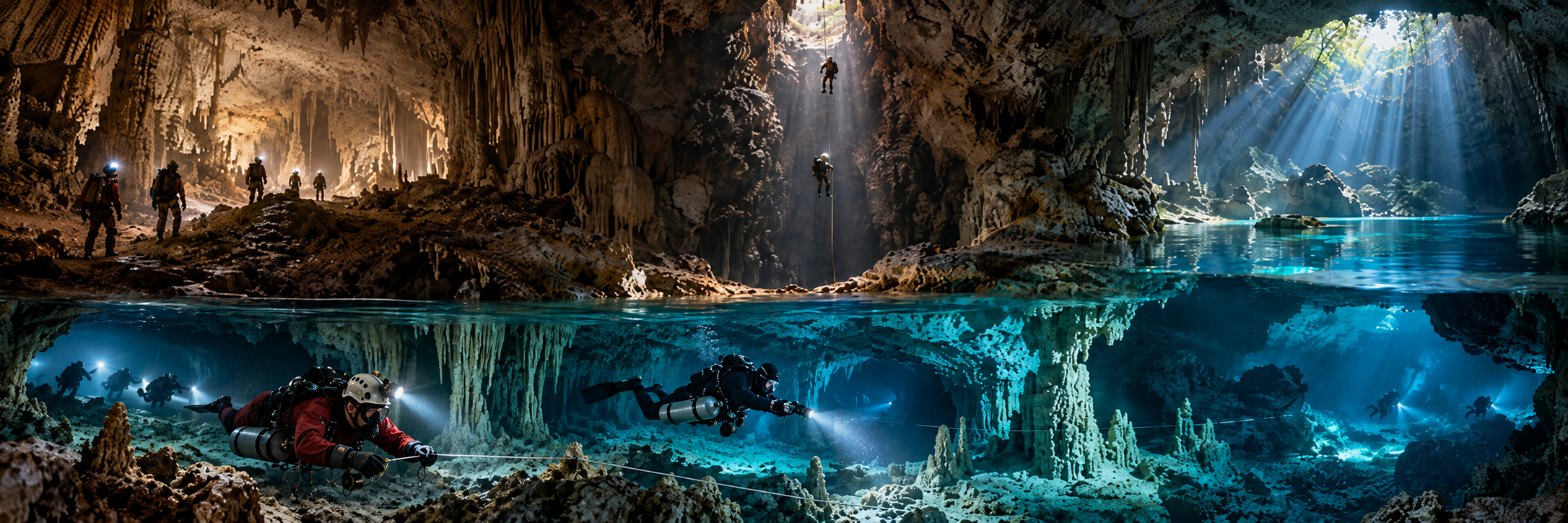
Finland is not a classic karst-cave country. Its overhead-diving culture developed around flooded mines and quarries: cold clear groundwater, industrial shafts and galleries, deep horizontal levels, winter ice and technically demanding mine exploration.

Cave Dive World banner

approved research integrated · v0.1

Flooded Mines • Quarry Tunnels • Cold-Water Overhead • Ice • Industrial Exploration

Professional catalogue v0.1 — September 2026

Research and information catalogue. This page is not a dive guide and does not replace training, permissions, current access checks, local knowledge or expedition planning.

Finland · research catalogue

Geological reality - why Finland became a mine-diving country

Finland has more than a thousand known dry caves and shelters, but most are glacial boulder caves, tectonic/glacial crevices or rock shelters. Major solutional cave systems are essentially absent. Torhola near Lohja is Finland’s longest accessible limestone cave at only about 107 m. For submerged exploration, old mines and quarries therefore define the national picture.

Finland · research catalogue

National priority sites

Ojamo Mine, Lohja

Type: FLOODED LIMESTONE MINE

Published scale: ~28/30 m, 56 m, 88 m, 138 m levels; shaft ~250 m; deepest recorded dives ~160 m

Status: ACTIVE / MANAGED

KCore note: Finland’s flagship mine-diving site; kilometres of tunnels, large halls, ~4°C water; access coordinated by Ojamo Dive ry.

Montola Mine, Pieksämäki

Type: FLOODED LIMESTONE MINE

Published scale: Multi-level mine; active diving at ~48 m, 88/90 m and beyond

Status: ACTIVE / MANAGED

KCore note: Major living mine-diving community with colour-coded permanent lines and organised events.

Haveri Gold Mine, Ylöjärvi

Type: FLOODED GOLD/COPPER MINE

Published scale: Open pit nearly 70 m; cave levels around 35 m and routes toward 80 m+

Status: ACTIVE / RESTRICTED

KCore note: Association-based access; detailed technical support and gas rules.

Kaatiala Quarry, Kuortane

Type: FLOODED FELDSPAR/QUARTZ QUARRY + TUNNELS

Published scale: Open pit ~40 m; cave system ~400 m total; far end just under 100 m penetration

Status: ACTIVE

KCore note: Open-water plus genuine overhead training; major 3D photogrammetry project launched 2025.

Paakkila Asbestos Mine, Tuusniemi

Type: FLOODED OPEN PIT + TUNNEL

Published scale: Open water ~30 m; tunnel entrance ~28 m

Status: ACTIVE / LANDOWNER PERMISSION

KCore note: Clear-water former asbestos mine; recreational, freediving and overhead use with permission.

Illo Quarry, Kemiönsaari

Type: OPEN FLOODED QUARRY

Published scale: ~70 m

Status: ACTIVE / ACCESS VERIFY

KCore note: Recorded as sport-diving site; no significant tunnel system verified.

Outokumpu / Keretti

Type: FLOODED HISTORIC MINE

Published scale: Kilometres of flooded workings

Status: CLOSED / NO PERMISSION

KCore note: Current Outokumpu policy states no diving or filming permission at former mine areas.
Finland · research catalogue

Ojamo - Finland’s flagship submerged mine

Ojamo contains near-horizontal levels linked by shafts and large mining chambers. The best-known levels begin around 28–30 m and continue through approximately 56 m, 88 m and 138 m. The 88 m level includes a tunnel reported at about 1.7 km long, explored through to beneath Lake Lohjanjärvi in 2008. Water stays close to 4°C year-round.

Current access is managed by Ojamo Dive ry through registration, qualification checks and approved events. Cave dives require organiser approval, a named dive leader and safety diver, with specific winter-ice and overdue-team procedures.

Finland · research catalogue

Montola - a living Finnish mine-diving community

Montola is a former limestone mine flooded after closure in 1976. Montolan Kaivossukeltajat ry coordinates current activity through registration, organised events, permanent colour-coded guidelines, published maps and formal operating rules. Active diving includes the 48 m and 88/90 m levels.

Finland · research catalogue

Haveri - deep open pit and structured technical access

Haveri is a former gold and copper mine with a flooded pit close to 70 m. Current diving is association-based. Site rules document cave openings around the 35 m level and routes associated with the 80 m level; deeper dives require technical support and specified gas procedures.

In January 2020 a diver became separated in poor visibility during a deep dive and survived roughly eight hours in the cold mine before rescue.

Finland · research catalogue

Kaatiala - quarry cave, training site and 3D documentation laboratory

Kaatiala combines a ~39–40 m flooded quarry with roughly 400 m of mapped tunnel/cave. It serves both ordinary open-water diving and genuine overhead training.

The Finland Underground project led by Mikko Paasi and Bottomline Projects combined more than 100,000 underwater photographs with drone LiDAR and multibeam sonar into a 3D model launched publicly in 2025 for planning, preservation and rescue support.

Finland · research catalogue

Natural caves - important to understand, but not dive targets

Torhola, Repouuro, Korkberget and Toskaljärvi illustrate Finland’s dry-cave geology, but none is a major natural sump-diving system. KCore therefore records Finland as a mine/industrial-overhead country rather than inventing a karst-cave identity that the geology does not support.

Finland · research catalogue

Ice overhead - a major Finnish specialty

Finland’s climate makes ice a recurrent overhead condition at mines, quarries and ordinary lakes. Site rules distinguish surface-tether ice diving from deeper under-ice penetration. KCore keeps this as a separate classification: OVERHEAD - ICE, not NATURAL CAVE.

Finland · research catalogue

Rescue and accident history - factual and respectful

  • Ojamo 2017 — fatal winter mine dive; reinforced site-specific rescue and ice procedures.
  • Kaatiala 2014 — fatality during a mine-diving course near the open-water boundary at ~30 m.
  • Kaatiala by 2021 — Yle reported three fatalities associated with tunnel/cave environment.
  • Haveri 2020 — experienced diver separated in poor visibility and survived roughly eight hours before rescue.
  • Montola 2021 — fatal deep mine-diving accident around 88 m; Tukes later issued 12 safety recommendations.

Finland · research catalogue

Finnish people, groups and culture

  • Divers of the Dark — documentation group strongly associated with Ojamo.
  • Antti Apunen — Finnish cave/mine diver and writer; major Ojamo history source.
  • Janne Suhonen — photographer/diver associated with international Ojamo documentation.
  • Mikko Paasi — cave/rescue diver; led Finland Underground photogrammetry at Kaatiala.
  • Sami Paakkarinen — technical/cave/rebreather instructor associated with Kaatiala and mine diving.
  • Teppo Lallukka — cave/mine instructor with Montola/Ojamo activity.
  • Montolan Kaivossukeltajat ry — current managing association for Montola.
  • Ojamo Dive ry — current coordinating body for Ojamo.
  • Haverin Kaivossukeltajat ry — current structured-access association for Haveri.
  • Suomen Luolaseura / Finnish Caving Society — recognises mine diving as Finland’s principal submerged-cave activity.

Finland · research catalogue

Modern training - one layer, not the origin

Finnish cave and mine-diving training includes mine-diver, limited-mine/cavern, technical cave, DPV and rebreather pathways. Domestic training commonly uses Kaatiala, Ojamo and Montola, while full natural-cave training may continue abroad in regions such as France.

Finland · research catalogue

Discovery frontiers - Finland’s next overhead chapters

Ojamo deeper levels

Frontier: The 138 m level and deeper shaft/tunnel structure remain technically formidable; old plans and modern exploration may reveal more reachable galleries.

Montola deeper network

Frontier: Potential lies in documentation, line refinement and industrial-archaeology recording across deeper levels.

Haveri deep mine routes

Frontier: Strictly managed deep routes remain a technical and documentation frontier.

Finland Underground expansion

Frontier: Applying Kaatiala-style 3D photogrammetry to Ojamo, Montola, Haveri or Paakkila could create world-class digital mine archives.

Closed historic mines

Frontier: Outokumpu/Keretti and other flooded workings remain documentary frontiers unless owners explicitly permit diving.

Natural cave frontier

Frontier: Realistic natural frontier is small fracture/limestone hydrology, not a hidden giant karst sump.

Finland · research catalogue

Selected source backbone

  • Finnish Caving Society - Caving in Finland
  • Ojamo Dive ry - current portal and rules
  • Divers of the Dark - Ojamo documentation
  • CDAA Guidelines - Diving the Ojamo lime mine in Finland
  • Montolan Kaivossukeltajat - current portal and operating rules
  • Visit Finland / Visit Ylöjärvi - Haveri Gold Mine
  • Haverin Kaivossukeltajat - current rules
  • Kuortane municipality - Kaatiala quarry
  • Sukeltaja-lehti - Kaatiala 2026
  • Bottomline Projects - Finland Underground
  • Sukeltaja-lehti / Sukeltajaliitto - Paakkila
  • Finnish Heritage Agency - Illo quarry
  • Outokumpu - current former-mine access policy
  • Yle - Haveri rescue, Montola accident and Kaatiala mapping/history
Publication rule: distinguish open flooded quarries from true mine overhead; never infer public access from the existence of flooded workings; keep mine plans, landowner permission and current association rules as separate evidence layers.