Music is set to start automatically. If your browser blocks autoplay, click Music On once.
Site Navigation

Cave Dive World · country catalogue

China

Guangxi Du’an · Jiudun · Daxing · Disu underground river · WUD/GXKSP · rescue · artificial overhead.

Cave Dive World banner

integrated research · v0.1

China — an underwater Himalaya of karst

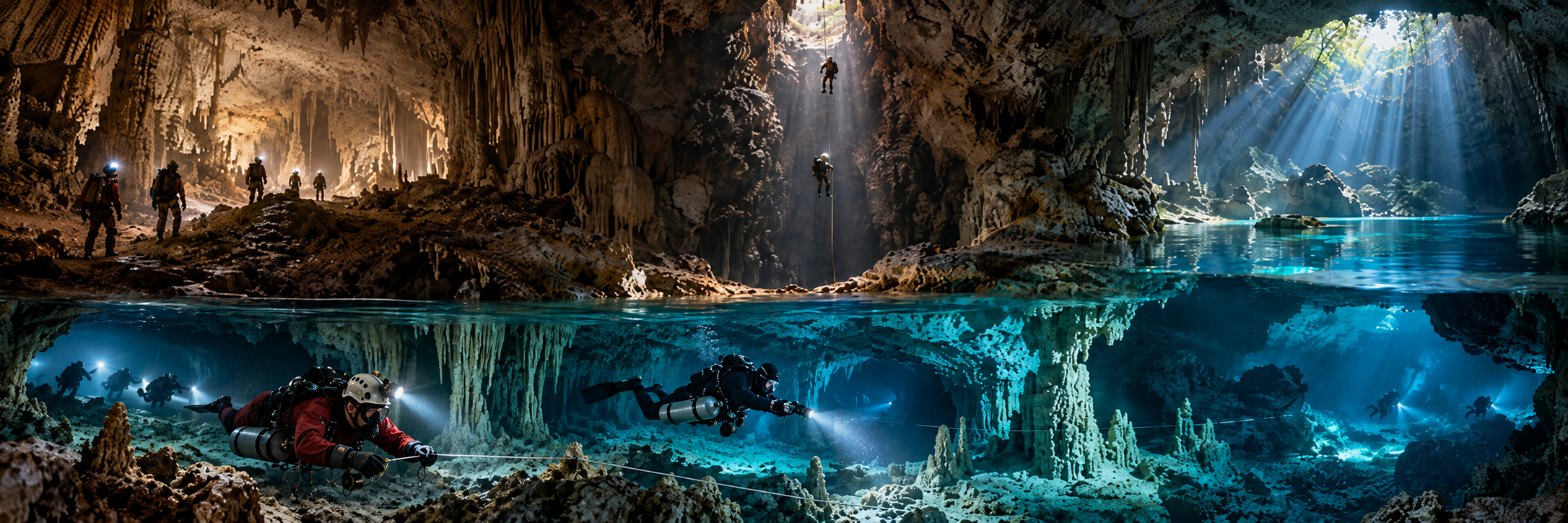
Southern China contains immense carbonate provinces and regional underground-river systems. Du’an in Guangxi is the clearest national centre, but modern exploration and training also extend into Guangdong, Guizhou, Hunan, Yunnan and other provinces.

China already has its own domestic exploration, mapping, training and rescue culture. Deep 200 m-plus CCR projects coexist with village water sources, geopark management, biological research and fast-changing access after serious accidents.

Jiudun and Daxing access is dynamic after the 2023 fatality period. Historical depth records are not current visitor permission. Community water use, local agreement and human-remains sensitivity are part of site access.

China · research catalogue

National KCore identity

China’s submerged-cave potential follows the South China Karst through Guangxi, Guizhou, Yunnan and neighbouring provinces. Du’an is the most concentrated centre, but the important unit is the regional aquifer rather than any single spring.

China’s modern cave-diving culture evolved quickly from international collaboration into domestic exploration, training, standardized line projects, deep CCR capability and specialist public-safety rescue.

China · research catalogue

National priority cave and overhead catalogue

Jiudun Skylight / 九顿天窗

Region: Du’an, Guangxi

Type: EXTREME DEEP KARST WINDOW / MULTI-SHAFT CAVE

Published scale: 277.4 m reached April 2023

Status: RESTRICTED / HISTORIC EXTREME / ACCESS VERIFY

KCore note: Asian depth-record history; major 2014 and 2023 fatalities; post-2023 access changed.

Daxing Spring Cave / 大兴

Region: Du’an, Guangxi

Type: MASSIVE DEEP RESURGENCE

Published scale: 151 m south gallery in 2014; 258 m reached by Chen Qian in later project

Status: RESTRICTED / SPECIAL PERMIT / EXPLORATION

KCore note: Major deep resurgence with seasonal water-level effects.

Disu subterranean river / 地苏地下河

Region: Du’an, Guangxi

Type: REGIONAL UNDERGROUND-RIVER NETWORK

Published scale: 241 km official system; 300+ karst windows

Status: GEOPARK / RESEARCH / DIVE REGION

KCore note: National-scale aquifer architecture, not one single dive route.

Jellyfish cave series

Region: Du’an, Guangxi

Type: DEEP KARST CAVES / BIOLOGY

Published scale: historic 180 m-class exploration

Status: EXPLORATION / ACCESS VERIFY

KCore note: Early international deep-project focus; freshwater jellyfish reported in the region.

Sun-Moon / Riyu cave system / 日月潭

Region: Guangxi

Type: CONNECTED FLOODED CAVE

Published scale: WUD connection achieved 2013; later resurvey

Status: PROJECT / TRAINING / ACCESS VERIFY

KCore note: Important early domestic connection and survey site.

Hongjun Cave / 红军洞

Region: Guangxi project region

Type: FLOODED CAVE

Published scale: permanent-line maintenance documented

Status: PROJECT / TRAINING

KCore note: Part of WUD standardized-line culture.

Fossil Cave / 化石洞

Region: Guangxi

Type: DEEP CAVE / DOCUMENTATION

Published scale: 2014 bottoming/documentation project

Status: RESEARCH / PROJECT

KCore note: Second-tier project illustrating persistent domestic survey work.

Lingwan Lake / 灵婉湖

Region: Guangxi

Type: FLOODED CAVE / RESTRICTIONS

Published scale: surveyed by WUD; narrow-passage project

Status: PROJECT / ADVANCED

KCore note: Non-record route-development cave work.

Langkou Spring / 狼口泉

Region: Liuzhou, Guangxi

Type: DEEP SPRING CAVE

Published scale: ~72 m bottoming in 2017 reconnaissance

Status: EXPLORATION / LOCAL SUPPORT

KCore note: Regional exploration beyond Du’an.

Guwa Reservoir cave / 古瓦水库

Region: Laibin, Guangxi

Type: SUBMERGED CAVE / RESERVOIR INTERFACE

Published scale: guideline advanced to ~92 m depth in 2017

Status: EXPLORATION / ACCESS VERIFY

KCore note: Karst cave in reservoir setting.

Baibiyan upstream / 白壁岩

Region: Guilin, Guangxi

Type: UNDERGROUND-RIVER / CAVE SURVEY

Published scale: upstream mapping documented 2019

Status: RESEARCH / PROJECT

KCore note: Shows Guangxi exploration spread beyond Du’an.

Shenglong / Sheng-loong / 圣龙潭

Region: Guangxi region

Type: EXTREME DEEP SINKHOLE / CAVE

Published scale: 252 m reached by Chen Qian and Craig Challen in 2024

Status: ACTIVE PROJECT / SPECIALIST

KCore note: Chinese-led international deep project using dual-CCR and habitat methods.

Lükutan / 绿窟潭

Region: Meizhou, Guangdong

Type: FULLY FLOODED INLAND KARST CAVE

Published scale: A/B line projects; WUD training centre

Status: ACTIVE TRAINING / PROJECT / CULTURAL SENSITIVITY

KCore note: Major non-Guangxi domestic cave; human remains require respectful treatment.

Huowang River source cave / 活旺河源头

Region: Baise, Guangxi

Type: MULTI-AIR-CHAMBER KARST CAVE

Published scale: 2025 rescue search ~500 m; ~28 m depth

Status: RESCUE / RESEARCH

KCore note: Site of China’s first widely reported successful cave-diving rescue.

Mengdong River flooded cave / 猛洞河

Region: Yongshun, Hunan

Type: FLOODED FORMER DRY CAVE / AIR CHAMBERS

Published scale: entrance ~8-9 m; survivor ~80-100 m inside

Status: RESCUE / ACCESS VERIFY

KCore note: 2025 cross-province 110-hour survival rescue.

Fangshan marble quarry

Region: Beijing outskirts

Type: FLOODED QUARRY / ARTIFICIAL OVERHEAD

Published scale: historic marble extraction; documented dive project 2021

Status: SPECIALIST / ACCESS VERIFY

KCore note: Rare verified Chinese artificial-overhead example.

Panjiakou Underwater Great Wall

Region: Hebei

Type: SUBMERGED CULTURAL HERITAGE / OPEN-WATER STRUCTURE

Published scale: reservoir-flooded Great Wall; dive centre since 2016

Status: ACTIVE / HERITAGE / OPEN WATER

KCore note: Important underwater heritage; not automatically cave/overhead.
China · research catalogue

Du’an and the Disu underground-river system

Du’an Yao Autonomous County became the international face of Chinese cave diving in the early 2010s. Official material describes the Disu underground river as a 241 km network with twelve tributaries and more than 300 karst windows.

French explorers including Jean Bottazzi, Sébastien Lissarrague and Pierre-Éric Deseigne helped reveal the region internationally. A technical dive centre and logistics infrastructure appeared while the caves were still being discovered, creating a rare overlap of virgin exploration and organized diving development.

China · research catalogue

Jiudun Skylight — record depth and two defining tragedies

Jiudun has been explored by WUD teams since at least 2010. Progressive work reached 122 m, then 213 m in 2015 and about 212 m again in the south cave in 2022. On 27 April 2023 Han Ting reached 277.4 m using dual sidemount CCR trimix, a widely reported Asian cave-depth record.

Jiudun also shaped Chinese incident analysis. Wang Tao died during a planned 170 m exploration dive on 18 April 2014; survivor Wang Yuan later published a detailed first-person analysis. Han Ting disappeared during another deep project on 7 October 2023. An ROV located him at roughly 110-114 m, and robots recovered his body after 18 days when human recovery was judged too dangerous.

KCore treats Jiudun as an exploration and safety-history site, not a record-tourism target. Current access must be verified independently.

China · research catalogue

Daxing Spring — China’s giant deep resurgence

Daxing is one of Du’an’s defining resurgences. A French push reached about 121 m in 2012 and 2014 work extended the south gallery to roughly 151 m. Chen Qian later pushed the cave to the 258 m class.

Seasonal water-level change can alter the absolute depth, flow and point of entry. Project accounts also show that post-2023 permission became a major constraint, so historical deep exploration must not be read as current open access.

China · research catalogue

GXKSP and the second tier of Guangxi caves

WUD founded the Guangxi Karst Survey Project in 2014 to explore, map and document submerged caves while supporting freshwater protection and research. The project has used open circuit, CCR and DPVs, and has standardized routes and signage at selected sites.

Sun-Moon, Hongjun, Fossil Cave, Lingwan Lake, Langkou Spring, Guwa Reservoir cave and Baibiyan matter because they show the transition from one-off deep records to a persistent domestic cave-survey culture: line replacement, resurvey, connection work, training infrastructure and repeated project visits.

China · research catalogue

Shenglong 2024 — the modern Chinese-led deep generation

After Daxing access could not be secured, Chen Qian redirected a 2024 project with Craig Challen and Andrew Oakeley to Shenglong. Chen Qian and Challen each reached 252 m and repeatedly dived the system to establish its structure.

The team used a decompression habitat and exchanged techniques around dual-rebreather deep diving. The project illustrates a mature Chinese-led collaboration rather than foreign-led discovery.

China · research catalogue

Lükutan — domestic training, exploration and cultural sensitivity

Lükutan in Meizhou, Guangdong, is one of China’s most important cave-diving sites outside Guangxi. WUD has conducted repeated A-line, B-line and connection projects there and lists a training centre in Longwen, Meixian District.

The cave also contains numerous human skulls and skeletal remains. KCore therefore treats it simultaneously as an active training/project cave and a culturally sensitive site where remains are not objects of collection or spectacle.

China · research catalogue

WUD — China’s own cave-diving training system

WUD began organizing cave and deep-diving training in 2010 and developed a domestic technical curriculum covering cave, sidemount cave, deep, wreck, CCR and exploration pathways. Published Cave 1 standards include prerequisites, fitness benchmarks, a six-day / 48-hour course structure, a 30 m training-depth cap, team gas rules, guideline work and zero-visibility/lost-line/lost-diver drills.

Its standardization philosophy explicitly draws on Hogarthian/DIR ideas but has been adapted through years of Chinese cave use, including permanent-line projects and the 2020 Gold Line Project.

China · research catalogue

Rescue, recovery and accident history

China’s cave-diving safety culture includes the 2014 Wang Tao fatality and analysis, the 2023 Han Ting robotic recovery, and a major shift toward successful survival rescue in 2025.

In February 2025 specialist cave divers working with Baise police/fire/medical services found two scientific explorers alive in separate air chambers about 300 m/16 m and 500 m/28 m from the search start during a 69-hour operation. In July 2025 the same specialist capability travelled to Hunan and recovered another man alive after roughly 110 hours underground in a flooded cave with less than one metre visibility.

China · research catalogue

Artificial overhead and submerged heritage

China’s core cave identity is natural karst. Fangshan marble quarry near Beijing is a rare documented flooded-quarry/artificial-overhead example and requires current access verification. Panjiakou’s reservoir-flooded Great Wall is significant underwater heritage but should remain classified as open-water heritage unless a specific enclosed penetration is documented.

China’s huge mining industry does not by itself establish a legitimate national flooded-mine-diving culture.

China · research catalogue

People, teams and organisations

Wang Tao and Wang Yuan — WUD founders and central early Jiudun figures.
Han Ting — deep-cave pioneer and 277.4 m Jiudun record diver.
Chen Qian — Daxing and Shenglong deep explorer/organizer.
Wei Bai — GXKSP leader, instructor and rescue-development figure.
Jean Bottazzi, Pierre-Éric Deseigne, Sébastien Lissarrague — early French Du’an collaborators.
Richard Harris, Craig Challen, Andrew Oakeley — international deep-project collaborators.
WUD / GXKSP and Baise public-safety dive teams — core domestic structures.

China · research catalogue

Science, freshwater, community culture and access

Du’an’s karst windows are village water sources and cultural places as well as dive entries. WUD projects explicitly connect cave survey with freshwater protection, biology and water-quality work. Local belief and community use can make a physically diveable spring socially inappropriate to enter without agreement.

Jiudun and Daxing access must be treated as dynamic. Project rules, local authorities, geopark status, village relationships and post-accident restrictions can all override older dive reports.

China · research catalogue

Discovery frontiers

Disu: hundreds of windows sit over a 241 km underground-river network whose human-passable links remain unresolved.
Daxing: 258 m-class exploration did not establish a geological endpoint.
Jiudun: explorers originally sought a horizontal river conduit beyond the deep shafts.
Shenglong: 252 m was still a structural reconnaissance stage.
Guizhou and Yunnan: enormous karst with comparatively little published underwater mapping.
National rescue mapping: the 2025 survival rescues show how lines, air-chamber knowledge and public-safety training are becoming their own technical discipline.

China · research catalogue

Selected source backbone

World Underwater Discovery (WUD) — organisation history, cave-training structure, GXKSP, Jiudun/Daxing/Shenglong/Lükutan project archives and 2014 accident report; China Daily and official Guangxi media — Disu/Du’an and Han Ting reporting; InDEPTH / X-Ray Mag / Advanced Diver — Du’an and Shenglong project context; People’s Daily / Xinhua / Guangming Daily — 2025 survival rescues; Beijing municipal sources — Fangshan karst protection; PADI — Panjiakou heritage-dive context.

Publication rule: do not reduce China to depth records. Preserve the regional aquifer, domestic training/rescue culture, community water use and fast-changing access. Date deep figures, separate lakes from caves and open-water heritage from overhead, and never infer a mine-diving industry from mining scale alone.