Music is set to start automatically. If your browser blocks autoplay, click Music On once.
Site Navigation

Cave Dive World · country catalogue

Brazil

Serra da Bodoquena · Bahia mega-sumps · Goiás deep dolines · PETAR · Mato Grosso · training · paleontology · exploration frontiers.

Cave Dive World banner

integrated research · v0.1

Brazil — research catalogue integrated

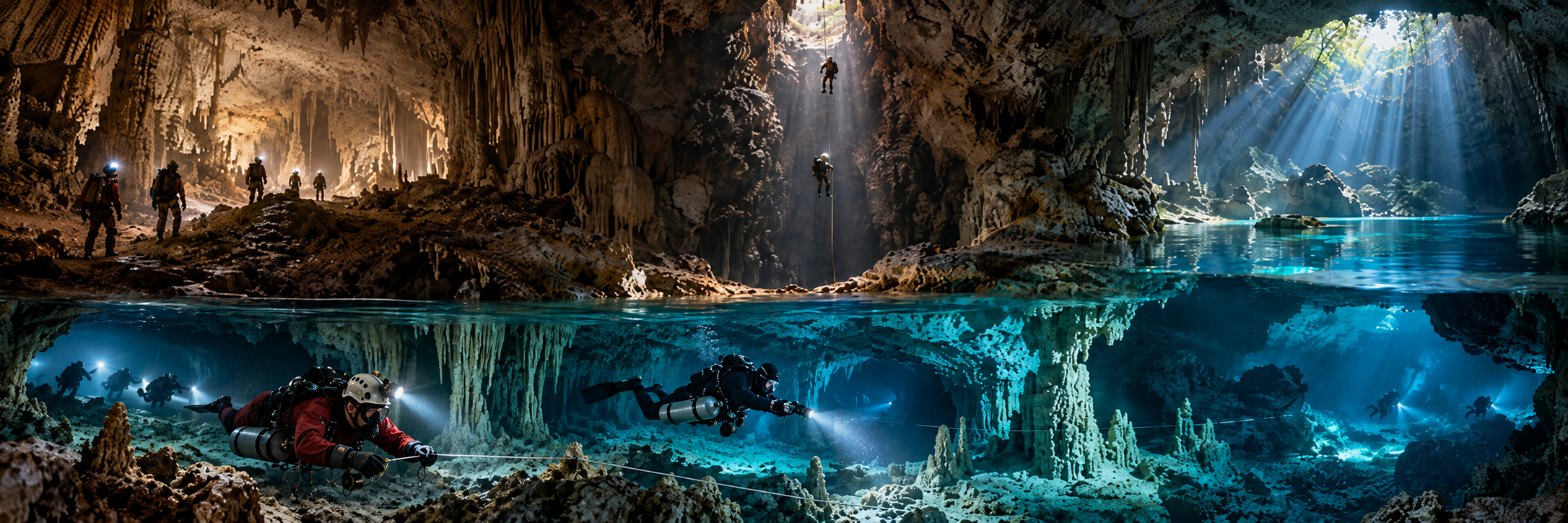
Brazil’s cave-diving geography is continental in scale: clear-water training caves, extreme vertical dolines, kilometre-scale low-visibility sumps, caver-first internal sumps and conservation-first fossil caves all belong to the same national catalogue.

Do not reduce Brazil to Bonito tourism. The 6.4 km Gruna da Bananeira push, deep Goiás dolines, PETAR sump history, paleontology and water-resource protection are equally central to the country’s identity.

Brazil · research catalogue

National priority cave and overhead catalogue

Lago Azul / “Lago sem Fundo”

Region: Niquelândia, Goiás

Type: EXTREME FLOODED DOLINE / VAUCLUSIAN-TYPE CAVE

Published scale: 274 m established dive-depth figure in 2019 national list; bottom unresolved

Status: EXTREME / PRIVATE / ACCESS VERIFY

KCore note: Deepest listed Brazilian flooded-cave dive in Bambuí compilation; viral “bottomless” claims remain unverified.

Lagoa Misteriosa

Region: Jardim, Mato Grosso do Sul

Type: DEEP FLOODED PHREATIC CAVE / DOLINE

Published scale: 220 m reached in 1998; bottom not reached

Status: ACTIVE / MANAGED / TECHNICAL

KCore note: World-class clear-water depth site with tourism and technical-diving layers.

Gruna da Bananeira

Region: Santa Maria da Vitória, Bahia

Type: VERY LONG SUMP / UNDERGROUND RIVER

Published scale: ~6.4 km penetration in 2004; ~50 m max on record push

Status: EXPEDITION / HISTORIC RECORD

KCore note: Gilberto Menezes’ 2004 push was then the world’s longest cave dive; passage continued.

Buraco do Inferno

Region: Padre Bernardo, Goiás

Type: DEEP COLLAPSE DOLINE / CAVE

Published scale: 185 m reached in 2017; bottom not reached

Status: PRIVATE / EXTREME / ACCESS VERIFY

KCore note: Deep exploration plus 1992 double fatality and 2014 collapse incident.

Água Milagrosa

Region: Cáceres, Mato Grosso

Type: DEEP FLOODED DOLINE

Published scale: 180 m+ published dive depth; bottom not reached

Status: PRIVATE / TOURISM + TECHNICAL HISTORY

KCore note: Deep blue-green doline with reported exceptional visibility.

Poço Verde

Region: Ourolândia, Bahia

Type: DEEP KARST SPRING / DOLINE

Published scale: 180 m in 2019 Bambuí deep-dive list

Status: WATER SUPPLY / PROTECTED / ACCESS VERIFY

KCore note: Municipal water source: conservation outranks sporting-dive value.

Gruta Ceita Curê

Region: Bonito, Mato Grosso do Sul

Type: DEEP FLOODED CAVE

Published scale: 155 m in national deep-dive list

Status: SPECIALIST / ACCESS VERIFY

KCore note: Important Bodoquena depth site with less public documentation than Lagoa Misteriosa.

Gruta do Lago Azul

Region: Bonito, Mato Grosso do Sul

Type: DEEP SUBMERGED CAVE / PALEONTOLOGY

Published scale: Research dives to ~96 m

Status: RESEARCH ONLY / MONUMENT

KCore note: Pleistocene fossils, endemic fauna and conservation-first underwater access.

Gruta do Mimoso

Region: Bonito, Mato Grosso do Sul

Type: DECORATED FLOODED CAVE / MULTI-ROOM SYSTEM

Published scale: Lake >70 m; guided cave dives to ~40 m under current programme

Status: ACTIVE / LICENSED / CAVERN-TO-FULL-CAVE

KCore note: Historic training cave for Brazil’s first generation; reopened 2022.

Abismo Anhumas

Region: Bonito, Mato Grosso do Sul

Type: VERTICAL DRY CAVE + SUBMERGED LAKE

Published scale: 72 m descent; lake ~80 m class; tourist scuba to ~18 m

Status: ACTIVE / MANAGED / CONTROLLED DIVE

KCore note: Spectacular vertical access; controlled cave-lake diving is not long full-cave penetration.

Buraco das Abelhas — Túnel C

Region: Jardim, Mato Grosso do Sul

Type: LONG FLOODED CAVE

Published scale: ~1,900 m in 2019 national list

Status: EXPEDITION / ACCESS VERIFY

KCore note: One of Brazil’s longest Bodoquena submerged passages.

Buraco do Sapo

Region: Jardim, Mato Grosso do Sul

Type: FLOODED CAVE

Published scale: ~580 m in 2019 national list

Status: EXPLORATION / ACCESS VERIFY

KCore note: Secondary but nationally significant long-penetration site.

Nascente do Rio Formoso

Region: Bonito, Mato Grosso do Sul

Type: SPRING CAVE / UNDERGROUND SOURCE

Published scale: ~500 m submerged development in 2019 list

Status: RESEARCH / SPECIALIST

KCore note: Major regional aquifer source explored during 1991/92 Bonito expeditions.

Garganta do Bacupari / Poço do Surubim

Region: São Desidério, Bahia

Type: LONG SUMP / KARST RIVER

Published scale: ~1,300 m submerged development

Status: EXPEDITION / RESEARCH

KCore note: Part of the major western-Bahia karst systems.

Poço Azul

Region: Nova Redenção, Bahia

Type: FLOODED CAVE / PALEONTOLOGY

Published scale: Deep crystal pool; scientific diving documented

Status: TOURISM / RESEARCH

KCore note: Major Pleistocene megafauna fossil site; visitor flotation differs from research diving.

Poço Encantado

Region: Itaetê, Bahia

Type: DEEP FLOODED CAVE / GEOHERITAGE

Published scale: ~60 m visible water depth

Status: PROTECTED / NO SWIMMING

KCore note: Conservation-first blue cave, not a cave-dive destination.

Santana Cave sump

Region: PETAR, São Paulo

Type: DRY CAVE + SUMP

Published scale: Historic sump crossed 1986/87

Status: PROTECTED / SPELEOLOGY / PERMIT

KCore note: Classic early Brazilian caver-first cave-diving milestone.

Brazil · research catalogue

National KCore identity — several completely different cave-diving worlds

Brazil has no single dominant cave-diving province. Serra da Bodoquena around Bonito and Jardim is the best-known training/tourism region, western Bahia contains giant long-distance sumps, Goiás and Mato Grosso hold extreme-depth dolines, and PETAR preserves a classic caver-first sump tradition.

Brazilian cave diving grew from both dry-caver sump exploration and later North American-style formal cave-diving training. Scientific literature places the earliest documented Brazilian cave dives in 1981 at Vila Velha, Paraná.

Brazil · research catalogue

History — before Bonito became famous

Brazil’s submerged-cave history includes 1981 sandstone cave dives at Vila Velha, a Santana Cave sump passage in PETAR in 1986 and further post-sump exploration in 1987. These were exploration problems inside broader speleology rather than destination cave tourism.

The 1991–92 Franco-Brazilian Bonito expeditions then brought systematic underwater topography to Gruta do Lago Azul, Mimoso, Abismo Anhumas, Nascente do Rio Formoso and Lagoa Misteriosa, while also investigating hydrology and submerged Pleistocene remains.

Brazil · research catalogue

Gruta do Mimoso — schoolhouse of Brazil’s first cave-diving generation

Municipal tourism sources describe Mimoso as Brazil’s principal cave-diving training cave during the 1990s, where much of the first national generation trained. The site later closed for roughly fifteen years and reopened in 2022 under a formal tourism/conservation framework.

Current operator rules distinguish Cavern, Intro-to-Cave and Cave/Full-Cave levels, with progressively deeper and farther guided routes. This makes Mimoso both a historical training landmark and a modern regulated cave-diving site.

SBE archives also preserve a 1995 Akakor/Mimoso accident report. KCore keeps causation details conservative until the primary article is reviewed directly.

Brazil · research catalogue

Lagoa Misteriosa — depth without a known bottom

Lagoa Misteriosa is a collapse doline whose flooded void develops into phreatic cave geometry a few metres below the surface. Augusto Auler made the first scuba exploration during the 1992 Franco-Brazilian expedition.

In 1998 Gilberto Menezes de Oliveira reached 220 m without finding the bottom. Modern management combines supervised recreational and technical diving with a formal cave-management framework.

A 2008 trimix survey expedition produced a documented suspected decompression-illness case, showing that cave survey can become a diving-medical problem even when navigation and gas supply remain controlled.

Brazil · research catalogue

Abismo Anhumas and Gruta do Lago Azul — tourism and science are not the same thing

Abismo Anhumas requires a 72 m vertical descent into a giant chamber above a deep lake. Modern visitor diving is highly controlled and limited to the lake, not long guideline penetration. Its exploration history, however, belongs to the 1991/92 Bonito survey generation.

Gruta do Lago Azul is a different category: research dives documented Pleistocene megafauna, rare minerals and endemic fauna, and modern authorized research has reached about 96 m. Ordinary diving is prohibited. KCore frames it as a protected scientific cave, not a bucket-list technical objective.

Brazil · research catalogue

The hidden Bodoquena long-cave layer

The famous Bonito attractions are only part of Serra da Bodoquena. Grupo Bambuí’s 2019 compilation lists Buraco das Abelhas Túnel C at roughly 1.9 km, Buraco do Sapo around 580 m and Nascente do Rio Formoso around 500 m of submerged development.

These figures prove the region contains serious horizontal cave systems in addition to clear vertical pools. Public access and current line status are less clear, so the sites remain exploration/access-verify rather than visitor recommendations.

Brazil · research catalogue

Gruna da Bananeira — the 6.4 km cave-dive landmark

On 20 September 2004 Gilberto Menezes pushed the upstream sump of Gruna da Bananeira to roughly 6,400 m. SBE reported it at the time as the world’s longest cave dive.

The cave was narrow and silty rather than glamorous: about 3 m wide by 2 m high on average, with visibility often below 3 m and around 1.5 m during the record push. The first 3.5 km were generally shallower than 25 m; near 6 km a deeper loop reached around 50 m.

Scooters were used for most of the route, the final section was swum, total dive time was about 11 h 23 min, and the passage still continued when the dive turned. This is a global-class endurance and logistics story.

Brazil · research catalogue

Goiás depth frontier — Lago Azul and Buraco do Inferno

Grupo Bambuí’s national list gives Lago Azul at Niquelândia a historical dive-depth figure of 274 m. Modern viral attempts to call the site “bottomless” or hundreds of metres deeper using weighted camera lines do not replace a professional survey. KCore keeps 274 m as the documented dive figure and the true bottom unresolved.

Buraco do Inferno reached 185 m in 2017 without a confirmed bottom. Its accident history includes two diver deaths in 1992 and a 2014 underwater collapse that struck and dragged a diver who survived. Depth, rock instability and private access make it an extreme specialist site.

Brazil · research catalogue

Água Milagrosa and deep doline culture

Água Milagrosa near Cáceres is another deep Brazilian collapse doline, with 180 m-plus exploration and exceptional reported visibility. Visitor tourism and extreme technical exploration are separate layers and should not be conflated.

Poço Verde in Bahia presents a different access problem: it is both a deep karst spring and a municipal water source, so conservation and water-supply priorities outrank sporting-dive interest.

Brazil · research catalogue

PETAR, Minas Gerais and Paraná — the caver-first chapters

PETAR’s Santana Cave represents the Brazilian tradition most similar to Britain, Austria or Poland: dry caving first, sump as a barrier, then continuation beyond. The 1986/87 sump work is foundational even though Brazil later became more famous for flooded entrance caves.

SBE archives document early submerged-cave work in Minas Gerais, while the 1981 Vila Velha dives in Paraná remain the earliest documented Brazilian cave dives in current scientific literature. These chapters should not disappear behind Bonito’s later fame.

Brazil · research catalogue

Poço Azul, Lago Azul and the Ice Age archive

Poço Azul in Bahia preserves exceptionally complete Pleistocene megafauna, including giant ground sloth remains and thousands of bones from multiple species. Public flotation is a tourism activity; scientific fossil recovery is a separate research operation.

Poço Encantado is managed as sensitive geoheritage where swimming is prohibited. Together with Gruta do Lago Azul, these sites show why Brazil’s submerged caves are major paleontological archives rather than empty tunnels.

Brazil · research catalogue

Training and cave-diving infrastructure

By the 1990s Brazil had a formal cave-diving education layer and SBE estimates roughly 300 divers were certified during that decade. Gruta do Mimoso became the principal practical training cave for the first national generation.

Today Mimoso provides the clearest structured cavern-to-full-cave progression, while Lagoa Misteriosa supports supervised technical depth diving. KCore distinguishes this modern training infrastructure from the earlier exploration culture that preceded it.

Brazil · research catalogue

People, teams and institutions

Augusto Auler — geologist/speleologist, Bonito 1991/92 organiser and first Lagoa Misteriosa scuba exploration.
Gilberto Menezes de Oliveira — 220 m Lagoa Misteriosa dive and 6.4 km Gruna da Bananeira push.
Sérgio Beck — pioneering PETAR sump exploration.
Ézio Rubbioli — major Brazilian cave researcher and early Minas Gerais cave-diving history.
Grupo Bambuí — exploration, national cave statistics and giant Bahia systems.
Sociedade Brasileira de Espeleologia (SBE) — national speleological archive, training, conservation and rescue.
CECAV / ICMBio — federal cave research and protection framework.
SER/SBE — national volunteer cave-rescue structure.

Brazil · research catalogue

Rescue and accident history — factual and site-specific

Buraco do Inferno’s 1992 double fatality and 2014 collapse are cave-specific events. Mimoso’s 1995 incident is preserved in an SBE report but should not be over-interpreted until the primary article is reviewed. Lagoa Misteriosa’s 2008 event was a decompression-illness case rather than a navigation failure.

Brazil has a national volunteer cave-rescue framework through SER/SBE, while submerged rescue remains highly specialized. Accident narratives should distinguish penetration failures, collapse, decompression illness and ordinary open-water events.

Brazil · research catalogue

Artificial overhead — a mining country without a verified public mine-diving scene

Brazil has enormous mining regions, but this research did not verify a mature, openly managed flooded-underground-mine penetration culture comparable with Finland, Poland or South Africa.

Flooded quarries remain open water unless submerged galleries are proven. Reservoir and hydropower structures belong to occupational/research diving unless a legitimate recreational overhead operation is specifically documented.

Brazil · research catalogue

Access, cave protection and publication discipline

Mimoso is licensed and managed; Lagoa Misteriosa is active under supervision; Abismo Anhumas is controlled tourism; Gruta do Lago Azul is research-only; Buraco do Inferno is private/specialist; Poço Verde is conservation/water-supply sensitive; PETAR sumps are protected-park/speleology environments.

Historic exploration does not create modern access rights, and visitor swimming or flotation at a cave does not imply permission for cave diving.

Brazil · research catalogue

Discovery frontiers — Brazil is much bigger underwater than its tourist map

Lago Azul Niquelândia: 274 m remains the documented dive figure; the true bottom is unresolved.
Lagoa Misteriosa: 220 m was not the bottom.
Gruna da Bananeira: the 6.4 km push turned with continuing passage.
Buraco das Abelhas: ~1.9 km deserves modern survey and access verification.
Western Bahia: giant underground rivers imply major unresolved groundwater routes.
PETAR: internal-sump potential remains underdeveloped relative to the scale of Brazilian karst.
Paleontology: new flooded caves may preserve entire Ice Age ecosystems.
Archives: many primary reports still sit in SBE bulletins and expedition notes rather than modern databases.

Brazil · research catalogue

Selected source backbone

Sociedade Brasileira de Espeleologia historical archive; 2024 scientific-diving history paper; Grupo Bambuí 2019 deepest/longest cave-diving lists; SBE and Redespeleo reporting on the 2004 Gruna da Bananeira push; Bonito municipal tourism and current Mimoso/Lagoa Misteriosa/Anhumas/Lago Azul management sources; SBE accident archives; Brazilian Geological Survey and university paleontology studies; SER/SBE cave-rescue material.

Publication rule: Do not reduce Brazil to Bonito. Separate controlled cave-lake diving from full cave penetration, vertical depth records from long-sump penetration, and caver-first sump work from destination cave diving. Date records, reject viral ‘bottomless’ claims without survey, keep fossil caves conservation-first, respect private/park/water-supply access, and do not invent flooded-mine diving from Brazil’s mining scale.