Music is set to start automatically. If your browser blocks autoplay, click Music On once.
Site Navigation

Cave Dive World · country catalogue

Belize

Caye Caulker Giant Cave · Winter Wonderland · Great Blue Hole · The Abyss · Chiquibul · St. Herman’s · Maya archaeology · rescue.

Cave Dive World banner

integrated research · v0.1

Belize — much more than the Great Blue Hole

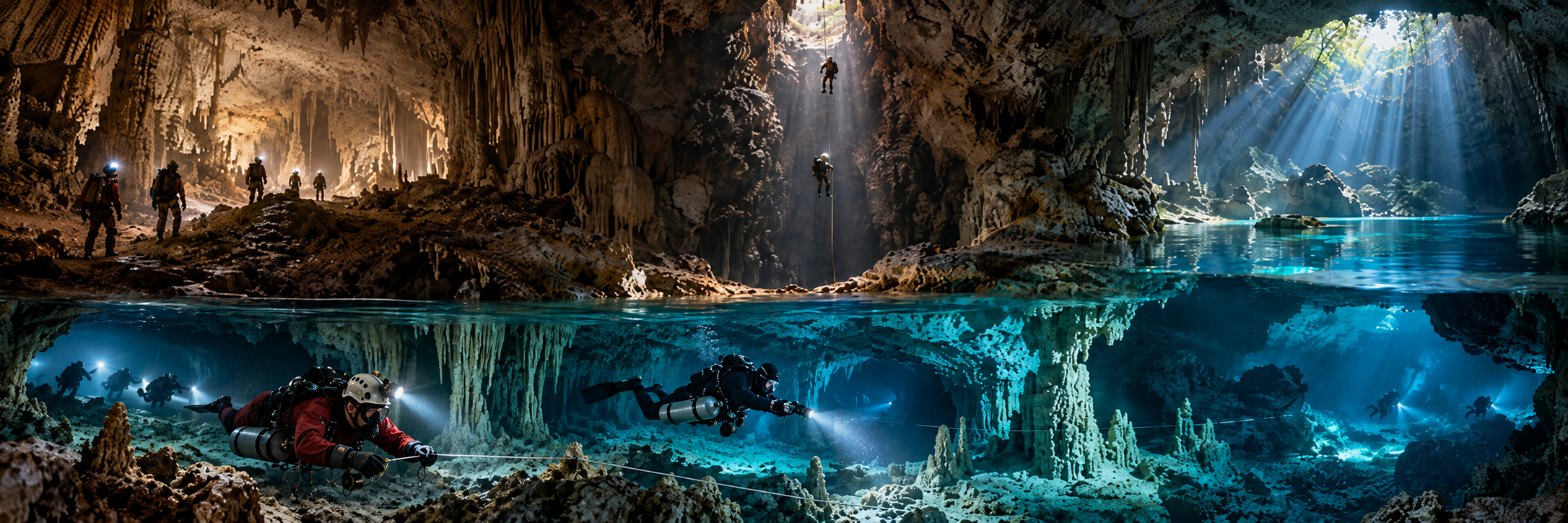
Belize combines a major anchialine cave province beneath Caye Caulker, historic inland sump exploration, deep submarine cave work at Lighthouse Reef, Maya archaeology and tropical river-cave flood hazards. Its cave identity spans full cave, caver-first expedition work, technical depth, tourism, science and protected cultural heritage.

The 2025 NICH Cave Management Policy treats Belize’s caves as protected archaeological sites. Historical exploration or tourist access does not establish independent cave-diving permission.

Belize · research catalogue

National KCore identity - a cave country hidden behind a famous Blue Hole

Caye Caulker lies over a serious anchialine cave network, the Chiquibul River disappears through one of Central America’s largest cave systems, the Caves Branch area preserves classic sump-diving history, and Lighthouse Reef contains both the Great Blue Hole and the much less famous deep submarine cave called The Abyss.

The national access model is inseparable from archaeology, conservation and permitting because virtually every inland cave is also a protected cultural site.

Belize · research catalogue

National priority cave and overhead catalogue

Giant Cave

Region: Caye Caulker

Type: ANCHIALINE FULL CAVE

Published scale: ~30,000 ft / ~9 km surveyed; max depth ~45-55 m source-dependent

Status: FULL CAVE / GUIDED / PERMISSION

KCore note: One of Central America’s major submerged cave systems; modern survey and line restoration 2012-2019.

Winter Wonderland

Region: Caye Caulker / Caye Chapel area

Type: MARINE-ANCHIALINE CAVE / CAVERN

Published scale: average ~29 m; max ~39 m in published profile

Status: ACTIVE CAVERN / CAVE TRAINING

KCore note: Highly decorated cave with current cavern-training role.

Queen of Hearts / Rabbit Hole routes

Region: Caye Caulker cave region

Type: CAVE ROUTES / BRANCHES

Published scale: public metrics sparse

Status: ADVANCED / ACCESS VERIFY

KCore note: Preserve route names without inventing independent-system status.

Great Blue Hole

Region: Lighthouse Reef

Type: DROWNED COLLAPSE SINKHOLE / OVERHANGS

Published scale: ~300-318 m across; ~120-124 m deep

Status: ACTIVE RECREATIONAL + TECHNICAL / PROTECTED

KCore note: Global icon; open central ascent with paleo-cave overhangs and stalactites.

Great Blue Hole bottom

Region: Lighthouse Reef

Type: EXTREME TECHNICAL OPEN-SINKHOLE DIVE

Published scale: 123 m bottom reached by scuba team in 1995

Status: HISTORIC TECHNICAL / RESEARCH

KCore note: First scuba bottom expedition; H2S layer around 90 m.

The Abyss

Region: North Lighthouse Reef

Type: DEEP SUBMARINE CAVE

Published scale: 148 m reached in 1997; continuation unresolved

Status: EXTREME TECHNICAL / EXPEDITION

KCore note: Often overlooked deep cave, colder below H2S layer.

Actun Tun Kul–Cebada connection

Region: Chiquibul NP

Type: RIVER-CAVE SUMP / CONNECTION

Published scale: ~60 m connection dive in 1999; combined cave ~39 km then

Status: RESEARCH / EXPEDITION / STRICT MANAGEMENT

KCore note: Classic caver-first dive that physically linked giant cave sections.

Eel / Shrimp / fourth sumps

Region: Chiquibul system

Type: MULTI-SUMP EXPEDITION

Published scale: multiple sumps dived in 1999

Status: RESEARCH / FRONTIER

KCore note: Underwater barriers deep inside a huge jungle river-cave system.

St. Herman’s–Petroglyph connection

Region: Caves Branch / Cayo

Type: RIVER-CAVE SUMP CONNECTION

Published scale: successful connection in 1988; >1,500 ft further water passage 1990-91

Status: HISTORIC / PROTECTED / TOURISM REGION

KCore note: Important inland Belize cave-diving milestone.

Actun Tunichil Muknal upstream sump

Region: Tapir Mountain Nature Reserve

Type: RIVER CAVE / TERMINAL SUMP

Published scale: main cave ~4.8 km; river section ~3.2 km

Status: GUIDED ARCHAEOLOGY / NO PUBLIC SCUBA

KCore note: Major Maya ritual cave; tourism access is highly controlled.

St. Herman’s / Inland Blue Hole

Region: Blue Hole National Park, Cayo

Type: RIVER CAVE + COLLAPSE SINKHOLE

Published scale: tourist cave/kayak system; inland Blue Hole ~8-9 m wall depth

Status: MANAGED TOURISM / PROTECTED

KCore note: Public water-cave culture over a real historic sump-diving layer.
Belize · research catalogue

Caye Caulker - Giant Cave and Winter Wonderland

Giant Cave is the national full-cave heavyweight: roughly 30,000 ft / 9 km surveyed in current technical documentation, with source-dependent maximum depth in the 45-55 m class. Passages range from major restrictions to very large rooms with speleothems.

Paul Heinerth is central to the discovery era, with sources placing initial work in the late 1970s and early 1980s. Modern survey and line replacement resumed after 2011 permission under James “Chip” Petersen and an international team through 2019.

Winter Wonderland is a highly decorated cave with pale sediment-coated formations and a current cavern-training role. Route names such as Queen of Hearts and Rabbit Hole are preserved without inventing independent system metrics.

Belize · research catalogue

Great Blue Hole - famous, spectacular, but not Belize’s longest cave

The Great Blue Hole is a drowned karst-collapse feature around 300-318 m across and 120-124 m deep. Recreational and technical divers pass under large overhangs and stalactites, but the standard route remains an open central sinkhole rather than a long tunnel cave.

In November 1995 six Cambrian Foundation divers reached the 123 m bottom using mixed-gas staging and surface-supported oxygen decompression. Around 90 m they encountered a hydrogen-sulfide layer, with colder clear water below.

A 2018 submersible expedition later mapped the deep structure and observed two diver remains, reporting them to authorities rather than attempting recovery.

Belize · research catalogue

The Abyss - Belize’s almost forgotten 148 m submarine cave

At the north end of Lighthouse Reef, The Abyss is a much more cave-like deep site than the famous Blue Hole. Earlier dives by Frank Bounting and Andy Stockbridge reached about 73 m; the 1997 Cambrian Foundation expedition reached 148 m through H2S and colder deep water.

The cave was still continuing at the turn. KCore therefore treats The Abyss as an unresolved extreme technical cave and one of Belize’s most important underrepresented exploration sites.

Belize · research catalogue

Chiquibul - giant river cave and caver-first sump exploration

Friends for Conservation and Development currently lists about 65 km of mapped Chiquibul passage and more than 60 sinkholes. The river cave crosses a major protected jungle watershed and contains huge rooms, collapses and multiple sumps.

In 1999 James Brown made an approximately 60 m connection dive from Actun Tunkul into Cebada Cave, physically linking sections into an approximately 39 km combined cave at that survey state. Teams later dived Eel and Shrimp Sumps and reached another sump from underground camp.

This is pure caver-first exploration: the scuba section is one barrier inside an overwhelmingly dry and river-cave expedition.

Belize · research catalogue

St. Herman’s, Petroglyph and the inland sump-diving tradition

Belize’s inland cave-diving tradition predates the Chiquibul connection. NSS material records Jim Bowden’s successful 1988 St. Herman’s–Petroglyph sump connection, followed by more than 1,500 ft of additional water-filled passage during 1990-91 Caves Branch work.

Today St. Herman’s and the Inland Blue Hole are primarily managed park/tourism environments. Historic exploration does not imply independent modern scuba access.

Belize · research catalogue

Maya archaeology and cave law

ATM, Barton Creek, Nohoch Ch’en and many other water caves are primarily guided archaeology and cave-tourism sites. ATM contains a long river passage and an upstream sump, but its skeletal remains, ceramics and ritual deposits make it a protected cultural site rather than a public cave-diving objective.

The 2025 Cave Management Policy makes the legal principle explicit: caves are protected under the NICH framework as archaeological sites and cave-tourism use requires specialized authorization and guide certification.

Pottery, human remains, ritual deposits and other cave heritage are no-touch cultural material. Sensitive locations and Chiquibul archaeology are not published as route instructions.

Belize · research catalogue

Flash flood - the defining inland cave hazard, and rescue development

Tropical river caves can rise rapidly because rainfall in the Maya Mountains may arrive at cave passages long after or far from local rain. In December 2022 guide Julio Escobar died in a Caves Branch river incident during flash-flood conditions; in January 2023 rising water temporarily trapped roughly 100-150 ATM visitors before guide-led evacuation.

In July 2026 NICH temporarily closed ATM and Nohoch Ch’en for elevated water. The 2025 cave-management framework calls for specialized regional Cave Rescue Teams in cooperation with tourism authorities.

Belize · research catalogue

Training and local cave-diving culture

Caye Caulker supports a real modern training layer. Current sources document cavern training at Winter Wonderland and full-cave/decompression-level expectations for Giant Cave.

Belize’s distinctive culture is the contrast between reef tourism above and serious cave exploration below: bicycles and snorkel boats on Caye Caulker coexist with kilometres of anchialine cave beneath the island, while inland tourist river caves overlay a history of remote sump expeditions.

Belize · research catalogue

People and organisations to know

Paul Heinerth — pioneer of Caye Caulker cave exploration.
Frank Bounting / Bountain — Giant Cave and early deep Lighthouse Reef work.
James “Chip” Petersen, Jason & Christina Richards, Marty O’Farrell, Robbie Schmittner — modern Giant Cave survey era.
James Brown — 1999 Tunkul–Cebada connection.
Tom Miller, Jean Krejca & Peter Shifflett — Chiquibul exploration/science.
Jim Bowden — St. Herman’s–Petroglyph connection.
Cambrian Foundation — Great Blue Hole and Abyss deep projects.
FCD and Institute of Archaeology/NICH — modern cave management and heritage protection.

Belize · research catalogue

Science, conservation and artificial overhead

Great Blue Hole stalactites preserve Quaternary sea-level history; Giant Cave and Winter Wonderland preserve anchialine and formerly dry cave environments; Chiquibul is a massive tropical river-karst watershed; The Abyss adds deep H2S/cold-water stratification.

Belize has wreck and underwater-heritage diving, but this research pass did not verify a mature sporting flooded-mine scene. Natural cave, wreck and archaeological layers remain separate classifications.

Belize · research catalogue

Discovery frontiers - Belize is still much more than its tourist map

Giant Cave: survey edges and hydrology remain incomplete.
Winter Wonderland / Queen of Hearts: route names need a modern survey relationship.
The Abyss: 1997 exploration turned at 148 m with cave continuing.
Chiquibul: additional submerged links remain unresolved beyond the 1999 connection.
Caves Branch: historic sump work suggests more connectivity than tourism maps reveal.
Digital archive: Belize cave-diving history remains scattered across NSS/CDS journals, Cambrian reports and local records.

Belize · research catalogue

Selected source backbone

Institute of Archaeology / NICH Cave Management Policy 2025; Friends for Conservation and Development; NSS Journal of Cave and Karst Studies and NSS convention material; NSS-CDS Giant Cave accident analysis; modern Giant Cave technical project records; PADI and current Caye Caulker training sources; Cambrian Foundation 1995 and 1997 expedition reports; UNESCO and Belize protected-area sources; recent NICH high-water closure and rescue reporting.

Publication rule: do not reduce Belize to the Great Blue Hole; distinguish the open sinkhole from Giant Cave and The Abyss, date survey totals, preserve Maya heritage and flash-flood management, and do not invent a flooded-mine culture.