Music is set to start automatically. If your browser blocks autoplay, click Music On once.
Site Navigation

Cave Dive World · country catalogue

The Bahamas

Andros blue holes · Abaco Crystal Caves · archaeology · fossils · anchialine biology · deep exploration.

Cave Dive World banner

approved research integrated · v0.1

Blue Holes • Crystal Caves • Lucayan Archaeology • Fossils • Anchialine Life • Deep Pits • Exploration Frontiers

Professional catalogue v0.1 — September 2026

Research and information catalogue. This page is not a dive guide and does not replace training, permissions, current access checks, local knowledge or expedition planning.

The Bahamas · research catalogue

KCore identity - an archipelago built over flooded caves

The Bahamas is one of the world’s great blue-hole provinces. Carbonate islands were repeatedly exposed during low sea level and later flooded, preserving speleothems, freshwater lenses, haloclines, anoxic layers, cave-adapted fauna, Lucayan archaeology and fossils. Andros alone contains the world’s highest concentration of blue holes.

A blue hole may be an open basin, marine depression, cavern entrance, deep shaft or entrance to kilometres of overhead cave. KCore classifies the actual geometry, not the nickname.

The Bahamas · research catalogue

National priority catalogue

Dan's + Ralph's Crystal Caves

Region: South Abaco

Type: INLAND CRYSTAL CAVE SYSTEM

Published scale: 60,000+ ft / ~18.3 km combined publicly advertised; later >19 km interviews

Status: ACTIVE / GUIDED / TRAINING

KCore note: Highly decorated island cave system with sidemount/CCR and technical cave diving.

Sawmill Sink

Region: Abaco

Type: INLAND BLUE HOLE / FOSSIL SITE

Published scale: >600 m cave; ~54 m depth

Status: RESEARCH / PROTECTED

KCore note: Exceptional late-Quaternary fossil archive.

Lucayan National Park - Ben's/Burial Mound

Region: Grand Bahama

Type: INLAND CAVE SYSTEM

Published scale: 6+ miles / >9.6 km charted

Status: PROTECTED / AUTHORIZED DIVING

KCore note: Freshwater lens, halocline, Lucayan use and burials.

Guardian Blue Hole system

Region: Andros

Type: DEEP FRACTURE CAVE

Published scale: ~3,000+ ft combined passages; ~133-134 m depth

Status: ADVANCED / GUIDED-PERMITTED

KCore note: Deep multi-entrance fracture system with H2S/halocline and rare remipedes.

Uncle Charlie's / Little Frenchman

Region: Andros

Type: DEEP BLUE HOLE

Published scale: ~127 m depth

Status: ACCESS VERIFY

KCore note: Compact deep inland shaft in the Guardian fracture province.

Stargate Blue Hole

Region: South Andros

Type: DEEP FRACTURE CAVE

Published scale: shaft >80 m; ~237 m+ mapped horizontal passages in biology survey

Status: RESEARCH / SPECIALIST

KCore note: Major archaeology and anchialine-biology site.

Conch Sound Blue Hole

Region: Andros

Type: LONG FRACTURE / OCEAN CAVE

Published scale: historic exploration ~6,223 ft / 1.9 km

Status: RESEARCH / SPECIALIST

KCore note: Historically one of the longest ocean caves; biologically important.

King Kong's Cavern / Ocean Blue Hole

Region: Andros

Type: DEEP OFFSHORE CAVE

Published scale: ~500 ft / 152 m class cited by explorers

Status: EXTREME / SPECIALIST

KCore note: Serious deep cave; 2003 double disappearance/search operation.

Dean's Blue Hole

Region: Long Island

Type: DEEP OCEANIC BLUE HOLE

Published scale: 202 m / 663 ft; upper lateral passages around 45 m

Status: OPEN WATER + RESEARCH / TECHNICAL

KCore note: Famous freediving site with separate cave-exploration history.

Black Hole of South Andros

Region: South Andros

Type: VERTICAL BLACK HOLE

Published scale: ~47 m water column; ~300 m diameter opening

Status: RESEARCH

KCore note: Purple microbial layer and unusual thermogenic/anoxic ecosystem.
The Bahamas · research catalogue

Andros - the blue-hole capital

Andros combines inland freshwater openings, deep pits, bank-margin fracture caves and offshore ocean blue holes. Fracture zones can link multiple surface openings underground and tides/wind-driven hydraulic head may reverse flow rapidly.

Rob Palmer’s 1987 Andros Project brought major international scientific attention, building on earlier work by Dr. George Benjamin. Later exploration and research by Stephanie Schwabe, Brian Kakuk, archaeologists and cave biologists broadened the story into conservation and science.

The Bahamas · research catalogue

Guardian / Little Frenchman fracture system

Guardian Blue Hole is one of the deepest explored Bahamian cave systems. Current public sources place explored depth around 133 m, while protection proposals describe more than 3,000 ft of combined passage in a multi-entrance network including Guardian, Little Frenchman, K-3, Swimming Hole and offshore openings.

Freshwater over saltwater, hydrogen-sulfide zones, vertical canyon passages and rare remipedes make this a hydrological and biological system as much as a depth site.

The Bahamas · research catalogue

Stargate, Sanctuary and South Andros archaeology

Stargate contains an >80 m shaft with substantial rift passages. It is also culturally sensitive: Bahamian sources document Lucayan human remains and a small dugout canoe context. Nearby Sanctuary Cave became known for Lucayan burials documented during Palmer-era expeditions.

These are heritage contexts, not dive souvenirs. Sensitive coordinates are omitted and access is treated as research/protected.

The Bahamas · research catalogue

Ocean Blue Hole / King Kong’s Cavern

Andros also contains extreme deep offshore caves. Explorer accounts cite King Kong’s Cavern/Ocean Blue Hole in the ~500 ft class. On 1 January 2003 two divers disappeared there. IUCRR search divers examined likely areas around 220, 330 and 470 ft before stopping because of depth and deteriorating weather; neither diver was recovered.

The Bahamas · research catalogue

The Black Hole of South Andros

The Black Hole is a roughly 300 m-wide opening with a ~47 m water column and a distinctive microbial layer around 17.8 m. Research identified purple sulfur bacteria including Allocromatium palmerii. Heat production, anoxia and unusual chemistry make it a geomicrobiology site rather than a conventional cave-diving destination.

The Bahamas · research catalogue

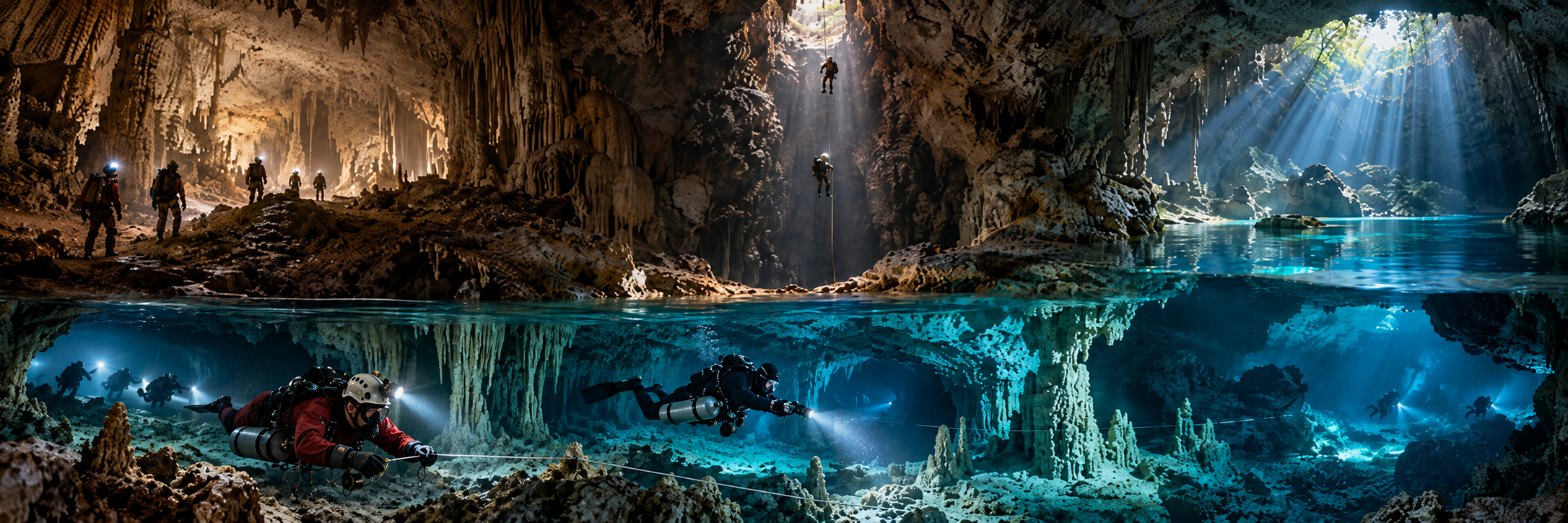
Abaco - the Crystal Caves

Dan’s and Ralph’s form the core of the South Abaco Crystal Caves. Bahamas Underground advertises more than 60,000 ft of combined underwater passage, while later explorer interviews put the system above 19 km. Dan’s includes huge rooms such as Wrigley Field and fragile crystal passages, restrictions and deep zones.

Modern Abaco cave diving is closely associated with Brian Kakuk, Bahamas Underground and the Bahamas Caves Research Foundation. Qualified guided diving/training exists, but the cave landscape is also protected and scientifically sensitive.

The Bahamas · research catalogue

Sawmill Sink - fossil time capsule

Sawmill Sink extends more than 600 m and reaches roughly 54 m. Below its freshwater lens and halocline, anoxic marine water preserves organic remains unusually well. Since 2004, research has recovered extinct crocodiles, tortoises, birds, plants and other late-Quaternary material.

Sawmill is a research and heritage site requiring Bahamian permits and AMMC approval, not a recreational cave dive.

The Bahamas · research catalogue

Grand Bahama - Lucayan National Park and research caves

Ben’s Cave and Burial Mound Cave open into a system with more than six miles of charted underwater tunnels. Ben’s contains a freshwater layer over saltwater with a marked halocline, while Burial Mound preserves Lucayan cultural material.

Official Bahamas guidance requires authorised instructor accompaniment for Ben’s Cave, while Bahamas National Trust bylaws prohibit unauthorised cave/sink diving in protected parks. Mermaid’s Lair adds freshwater-lens microbial and Saharan-dust research.

The Bahamas · research catalogue

Dean’s Blue Hole - more than freediving

Dean’s Blue Hole is famous for freediving and reaches 202 m / 663 ft. BCRF records Jim King as the first diver to reach the bottom in 1992. His team also identified upper lateral cave passages around 45 m depth, later explored with custom sidemount rebreather configurations.

The public surface/freediving site and technical cave passages are therefore separate layers.

The Bahamas · research catalogue

Tourism, cavern and training layer

Bahamian blue holes span ordinary swimming/freediving, open-water reef depressions, authorised guided cavern/cave access and high-level technical exploration. Ben’s Cave has an authorised guided layer; Abaco supports formal cave and technical training. KCore does not let the tourism term “blue hole” override the actual overhead classification.

The Bahamas · research catalogue

Cave-diving history and key people

  • Dr. George Benjamin — early 1960s blue-hole explorer and underwater photographer.
  • Rob Palmer — major Andros explorer, author and scientific expedition leader.
  • Stephanie Schwabe — geologist/researcher and blue-hole conservation leader.
  • Brian Kakuk — Bahamian cave explorer, instructor, conservationist and BCRF/Bahamas Underground figure.
  • Nancy Albury — fossil/Abaco conservation research coordinator.
  • Kenny Broad, Wes Skiles, Jill Heinerth — exploration, science and documentation.
  • Jim King — first reported bottom diver at Dean’s Blue Hole, 1992.
  • Michael Pateman — Bahamian archaeologist and cave diver.
  • Tom Iliffe — anchialine-cave biology.
  • BCRF, AMMC/National Museum, Bahamas National Trust — research, heritage and protected-area management.

The Bahamas · research catalogue

Biology, archaeology and paleontology

  • Bahamian blue holes support remipedes, copepods, ostracods, thermosbaenaceans and other stygobitic fauna across chemically stratified water layers.
  • Stargate / Sanctuary — Lucayan human remains and canoe context.
  • Burial Mound — protected Lucayan burial context.
  • Sawmill Sink — extinct crocodiles, tortoises, birds, plants and late-Quaternary records.
  • Other Abaco blue holes — fossils and paleoenvironmental records, some intentionally undisclosed.
Conservation may require that important discoveries never become public dive destinations.

The Bahamas · research catalogue

Conservation and access

Blue Holes National Park on Andros protects about 40,000 acres; Lucayan National Park protects the Ben’s/Burial Mound landscape; South Abaco’s blue-hole network has conservation-forest and national-park protection. Park bylaws prohibit unauthorised cave/sink diving and disturbance.

  • Dan's / Ralph's — active guided/training for qualified cave divers within protected/fragile landscape.
  • Sawmill Sink — research/protected.
  • Ben’s Cave — authorised guided diving; BNT rules apply.
  • Burial Mound — protected/research.
  • Guardian / Little Frenchman — advanced/guided-permitted; current access verify.
  • Stargate / Sanctuary — research/heritage-sensitive.
  • Dean’s — public open-water/freediving surface use; cave passages are separate technical activity.

The Bahamas · research catalogue

Discovery frontiers

  • South Abaco Crystal Caves — complex, fragile and incompletely explored; radiolocation helps align surface protection with cave footprint.
  • Andros fracture belts — multiple remote inland/offshore features remain minimally surveyed.
  • Remote South Andros — biology and chemistry may be more important than penetration records.
  • Grand Bahama groundwater caves — inland-to-coastal hydrological connections remain scientifically important.
  • Long Island deep-pit caves — Dean’s upper lateral passages remain less known than the vertical shaft.
  • Digital cave-footprint conservation — radiolocation, photogrammetry and GIS can protect underground passages invisible from the surface.

The Bahamas · research catalogue

Selected source backbone

  • Bahamas National Trust — Blue Holes National Park, Lucayan National Park and park bylaws
  • Bahamas Protected Areas Fund — protected-area register
  • Bahamas Caves Research Foundation — Dan’s, Sawmill, Dean’s and conservation projects
  • Bahamas Underground — guided cave diving and training
  • Rob Palmer Blue Holes Foundation — exploration, archaeology and science
  • Official Bahamas — Dean’s, Guardian, Uncle Charlie’s and Stargate
  • Friends of the Environment — blue holes and dry caves
  • Peer-reviewed Sawmill Sink fossil research
  • IUCRR — 2003 Ocean Blue Hole incident
  • National Geographic — blue-hole science
Publication rule: preserve heritage and biology, omit sensitive coordinates, separate public surface access from cave penetration, and treat park/private/research permissions as dynamic.